
Many laboratory technicians assume that a larger weighing capacity is always better. However, a high maximum capacity often reduces stability and precision at lower ranges. Analytical balances are precision instruments offering 0.1 mg accuracy or higher. This guide reveals how to calculate your safe weighing range and select the most cost-effective model.
I. Understanding the Three Key Dimensions of Weighing Capacity
You must understand the physical mechanics behind the numbers.
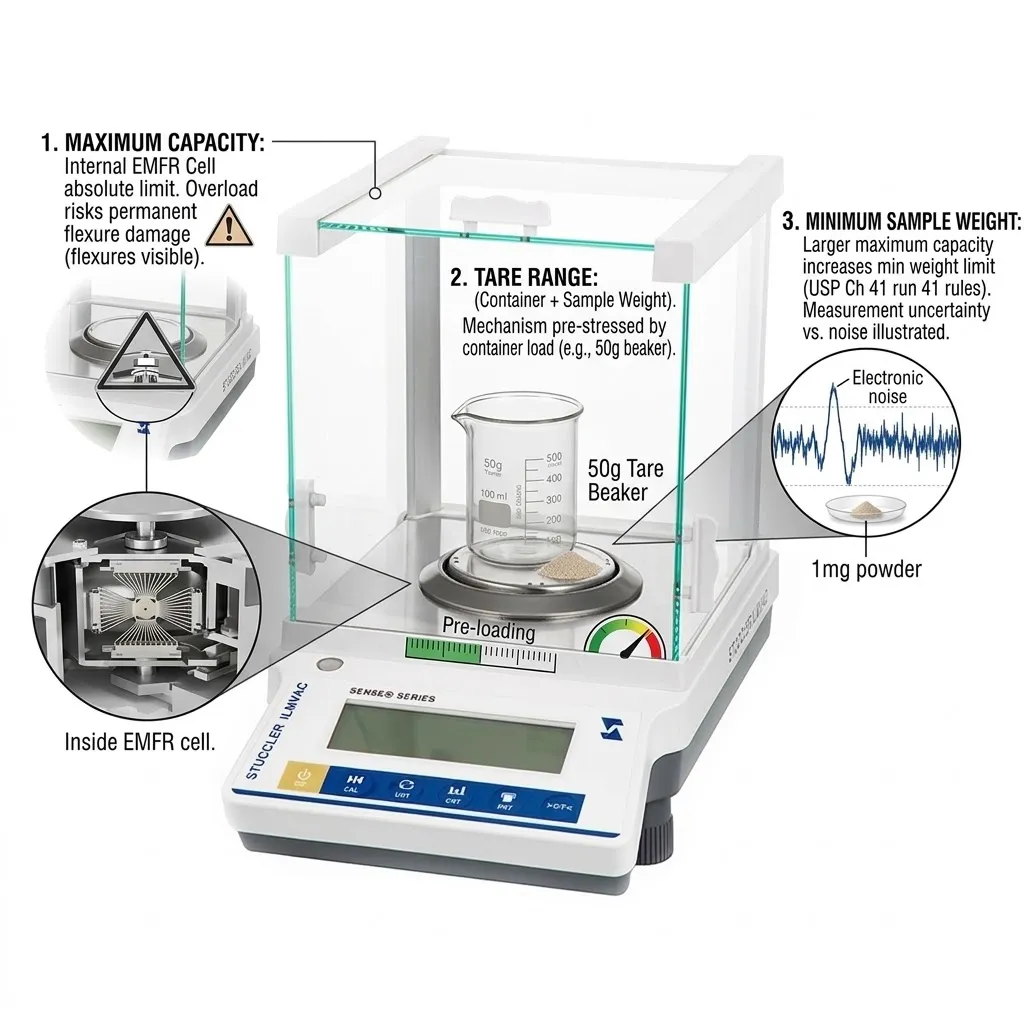
1. Maximum Capacity
This is the absolute physical limit. Inside, an electromagnetic force restoration (EMFR) cell balances the load. Pushing past the limit bends delicate flexures. You will permanently damage the internal sensors.
2. Tare Range
Remember this rule. Total Capacity = Container Weight + Sample Weight. Think of a heavy 50g glass beaker. If you use it, your effective capacity shrinks by 50g. The balance mechanism works harder before you even add your sample.
3. Minimum Sample Weight
USP (United States Pharmacopeia) Chapter 41 outlines strict rules. A larger maximum capacity increases the minimum sample weight limit. Why? Measurement uncertainty scales up with capacity. You cannot accurately weigh a 1mg powder on a massive 520g balance. The electronic noise overwhelms the actual sample mass.
II. The Balance Between Capacity & Readability
Use this matrix to pinpoint your exact technical requirement.
| Application Type | Recommended Capacity Range | Recommended Readability | Typical Samples |
| Micro-analysis | 2g – 30g | 0.001 mg (1 µg) | Precious metals, rare pharmaceutical powders |
| Standard Analysis | 120g – 220g | 0.1 mg | Chemical reagent formulation, filtration analysis |
| High-Capacity Analysis | 320g – 520g | 0.1 mg / 1 mg | Density determination, preparation of large-volume solutions |
III. 3 Professional Principles for Selecting the Right Capacity
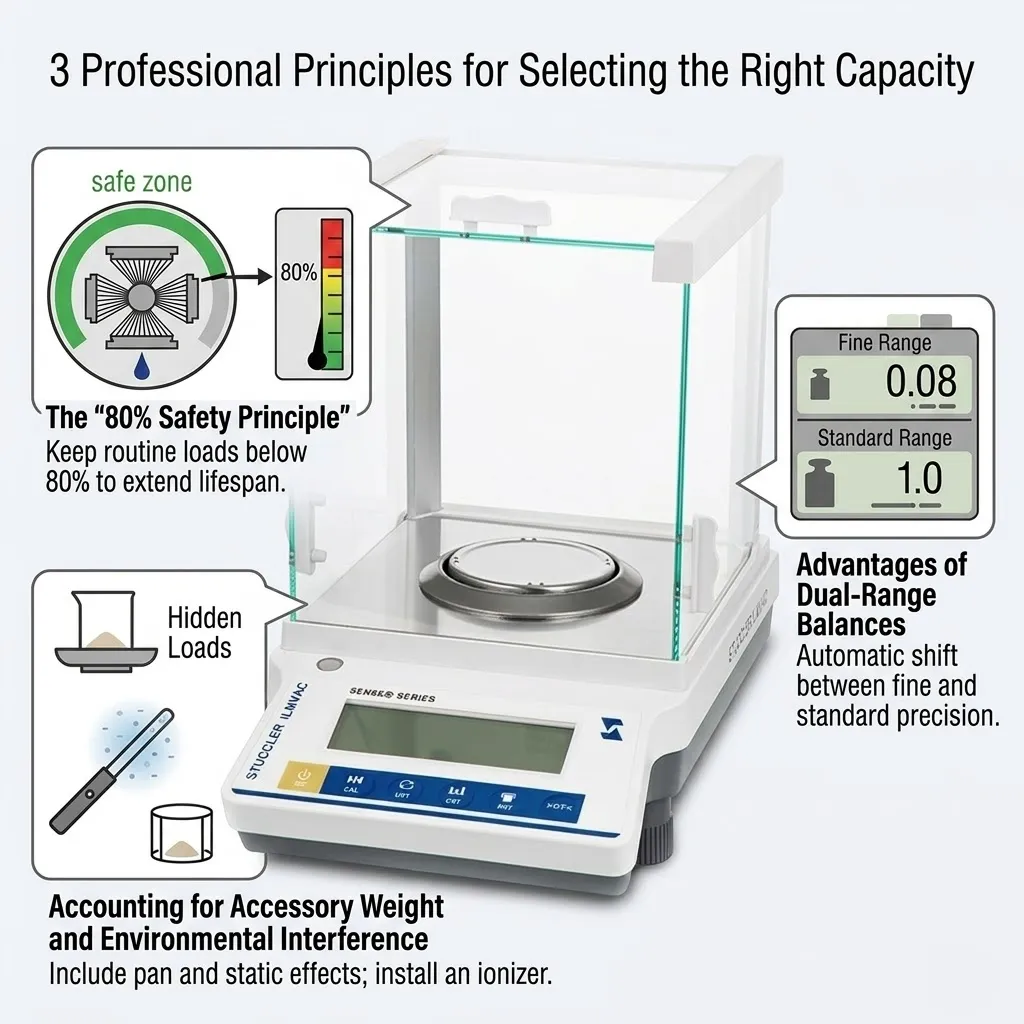
1. The “80% Safety Principle”
Do not operate at absolute maximums. Keep routine tasks under 80% of the rated limit. A constant 200g load on a 220g balance stresses the coil daily. Leaving a 20% buffer prevents premature sensor fatigue. It significantly extends instrument lifespan.
2. Advantages of Dual-Range Balances
These are brilliant investments. They feature a fine range and a standard range. For example, you get 0.01mg precision up to 42g. Past 42g, it automatically shifts to standard 0.1mg precision. You get two instruments in one footprint.
3. Accounting for Accessory Weight and Environmental Interference
Hidden loads ruin accuracy. Density kits and weighing pans consume valuable capacity. Furthermore, airflow interference is a severe threat near maximum limits. Micro-currents push on the pan. Draft shields must be securely closed. Static charges are equally destructive. Static creates invisible magnetic repulsion on the sample. Always install an ionizer inside the chamber.
IV. Core Selection Process: How to Determine Your Capacity Requirements
Stop guessing. Run your workflow through this exact framework.
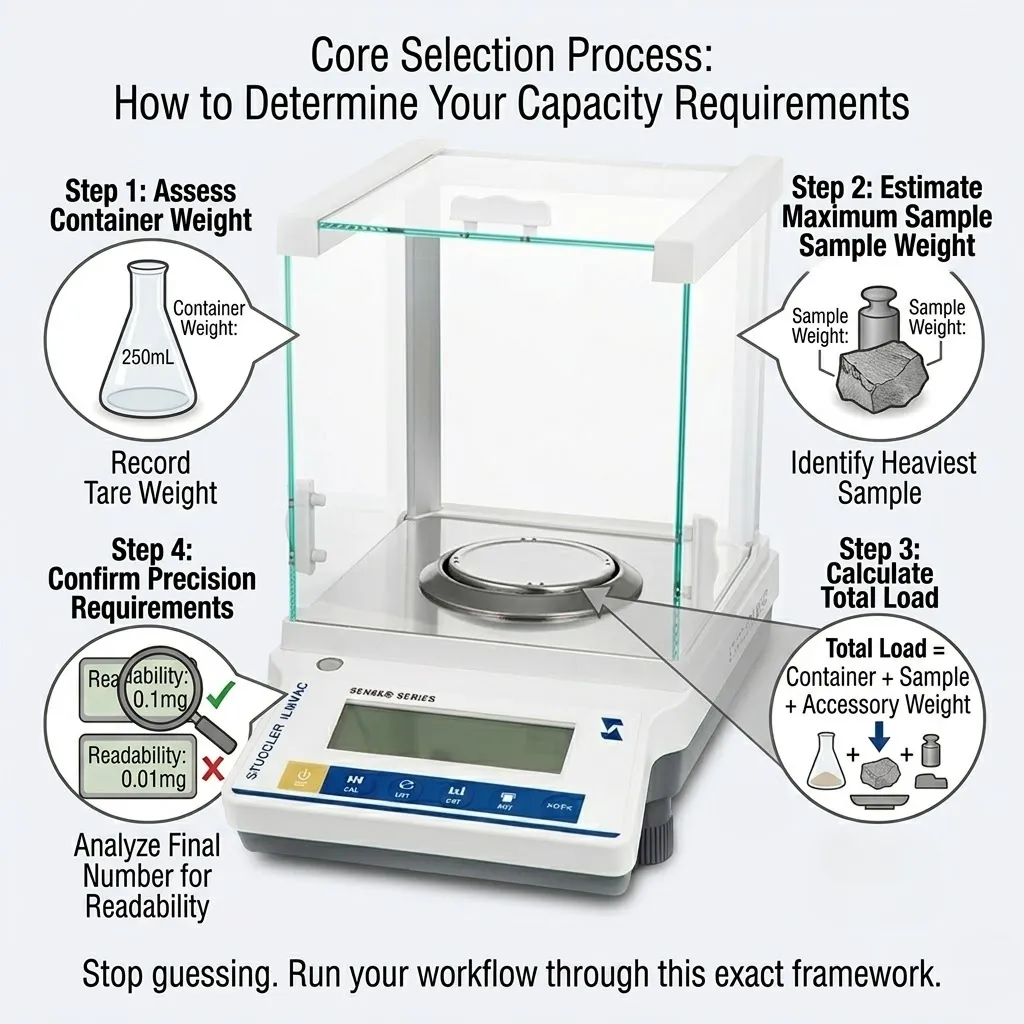
- Step 1: Assess Container Weight. Weigh your heaviest vessel. Is it a 250mL Erlenmeyer flask? Record this exact tare weight.
- Step 2: Estimate Maximum Sample Weight. What is your heaviest expected sample? Perhaps it is a 10g chunk of raw alloy.
- Step 3: Calculate Total Load. The math is simple. Total Load = Container Weight + Sample Weight + Potential Accessory Weight.
- Step 4: Confirm Precision Requirements. Analyze the final number. Do you need 0.1mg or 0.01mg readability at this specific load?
V. “Top Recommendations” for Various Laboratory Settings
Match the instrument to your daily workflow realities.
- Pharmaceutical R&D: We recommend 50g to 120g capacities. Drug discovery involves extremely light, potent Active Pharmaceutical Ingredients (APIs). A lower capacity ensures the ultimate repeatability required for critical drug formulations.
- Industrial Quality Control (QC): Choose 220g to 320g models. QC involves dense metal parts or heavy plastic resins. You need robust durability and rapid stabilization times. This capacity handles heavy repetitive testing effortlessly.
- University Education: The 220g standard capacity is ideal. It provides the highest cost-to-performance ratio. It easily survives the rough handling and heavy glassware typical of student chemistry labs.
- High-End Jewelry & Goldsmith Studios: Select a 120g to 220g Stuccler balance. Micro-weighing precious metals demands perfection. You will accurately price tiny diamonds or heavy platinum casting grains without sensor drift.
- Environmental & Water Quality Monitoring: A 120g capacity works best here. You will weigh ultra-light quartz filter membranes. These filters capture microscopic PM2.5 dust. The 120g limit ensures maximum sensitivity for environmental compliance.
Summary
Selecting the right balance is not about buying the most expensive model. Buy what fits your specific load. What do your current lab vessels weigh? Do you require expert consultation to meet specific ISO or USP standards? We invite you to explore our premium Stuccler Analytical Balance series for uncompromising precision.