

In precious metals trading, a daily 0.01g error causes staggering profit losses. You need a reliable Gold Scale. This guide helps jewelers and industrial buyers cut through the hype to protect their bottom line.
I. Uncovering the Accuracy Trap: Beyond the “Decimal Point”
Many buyers only look at the decimals. Don’t fall for this trap. Let’s explore what truly matters in a digital gold scale.
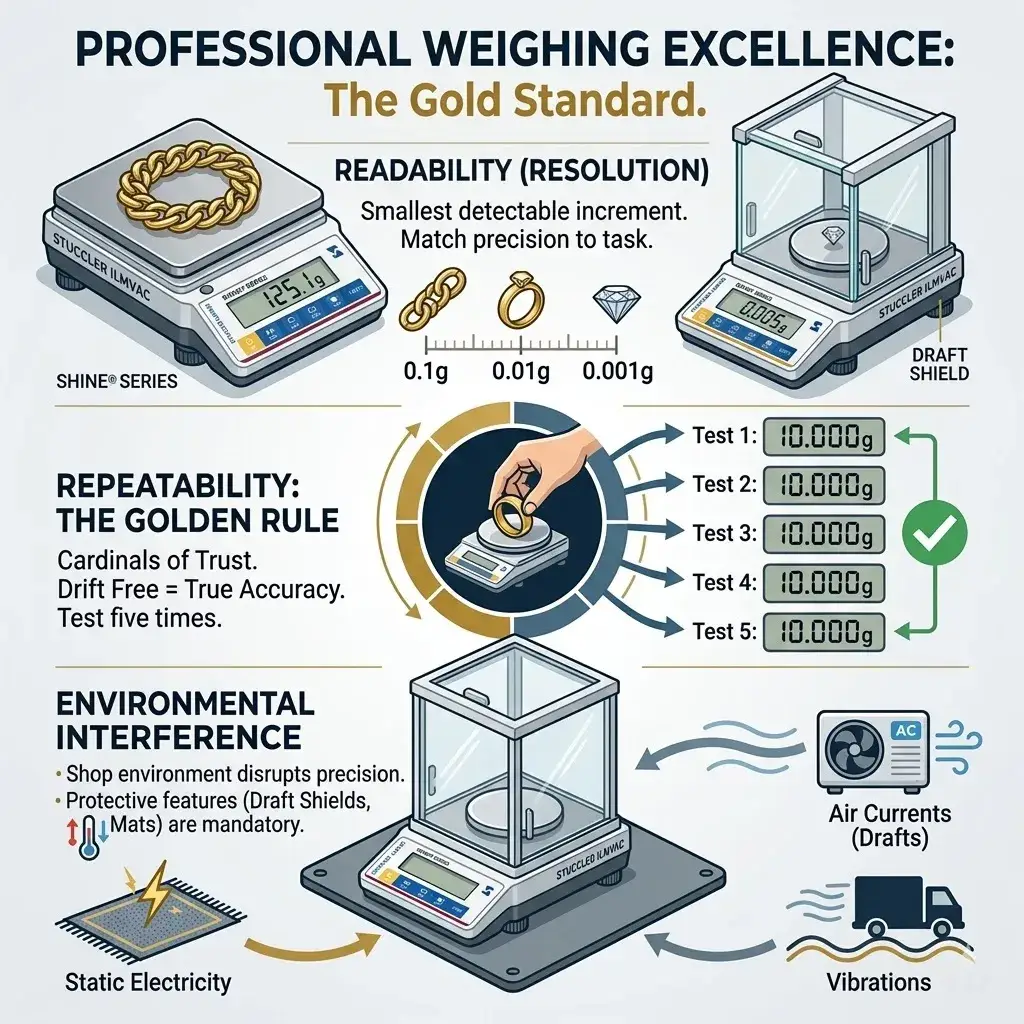
Readability (Resolution)
Readability is the smallest weight increment a scale displays. Different applications require specific readability levels. A 0.1g scale works well for sorting heavy scrap like thick chains. A 0.01g scale is standard for basic retail weighing and pawn shops. A 0.001g milligram scale is essential for precise alloying and gemstone weighing.
Repeatability: The Golden Rule
This is the cardinal rule. If a 10-gram gold ring yields three different weight readings, the scale fails. This frustrating phenomenon is called “reading drift.” If a scale drifts, its advertised accuracy is utterly meaningless. You cannot trust it. Always test a new scale by weighing the same item five times. The numbers must match exactly.
Environmental Interference
Your shop environment impacts weight readings heavily. Temperature fluctuations alter a basic sensor’s physical properties. Static electricity from carpets can pull down on the weighing pan. Even slight breezes from an AC vent disrupt results. Vibrations from passing trucks also cause jumping numbers. This is why professional setups require protective draft shields and anti-vibration mats.
II. The Core Showdown: Pocket Scales vs. Professional Bench Scales
You must choose the right tool for the job.
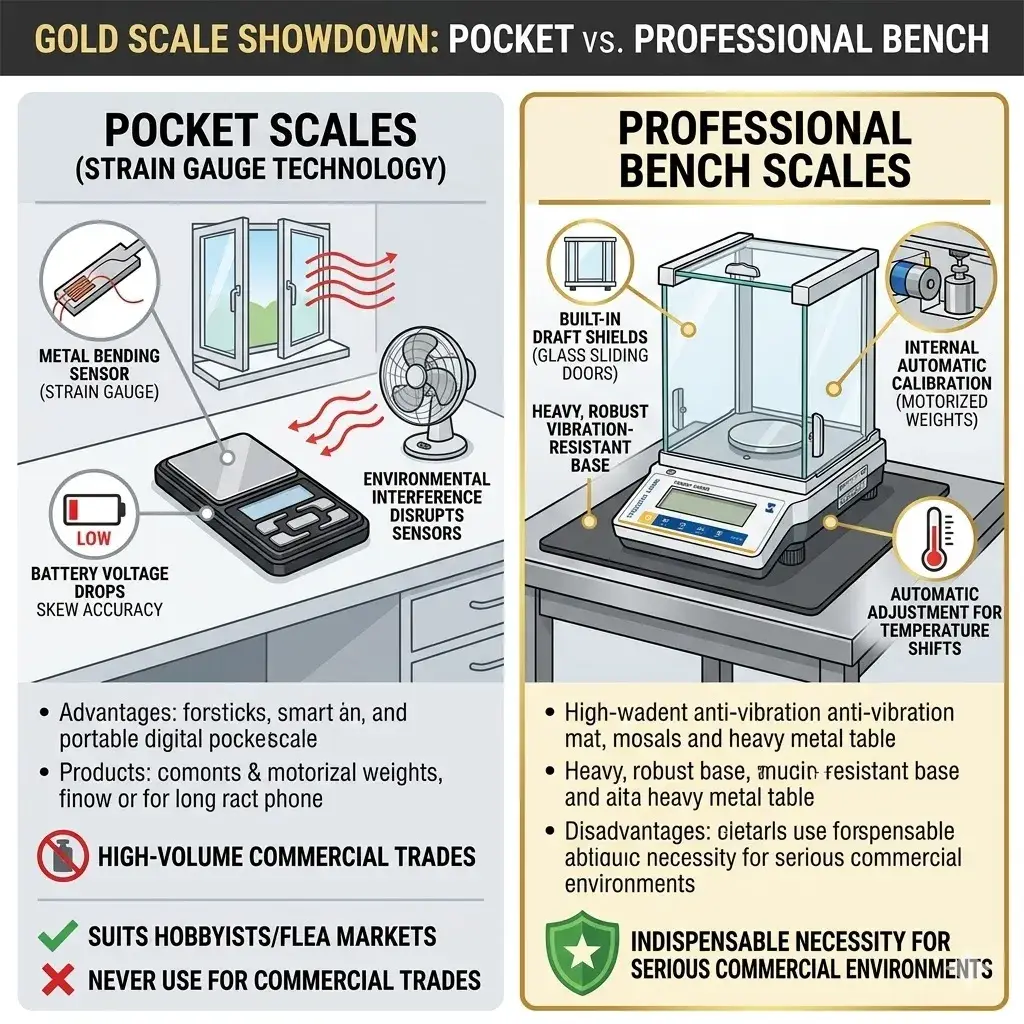
Pocket Scales (Strain Gauge Technology)
These utilize basic strain gauge technology. They measure electrical resistance changes when internal metal bends. They are highly affordable and perfectly portable. They suit hobbyists or occasional flea market vendors. But there is a catch. They suffer from short lifespans. Battery voltage drops quickly skew their accuracy. Environmental changes easily disrupt their basic sensors. Never use them for high-volume commercial trades.
Professional Bench Scales
This is the definitive choice for professionals. These units feature heavy, robust bases to resist vibration. They include built-in draft shields to block air currents. Glass sliding doors allow easy access while blocking wind. They also feature internal automatic calibration functions. Motorized internal weights adjust the scale automatically during temperature shifts. For serious commercial environments, these are an indispensable necessity. They cannot be compromised.
III. Seeking Peak Performance: What is EMFR Technology?
If you demand the absolute best, look at the sensor.
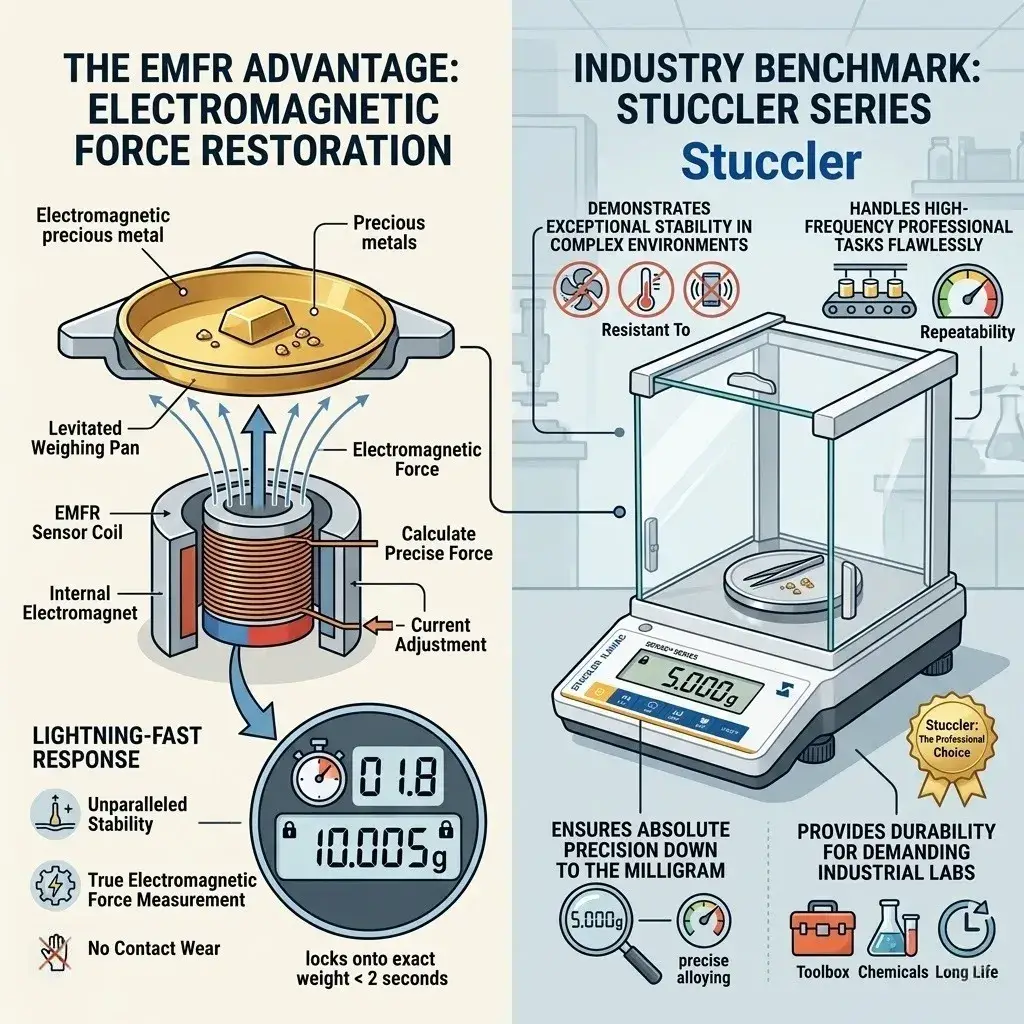
The EMFR Advantage
It measures true electromagnetic force. EMFR stands for Electromagnetic Force Restoration. It represents the pinnacle of current commercial weighing technology. Unlike strain gauges, EMFR uses an electromagnet to levitate the pan. It calculates the exact electrical current needed to maintain balance. This offers unparalleled stability and lightning-fast response times. The display locks onto the exact weight in under two seconds.
The Industry Benchmark
When evaluating top-tier benchtop balances, professionals look for reliability. Equipment like the Stuccler series is typically the first choice. These devices are equipped with advanced EMFR technology. They demonstrate exceptional stability in complex environments. They handle high-frequency professional weighing tasks flawlessly. Stuccler ensures absolute precision down to the milligram. They provide the durability needed for demanding industrial labs.
IV. What Are Your Specific Needs?
Match the gold scale to your exact workflow. Always check if the scale measures in Troy Ounces (ozt) and Pennyweights (dwt).
Scenario 1: Hobbyists & Collectors
- Needs: You use it occasionally on a limited budget. You weigh old coins or scrap jewelry at home once a month.
- Recommended Type: Get a high-quality portable pocket scale. Ensure it has a reliable 0.01g precision level.
Scenario 2: Independent Jewelers & Studios
- Needs: You use the scale daily for precise mixing. You mix custom gold alloys and weigh tiny casting grains. You demand extreme stability and wind-shielding capabilities.
- Recommended Type: Invest in a benchtop jewelry balance. Look for a carat scale with 0.001g precision and a glass draft shield.
Scenario 3: Cash-for-Gold Businesses & Pawn Shops
- Needs: You conduct commercial transactions directly with customers daily. Local laws require your equipment to be fully legal and compliant. Fines for non-compliance are massive.
- Recommended Type: Buy a commercial-grade legal for trade scale. It must hold an NTEP Class II certification or equivalent standard.
Summary
Precision equals profit. Investing in a high-precision benchtop balance is vital. It is the most effective way to safeguard your business.
Are you looking for a trustworthy Gold Scale? As a trusted global supplier and manufacturer of precision balances, we offer industrial-grade original equipment alongside flexible OEM/ODM customization solutions. We provide highly competitive B2B wholesale pricing for our global partners. Contact our team today.