

In industrial settings, minor weighing errors cause costly batch failures and compliance issues. This quick 4-step framework—covering capacity, precision, environment, and compliance—helps you avoid over-specifying or under-specifying, ensuring you select the perfect industrial electronic balance.
I. The 4-Step Core Selection Method
Step 1: Clarifying the Balance Between Capacity and Precision
Choosing the right digital scale requires balancing total capacity against required readability. They fight each other. Higher capacity usually means lower resolution.
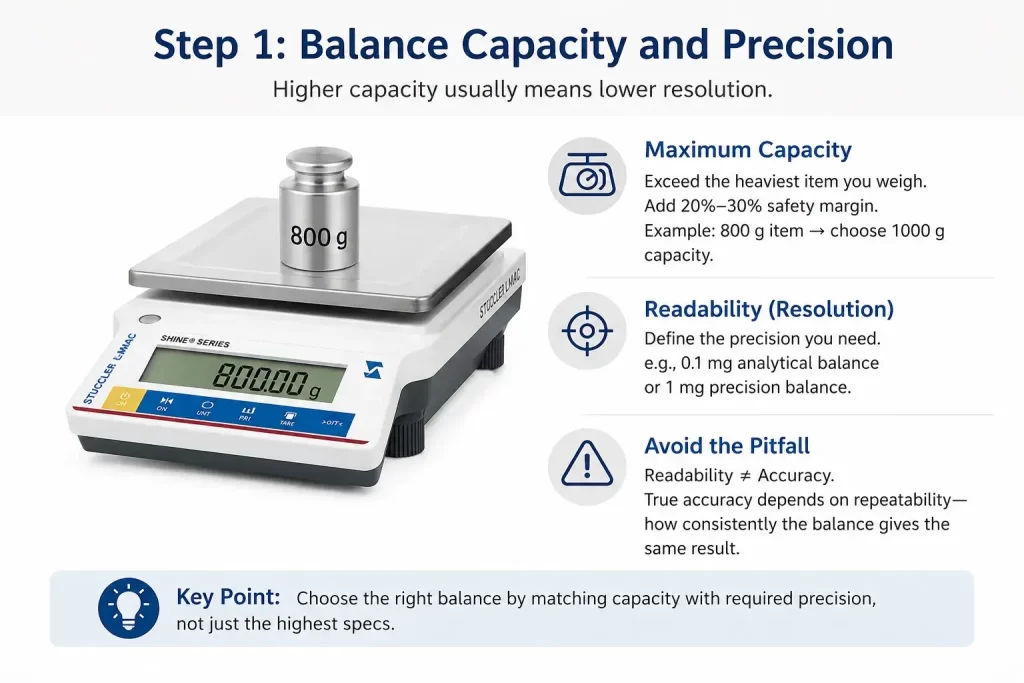
- Maximum Capacity: This must exceed the weight of the heaviest object you anticipate weighing. It is recommended to allow for a safety margin of 20%–30% to prevent accidental overloading from damaging the sensor. For example, if your heaviest batch is 800 g, choose a 1000 g capacity model.
- Readability (Resolution): Clearly define the absolute precision you require. Do you need a 0.1 mg analytical instrument or a 1 mg precision balance?
- Pitfall Guide: Distinguish between Readability and Accuracy. The ability to display a reading to four decimal places does not equate to absolute weighing accuracy; true accuracy depends on the Repeatability metric—how consistently the machine displays the exact same weight for the same object over multiple trials.
Step 2: Evaluating Core Sensor Technology
Choosing a sensor is akin to choosing the “heart” of your mass measurement device. In the industrial sector, two primary technologies dominate the market:
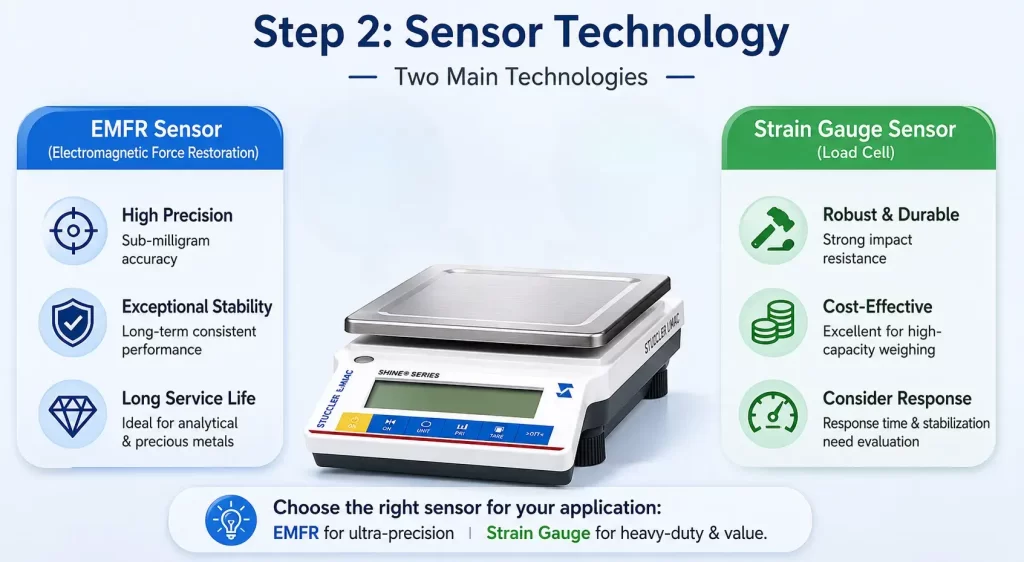
Electromagnetic Force Restoration (EMFR) Sensors
These utilize electromagnetic force to counterbalance the gravitational force of the load. They are highly advanced.
- Features: Extremely high precision, exceptional stability, and a long service life. This is the preferred choice for high-precision analytical balances and for the weighing of precious metals where sub-milligram accuracy is non-negotiable.
Strain Gauge Sensors (Load Cells)
These convert the mechanical deformation of a metal element into an electrical signal.
- Features: Robust construction and strong resistance to impact. They offer exceptional cost-effectiveness within high-capacity weighing ranges. However, for continuous, high-frequency weighing operations or trace analysis, its response time and data stabilization speed may require more careful evaluation.
Step 3: Assess the Industrial Operating Environment
Industrial sites differ significantly from standard laboratories. Factory floors introduce harsh variables. External interference factors must therefore be taken into account:
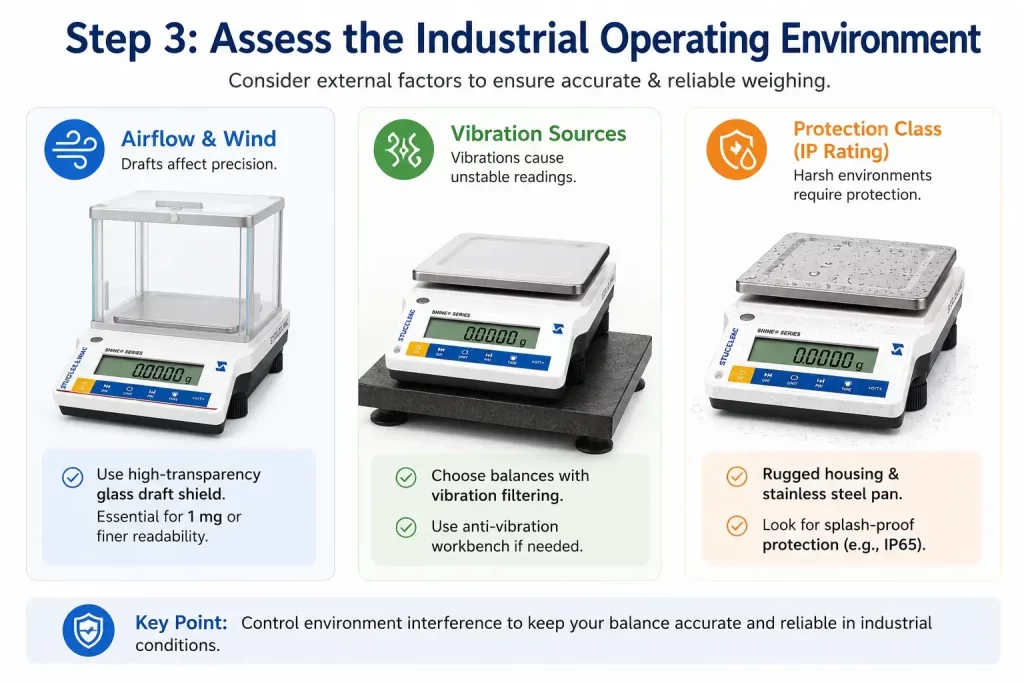
- Airflow and Wind: Ambient drafts wreck precision measurements. Balances with a readability of 1 mg or finer must be equipped with a high-transparency glass draft shield to stabilize the weighing chamber.
- Vibration Sources: Minute vibrations caused by factory machinery can cause readings to fluctuate. It is necessary to select a balance featuring digital filtering algorithms (Vibration Filtering) or to utilize a heavy anti-vibration workbench.
- Protection Class (IP Rating): In chemical or dusty environments, close attention must be paid to the housing material. Look for rugged die-cast aluminum enclosures. Ensure the corrosion resistance of the stainless steel weighing pan. Splash-proof capabilities (like IP65 ratings) may be required where liquid spills occur.
Step 4: Review Data Compliance and Calibration Methods
Data integrity and calibration methods dictate long-term operational success.
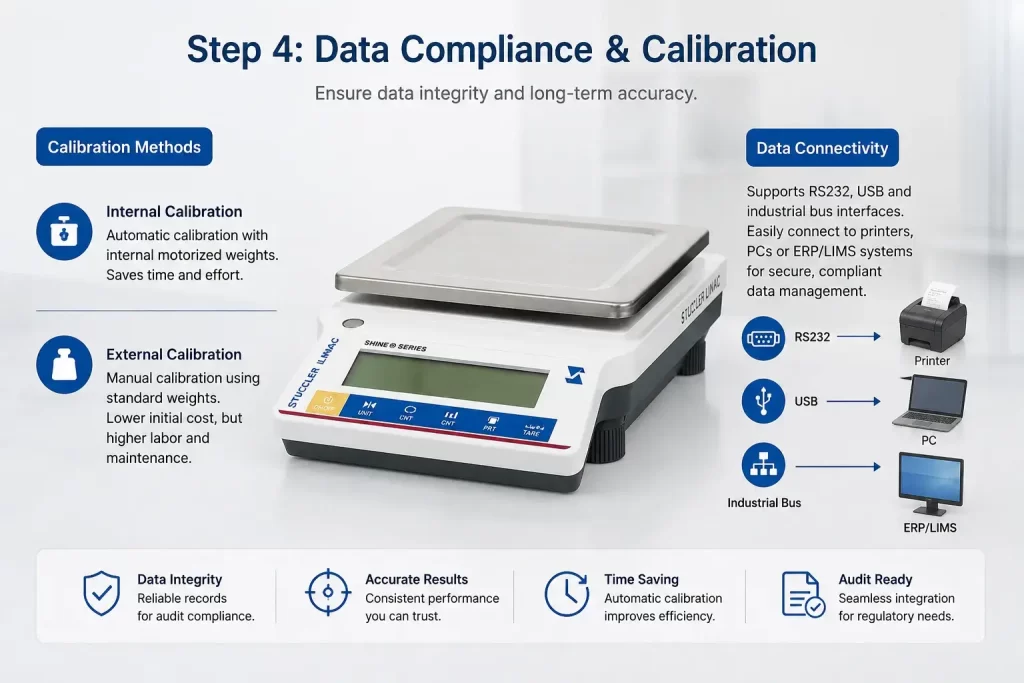
Calibration Methods
- Internal Calibration: The balance automatically triggers an internal calibration in response to changes in ambient temperature. It uses internal motorized weights. This saves time and effort, making it ideal for high-frequency, high-precision industrial applications.
- External Calibration: Requires the manual placement of standard reference weights. While offering high initial cost-effectiveness, this method entails increased labor and maintenance costs over time.
Data Connectivity
Does the device support RS232, USB, or industrial bus interfaces? Accurate record-keeping matters. Can data be transmitted directly to a secure printer or integrated into corporate ERP/LIMS systems? This is vital to ensure compliance with regulatory audit requirements.
II. A Comparative Guide to Common Industrial Application Scenarios
Different industries demand different hardware configurations. Use this matrix to match your specific application to the correct equipment tier.
| Industrial Application Scenario | Typical Requirements & Metrics | Recommended Configuration Focus |
| Precision Jewelry & Precious Metals Inspection | High repeatability; frequent switching between measurement units (e.g., grams, carats, pennyweights). | Accuracy ≥ 1 mg; optional EMFR sensor and a three-door glass draft shield for easy access. |
| Pharmaceutical & Biotech R&D Labs | Strict data compliance; absolute prevention of trace cross-contamination. | 0.1 mg analytical balance; must support automatic internal calibration and GLP/GMP-compliant data export. |
| Chemical Batching & Material Repackaging | High chemical corrosion resistance; high weighing capacity; ease of daily cleaning. | Industrial bench scale / high-capacity balance; configured with a large stainless steel weighing pan and high ingress protection (IP) rating. |
| Automated Production Line Integration (OEM) | Extremely short stabilization time; high-speed communication data rates. | Dedicated weighing module with millisecond-level response; natively supports PLC interface communication protocols (e.g., Profibus, Modbus). |
III. Maintenance & Lifespan Extension Tips for Industrial Balances
Industrial equipment represents a significant capital investment. Proper care extends operational life.
- Routine Cleaning: Spills happen. After weighing slightly corrosive chemical powders or metal shavings, immediately clean the weighing pan using a specialized soft cloth. Prevent contaminants from penetrating the sensor’s internal crevices.
- Warm-up Period: Precision requires thermal stability. For high-precision industrial balances (especially those with 0.0001 g readability), it is recommended to allow a warm-up period of 30–60 minutes after relocation or power interruption to achieve thermal equilibrium, thereby ensuring a high first-pass yield for initial measurements.
- Periodic Calibration: Never skip routine checks. Even for balances equipped with internal calibration systems, it is recommended—in accordance with corporate quality management systems (e.g., ISO 9001)—to have an accredited third party perform periodic calibration and certification using certified standard reference weights.
Conclusion
Selecting an industrial electronic balance is not about blindly chasing the “highest specifications,” but rather about finding the “Right Match”—identifying the solution that satisfies industry compliance and accuracy requirements while simultaneously balancing environmental durability and return on investment (ROI).
By analyzing your capacity limits, understanding sensor limitations, protecting against environmental noise, and securing your data pipelines, you guarantee a lower total cost of ownership and flawless production metrics.
If you are looking for reliable precision, explore Stuccler’s premium range of industrial electronic balances, fully optimized for demanding work environments. We proudly support wholesale bulk purchasing and professional OEM/ODM branding services—simply contact our team today to get a tailored quote for your business needs.