

Choosing a generic scale for chemical mixing can be a costly mistake—leading to ruined formulations, corroded equipment, and compliance failures. For dynamic compounding, you need a precise, durable top-loading balance built for the job. This comprehensive 5-stage evaluation guide breaks down every critical decision from weight limits to environmental protection, helping you select the exact high-performance model your workflow demands.
Stage 1: Assess Total Weight & Container Capacity
Quick Summary: Your balance must comfortably support your mixing vessel plus ingredients without stretching the sensor to its absolute limit.
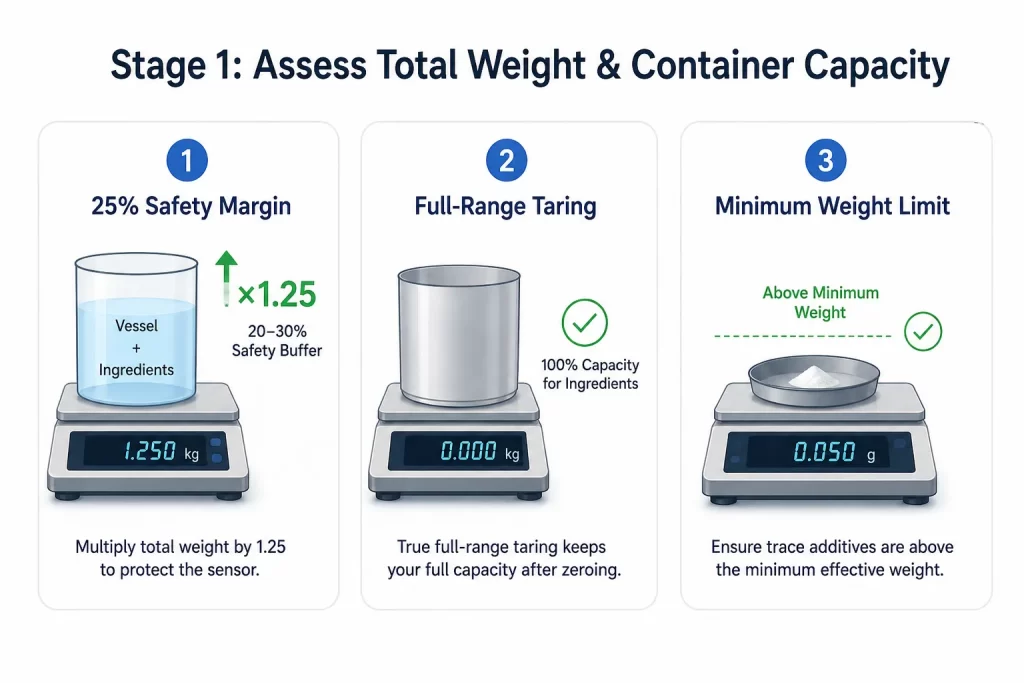
- Step 1: Apply the 25% Rule to Account for Dynamic Mixing Forces: Never match capacity to estimated total weight exactly. Mixing involves mechanical stirring and pouring impacts. Multiply the combined weight of your vessel and ingredients by 1.25 to create a 20% to 30% safety buffer, extending sensor lifespan.
- Step 2: Verify Full-Range Taring to Support Heavy Mixing Vessels: Heavy jacketed glass, stainless steel tanks, or ceramic crucibles can consume over half of a balance’s weight range. Ensure your selected model features true full-range taring so you retain 100% of the remaining capacity for chemical ingredients after zeroing the container.
- Step 3: Check the Minimum Weight Limit for Trace Catalysts and Additives: Balances lose relative accuracy at the extreme bottom of their range. If your formula requires trace additives (e.g., 0.05 grams), ensure this mass sits safely above the balance’s certified minimum effective weighing threshold (per USP Chapter 41).
Stage 2: Determine Formulation Readability & Precision
Quick Summary: Display readability must be chosen based on your tightest recipe tolerance, not bulk materials.
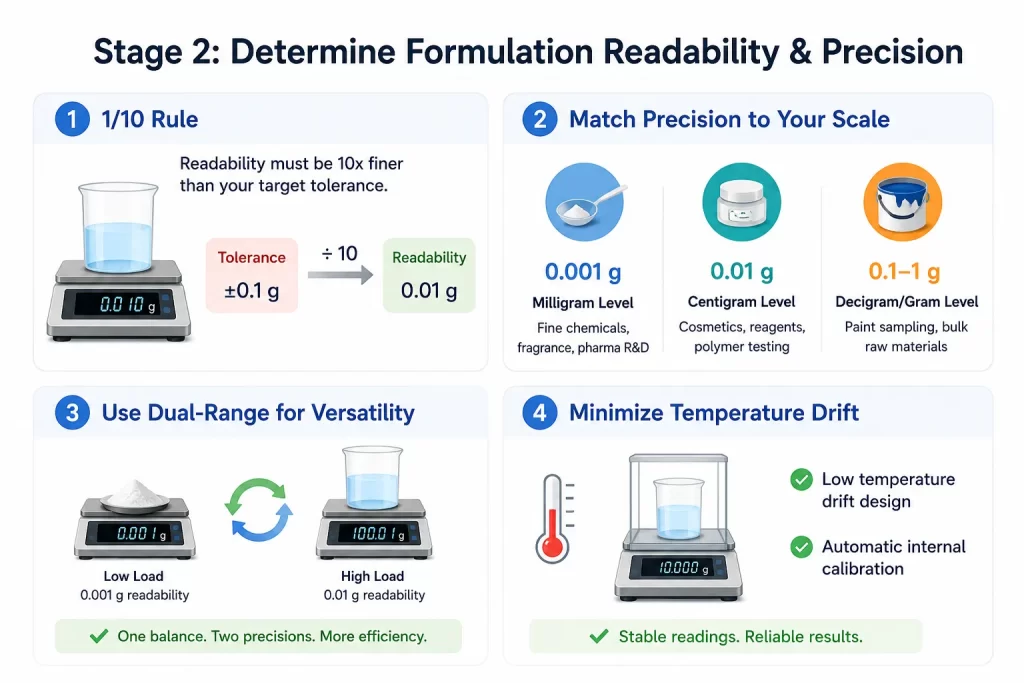
- Step 1: Use the 1/10 Rule to Calculate Your Required Resolution: The balance’s readability must be at least ten times finer than your target tolerance. For example, if your recipe allows a maximum error variance of ±0.1 grams, you must select a balance that reads down to at least 0.01 grams.
- Step 2: Match the Balance Precision Grade to Your Specific Mixing Scale:
- Milligram Level (0.001g): Select for fine chemical synthesis, fragrance blending, or pharmaceutical R&D.
- Centigram Level (0.01g): Select for cosmetic prototyping, standard chemical reagents, or polymer testing.
- Decigram/Gram Level (0.1g to 1g): Select for industrial paint sampling or bulk raw materials.
- Step 3: Evaluate Dual-Range Models to Simplify Multi-Component Recipes: If adding large bulk bases alongside tiny micro-additives, dual-range balances offer variable readability (e.g., 0.001g at low loads, switching to 0.01g at high loads), saving the cost of buying two separate instruments.
- Step 4: Review Thermal Properties to Resist Reaction-Induced Temperature Drift: Exothermic or endothermic reactions cause sudden temperature shifts. Select a balance with a low temperature drift coefficient and automatic internal calibration to prevent readings from drifting mid-mix.
Stage 3: Test Dosing Response Speed & Sensor Tech
Quick Summary: If the screen display lags while an operator continuously pours or drips chemicals, they will over-pour.
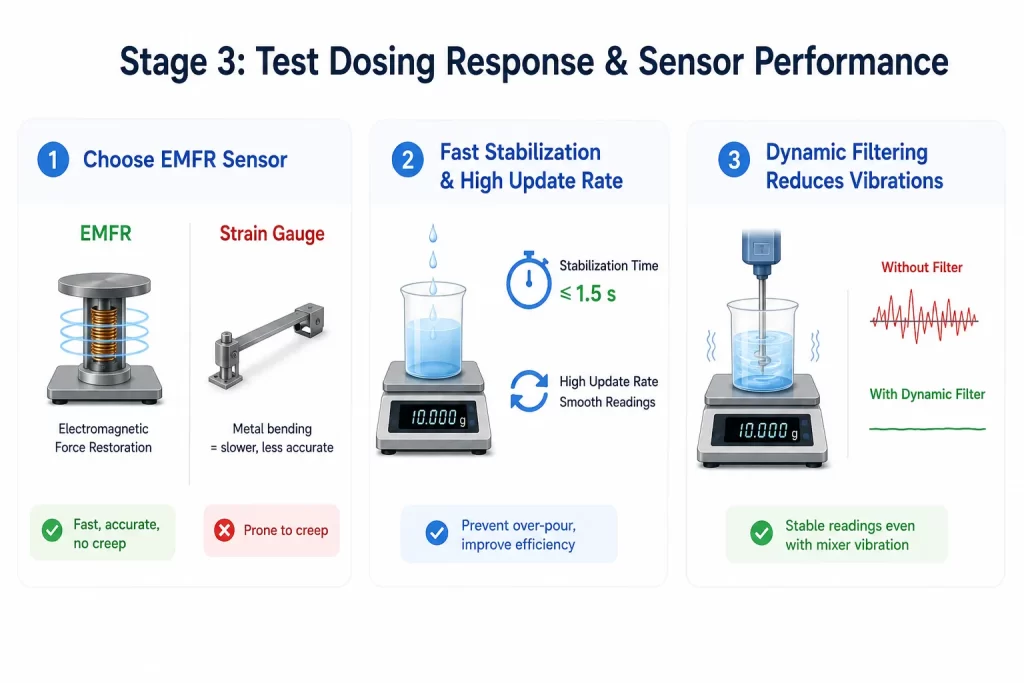
- Step 1: Mandate EMFR Sensors Over Strain Gauges: Reject low-cost strain gauge balances (they rely on physical metal bending, are slow, and suffer from “creep”). For continuous dynamic mixing, mandate Electromagnetic Force Restoration (EMFR) technology. EMFR cells use a magnetic coil to repel gravitational force instantly without mechanical deformation, giving real-time readouts.
- Step 2: Verify Stabilization Times and Update Rates: Check the technical data sheet: require a stabilization time of less than 1.5 seconds for liquid dripping or powder pouring, paired with a high digital update rate to ensure a smooth flow of numbers.
- Step 3: Check for Dynamic Filtering Modes to Neutralize Mixer Vibrations: Overhead stirrers and hotplates pass constant vibrations through the bench. Ensure your balance includes an adjustable dynamic digital filtering mode (vibration suppression) to isolate physical noise and display a steady number while the mixer runs.
Stage 4: Check Software & Data Compliance Requirements
Quick Summary: Decide whether your instrument should act as a simple standalone scale or a smart compliance node.
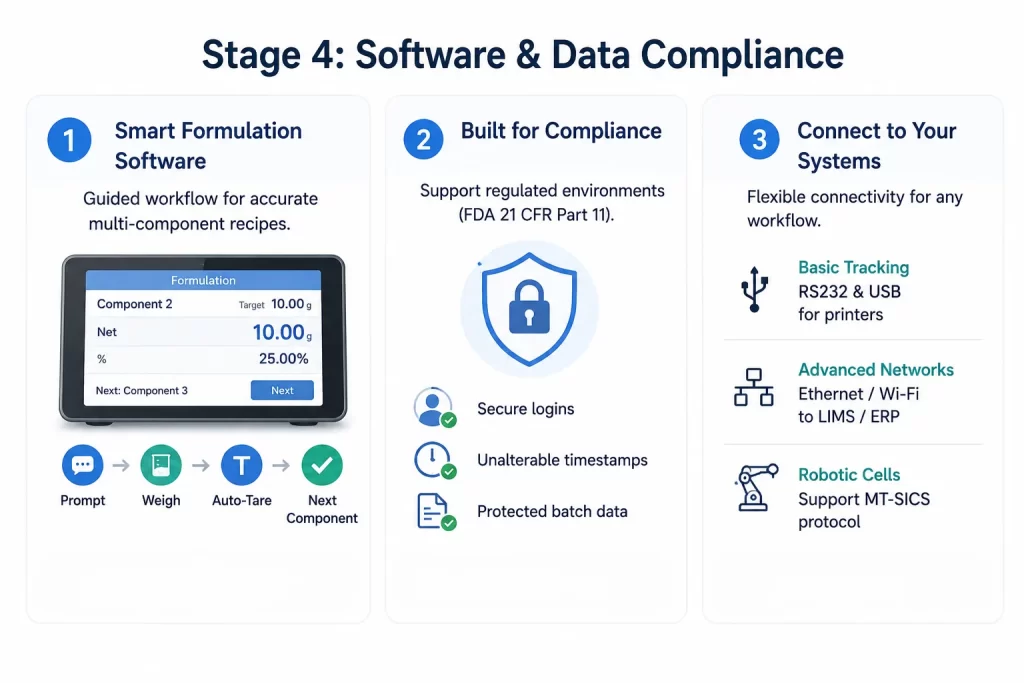
- Step 1: Review On-Screen Formulation Software for Recipe Complexity: For multi-component recipes, built-in Formulation software guides the operator step-by-step (Prompt → Weigh → Auto-Tare → Next Component). It automatically calculates percentages and prompts corrective scaling if an operator accidentally over-pours.
- Step 2: Assess Industry Compliance Needs (FDA 21 CFR Part 11): For regulated pharmaceutical or biotech environments, verify that the balance software supports secure operator logins, creates unalterable timestamps for every taring/calibration action, and protects raw batch data from manual tampering.
- Step 3: Match Communication Ports to Your Automation Systems
- Basic tracking: Demand standard RS232 and USB ports for local printers.
- Advanced networks: Look for integrated Ethernet or Wi-Fi to stream weight data straight to your LIMS or ERP software.
- Robotic cells: Ensure support for open protocols like MT-SICS.
Stage 5: Evaluate Environmental & Chemical Protection Levels
Quick Summary: Match the structural design of the balance directly to the aggressive traits of your chemical reagents.
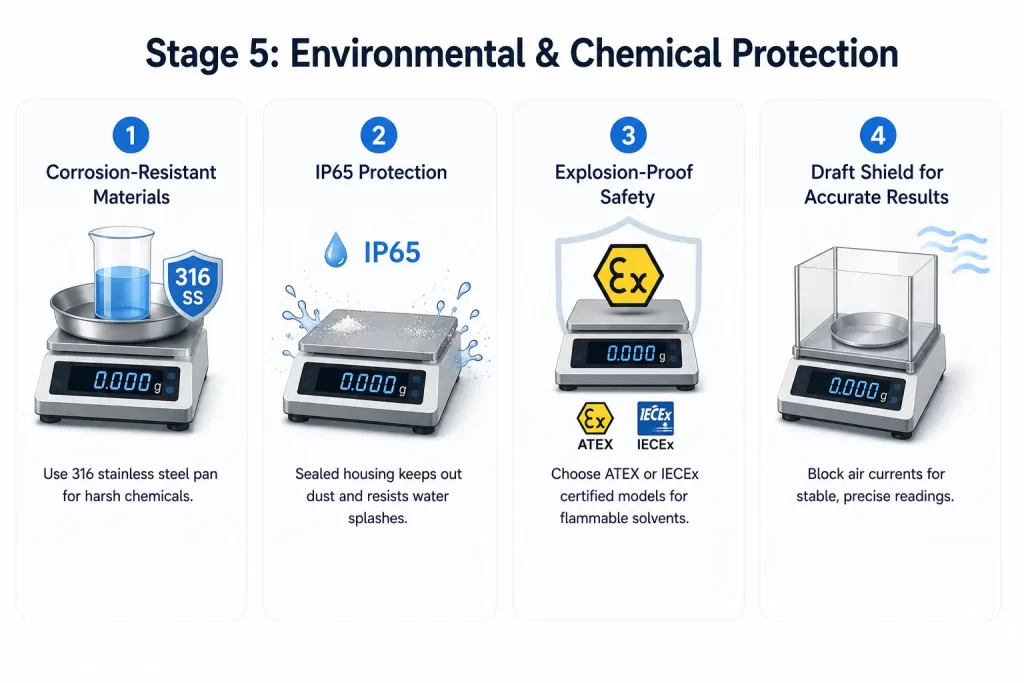
- Step 1: Select 316 Stainless Steel for Aggressive Reagents: Vapors and spills destroy standard metals. While 304 stainless steel is standard, environments processing harsh acids, bases, or salts require 316-grade stainless steel weighing pans for superior pitting resistance. Housing should be powder-coated die-cast aluminum or solvent-resistant ABS.
- Step 2: Insist on an IP65 Rating for Airborne Powders or Splash Hazards: Volatile powders (like carbon black) or liquid splashes jam ventilated electronics. Choose a certified IP65-rated sealed housing to prevent dust ingress and allow safe wash-downs between batches.
- Step 3: Enforce Explosion-Proof Standards for Volatile Solvents: If your workspace handles low-flashpoint organic solvents (e.g., acetone, toluene), standard switches can trigger micro-sparks. You must enforce a strict safety rule: select an intrinsically safe, explosion-proof balance with ATEX or IECEx certifications.
- Step 4: Analyze Air Currents to Determine If a Draft Shield Is Necessary: If using a high-precision top-loader (0.001 grams resolution), air currents from HVAC vents or fume hoods will cause display digits to dance. If airflow is turbulent, choose a model that includes a compact, three-sided draft ring or glass draft shield.
Final Selection Checklist
Before ordering, ensure your selected balance meets these 4 core technical requirements:
- [ ] Capacity: Includes a 20%–30% safety margin above your total weight (vessel + ingredients).
- [ ] Precision: Follows the 1/10 Rule (readability is 10x finer than your tightest formula tolerance).
- [ ] Speed: Uses an EMFR sensor with a sub-1.5-second stabilization time to prevent dosing overshoot.
- [ ] Protection: Features chemical-resistant materials (like 316 stainless steel) or necessary IP65/ATEX ratings.
Partner with the Precision Weighing Experts
As a leading manufacturer and supplier of professional-grade instruments, Stuccler delivers high-performance top-loading balances engineered for demanding chemical and industrial environments. We fully support B2B procurement, customized private labeling (OEM/ODM), and bulk production orders tailored to your brand’s standards.
Contact our technical specialists today to configure the perfect weighing solution for your workflow.