

Choosing between an internal and external calibration analytical balance comes down to one trade-off: upfront price versus long-term data integrity. For 0.1 mg precision, your choice impacts everything from GMP/USP compliance to daily lab efficiency. Here is how to pick the right model for your budget and workflow without overspending.
I. Quick Decision Matrix: Which One Should You Buy?
If you need a quick purchasing answer before diving into technical details, use this straightforward scenario guide:
- BUY INTERNAL CALIBRATION IF:
- You must comply with strict GMP, GLP, or USP Chapter <41> pharmaceutical audits.
- Your room temperature fluctuates by more than 1.5∘C throughout the day (e.g., active HVAC cycling).
- The analytical balance is shared across multiple technicians or shifts in a high-throughput lab.
- You are buying high-sensitivity micro or semi-micro balances (0.01 mg or higher precision).
- BUY EXTERNAL CALIBRATION IF:
- Your initial capital expenditure (CapEx) budget is strictly limited.
- You have a dedicated, climate-controlled balance room with stable temperature and humidity.
- The balance is used for occasional, low-frequency weighing tasks.
- You operate a university teaching laboratory where manual calibration procedures are part of the curriculum.
II. Core Differences at a Glance
| Evaluation Criteria | Internal Calibration Analytical Balance | External Calibration Analytical Balance | Which Choice Wins? |
| Calibration Method | Built-in standard weights; automatic motorized operation | Manual calibration using external standard test weights | Internal (Automated) |
| Ease of Operation | Effortless; single keypress or automatic trigger | Cumbersome; requires proper manual handling technique | Internal (Error-free) |
| Environmental Adaptability | High: Auto-adjusts when room temperature fluctuates | Low: Requires manual detection when drift occurs | Internal (For variable rooms) |
| Ongoing Maintenance | Sealed internal weights; zero routine weight upkeep | External weights need contamination protection & recertification | Internal (Lower maintenance) |
| Upfront Purchase Price | Higher initial investment (20% to 40% premium) | Lower upfront cost for the balance unit | External (Lower initial CapEx) |
III. Technology Comparison: Which Calibration Mechanism Works Best?
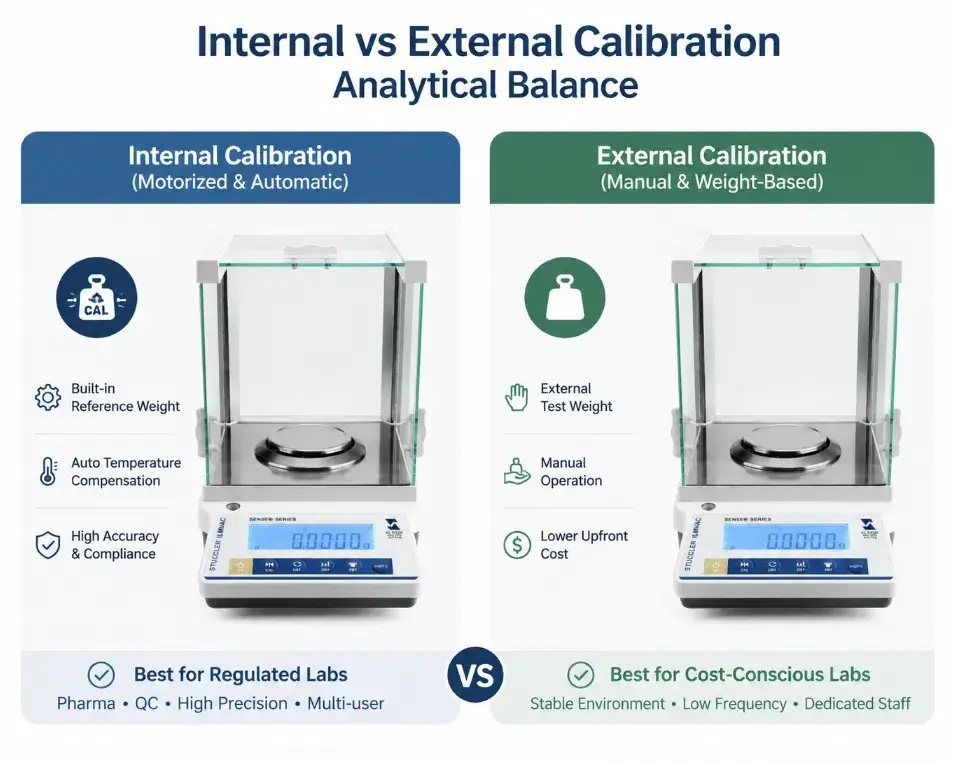
Internal Calibration (Motorized & Automatic)
An internally calibrated balance houses a factory-certified reference mass and a motorized loading mechanism inside its sealed casing.
- How It Drives Buying Value: When triggered, a stepper motor lowers the internal mass onto the electromagnetic sensor to adjust sensitivity automatically—without opening the draft shield. Advanced systems (such as isoCAL or FACT) continuously monitor ambient temperature. If the room shifts by >1.5∘C, the system self-calibrates.
- Which Labs Need It: Labs handling critical assays, pharmaceutical formulations, or certified quality control where opening the draft shield introduces thermal turbulence and contamination risks.
External Calibration (Manual & Weight-Based)
An externally calibrated balance relies entirely on physical reference masses (typically OIML Class E2 or F1 stainless steel weights) stored separately from the unit.
- How It Drives Buying Value: The operator manually opens the draft shield, places the external weight on the pan using non-magnetic forceps, and runs a manual calibration routine.
- Which Labs Need It: Facilities where the initial purchase price is the primary purchasing barrier and dedicated staff strictly control and certify external calibration masses.
IV. 4 Real-World Buying Factors to Evaluate
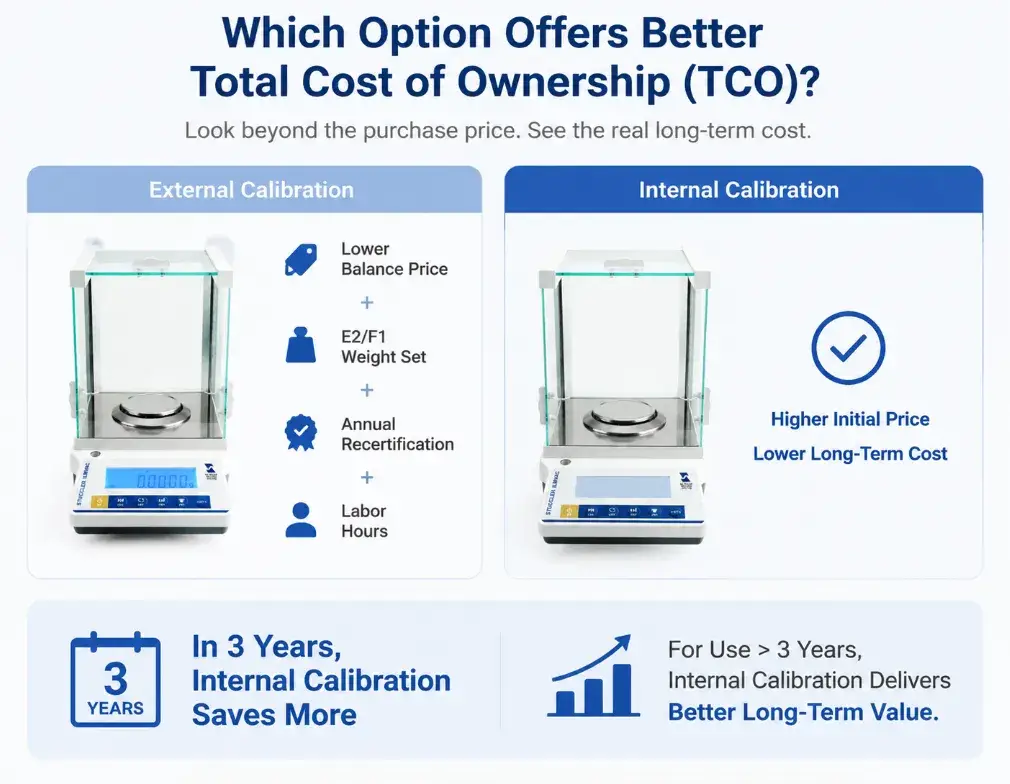
Factor 1: Which Option Offers Better Total Cost of Ownership (TCO)?
Don’t evaluate balances solely on the initial invoice. The true operational cost formula is:
TCO (External) = Balance Price + Class E2/F1 Weight Set + Annual Metrology Recertification + Labor Hours
While external models cost 20% to 40% less upfront, buying certified Class E2 weights and paying an accredited ISO 17025 metrology lab for annual recertifications often erases that initial savings within 3 years. If you plan to use the balance for more than 3 years, an internal calibration model offers better long-term financial value.
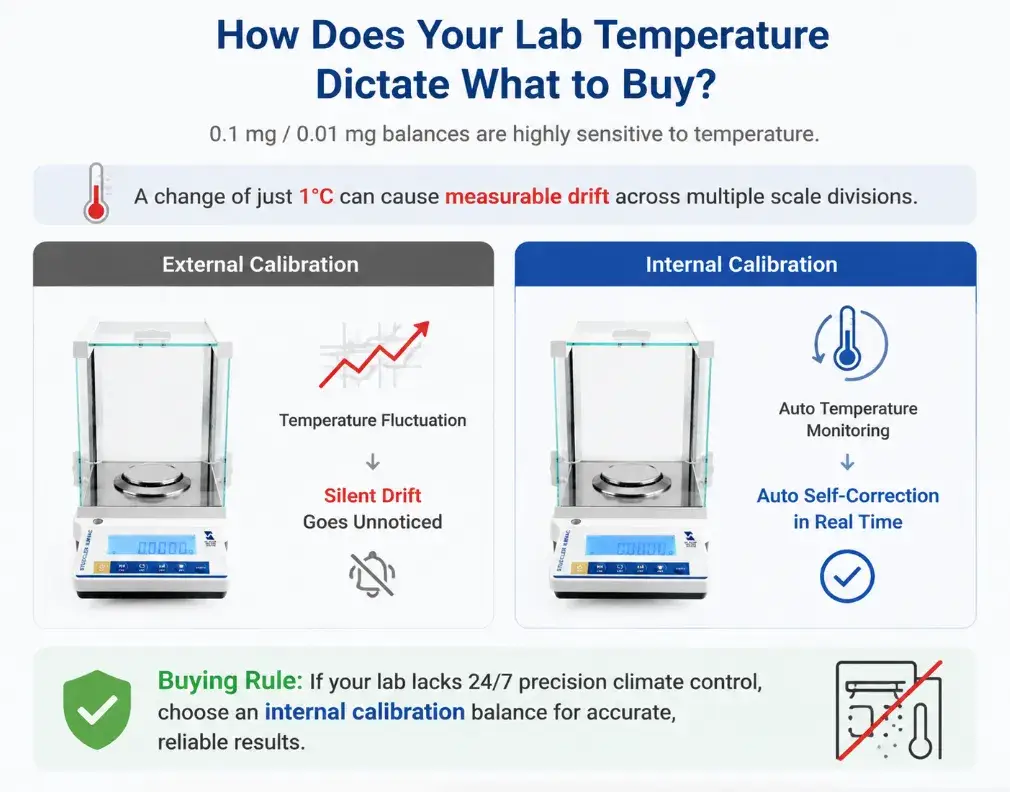
Factor 2: How Does Your Lab Temperature Dictate What to Buy?
Analytical balances measuring 0.1 mg or 0.01 mg are hyper-sensitive to ambient temperature shifts. A change of just 1∘C causes electronic and mechanical drift across multiple scale divisions.
Buying Rule: If your laboratory lacks 24/7 precision climate control, an external balance will experience “silent drift” without operators noticing. Buy an internal calibration balance to let automated temperature sensors self-correct in real time.
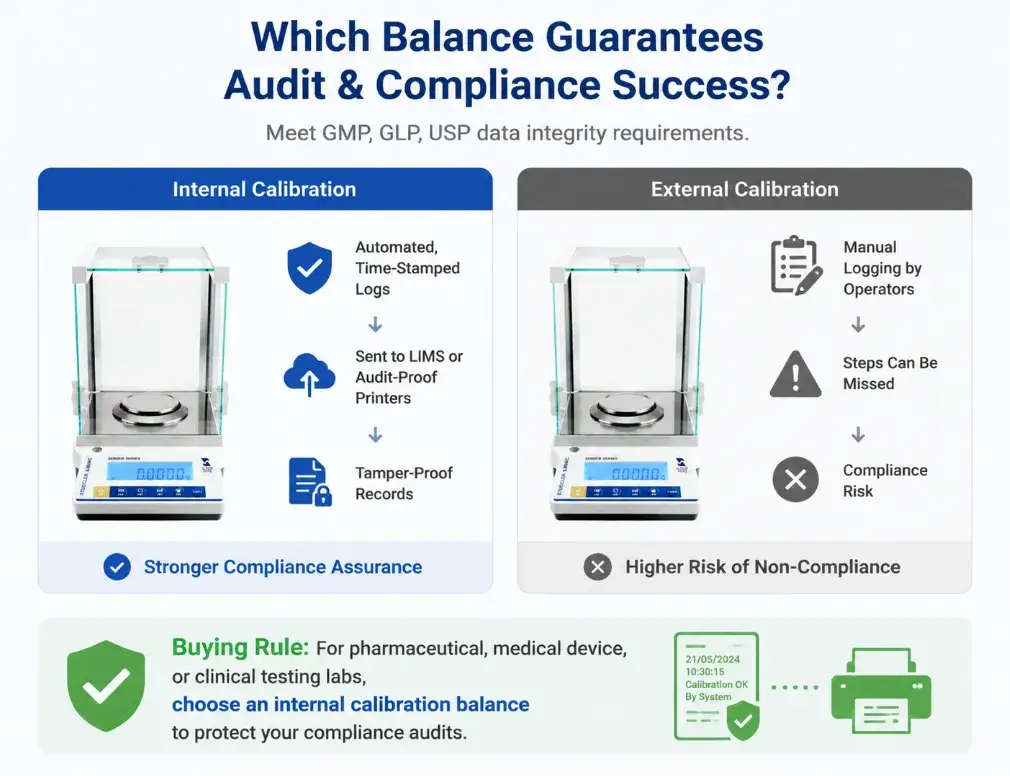
Factor 3: Which Balance Guarantees Audit & Compliance Success?
Regulated facilities operating under GMP, GLP, or USP standards face rigorous data integrity audits.
- Internal Balances generate automated, time-stamped, tamper-proof calibration logs directly sent to LIMS or audit-proof printers.
- External Balances rely on operators manually logging calibration events, creating compliance risks if a step is skipped.
Buying Rule: For pharmaceutical, medical device, or clinical testing labs, buy an internal calibration balance to safeguard your compliance audits.
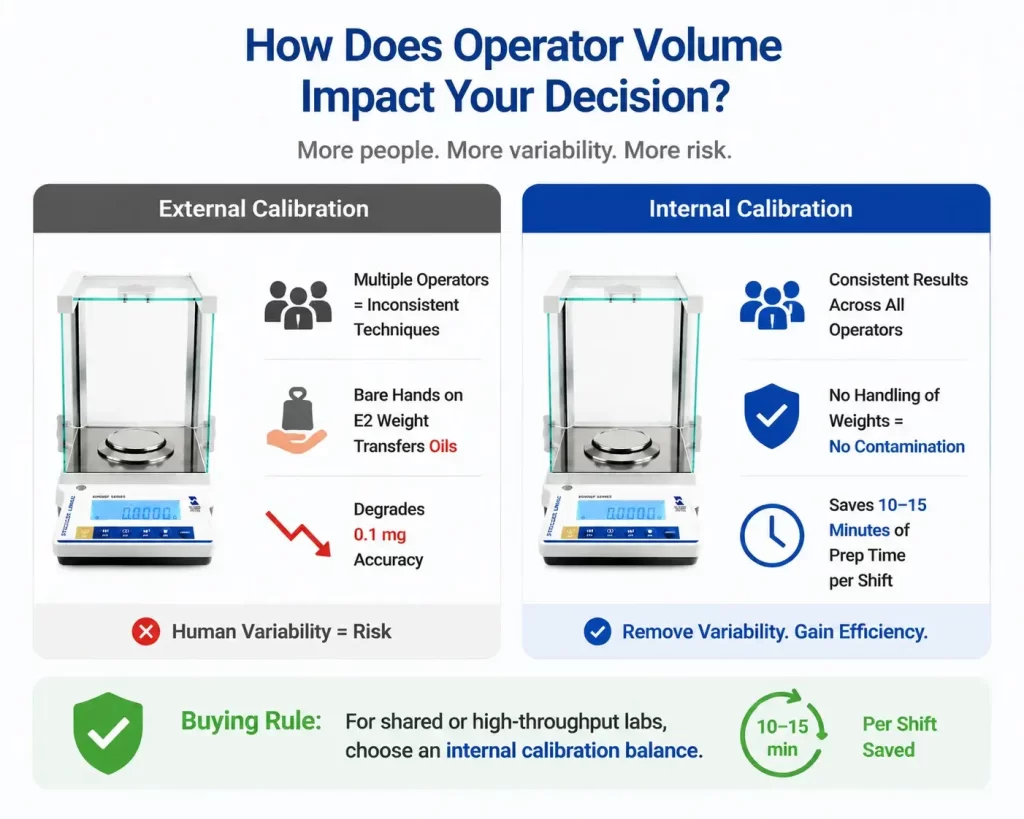
Factor 4: How Does Operator Volume Impact Your Decision?
When multiple technicians, shift workers, or researchers share an analytical balance, manual calibration techniques vary significantly. Touching a Class E2 weight with bare hands transfers microscopic skin oils that degrade 0.1 mg accuracy.
Buying Rule: For shared or high-throughput labs, buy an internal calibration balance to remove human variability and save 10–15 minutes of manual preparation time per shift.
Summary and Final Purchasing Recommendation
Choosing between internal and external calibration balances ultimately comes down to balancing upfront savings against long-term operational risk:
- Choose External Calibration if your budget is strictly constrained, your laboratory maintains a dedicated, climate-controlled balance room, and you have trained personnel dedicated to managing reference weights.
- Choose Internal Calibration if you operate in a regulated environment, experience room temperature swings, manage a shared laboratory, or want to eliminate human error and recurring weight certification expenses.
For most modern commercial and research laboratories, internal calibration balances provide superior data integrity, lower total cost of ownership, and total peace of mind.
Looking to Buy an Analytical Balance for Your Facility?
At Stuccler, we engineer and manufacture high-precision analytical balances (0.1 mg and 0.01 mg) designed for commercial, pharmaceutical, and industrial laboratories. As a direct manufacturer, we support:
- Factory-direct pricing for both internal and external calibration models
- Wholesale and B2B bulk procurement
- OEM customization and specialized housing configurations
Explore Stuccler Analytical Balances or Contact Our Technical Team today to get a customized quote for your lab requirements.