

Weighing errors destroy good science. In high-stakes testing, a single microgram deviation can invalidate days of work, ruin costly chemical formulations, or trigger audit failures. Upgrading to a high-precision analytical balance isn’t just a hardware swap—it eliminates data drift, boosts weighing speed, and ensures seamless ISO, GLP, and GMP compliance. Move your lab forward with a solid foundation for every downstream result.
I. Core Hardware and Technology Upgrades: What Do You Actually Gain?
Upgrading from aging or basic lab scales delivers substantial mechanical, electronic, and operational advantages. Modern high-precision instruments integrate critical engineering advancements designed to eliminate environmental noise and workflow bottlenecks.
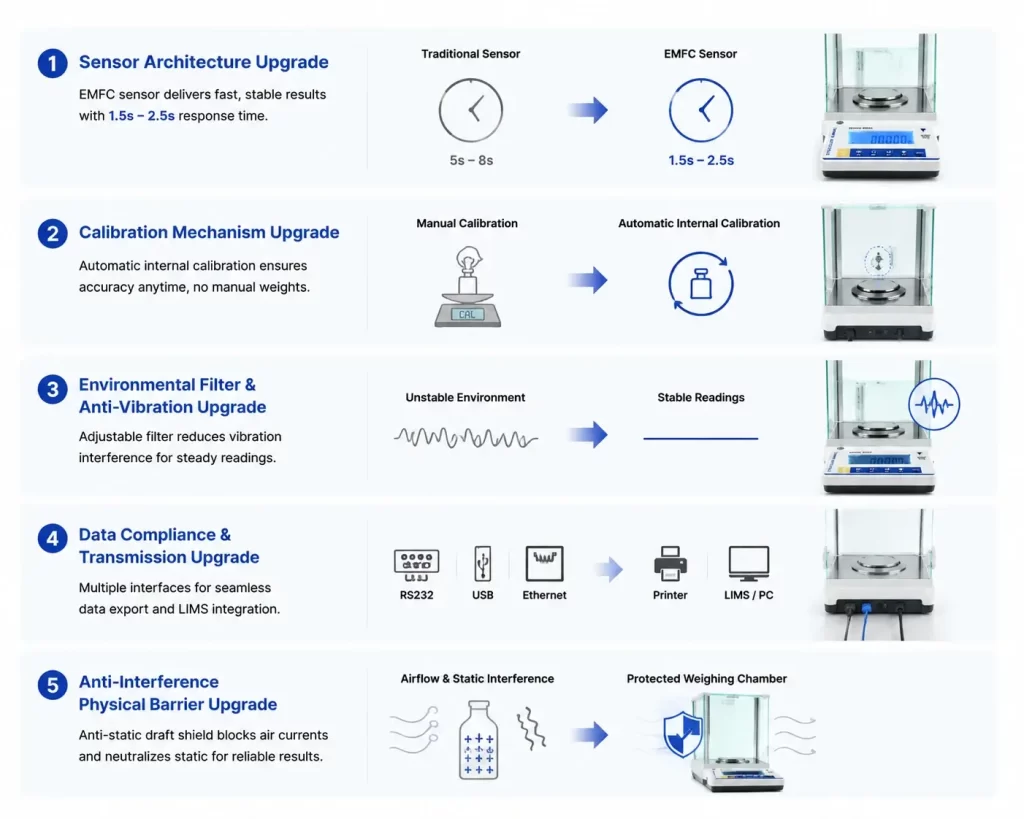
Sensor Architecture Upgrade
Older balances frequently rely on standard strain gauges or legacy force sensors that drift under continuous loads and require prolonged settling periods. Modern analytical balances adopt next-generation Electromagnetic Force Compensation (EMFC) sensors. By dynamically generating a magnetic field to counterbalance the applied load, EMFC technology reduces stable response times down to 1.5s–2.5s. This eliminates the inefficiency of waiting for readings to settle during rapid, high-volume sample preparation.
Calibration Mechanism Upgrade
Manual external calibration requires dedicated, certified class-mass weights, consistent ambient temperatures, and strict operational discipline. Human error or missed calibration schedules directly jeopardize measurement integrity. Upgraded instruments feature fully automatic internal calibration. Using motor-driven internal mass standards, the system automatically triggers self-calibration based on pre-set time intervals or detected temperature variations (ΔT), compensating for thermal drift without operator intervention.
Environmental Filter & Anti-Vibration Upgrade
Laboratory environments often suffer from subtle ambient vibrations caused by neighboring centrifuges, pumps, or foot traffic. Modern balances feature adjustable wave filter intensity functions. This software and sensor optimization allows operators to fine-tune stabilization levels based on room stability, guaranteeing steady, unwavering readings even in active workspaces.
Data Compliance and Transmission Upgrade
Paper logbooks and manual data entry are major sources of transcription errors and audit red flags. Upgraded analytical balances integrate versatile communication ports—including RS232, USB, and Ethernet. These interfaces support direct data export to printers or seamless integration with Laboratory Information Management Systems (LIMS), providing complete, tamper-proof data traceability required for GLP/GMP compliance.
Anti-Interference Physical Barrier Upgrade
Static charges on glass vials or plastic tare containers create invisible forces that cause digits to drift endlessly. Furthermore, ambient air currents from HVAC units destabilize micro-gram readings. Modern balances incorporate a high-transparency sliding draft shield treated with an anti-static coating. This physical barrier neutralizes static charges and shields the weighing chamber from subtle air currents, ensuring rock-solid stability for trace powders.
II. Targeted Replacement Solutions: What Should You Upgrade To?
Different analytical workflows demand distinct hardware configurations. Selecting the right replacement model ensures you match precision requirements without over-specifying or underperforming.
Solution 1: Routine Analysis & QC Upgrade — 0.1 mg Series Analytical Balances
- Primary Use Cases: Replacing aging general-purpose balances used in routine chemical compounding, pharmaceutical quality control, educational research, and high-value material analysis (such as the SE-Series and JD-Series).
- Key Specifications:
- Capacity: 120 g – 320 g
- Readability: 0.1 mg (0.0001 g) / 0.001 ct dual-unit precision
- Sensor & Calibration: Advanced Electromagnetic Force Compensation (EMFC) sensor with fully automatic internal calibration and multi-level adjustable wave filter anti-vibration functions
- Structure: Three-door glass draft shield with smooth-glide access, housed in durable aluminum and ABS shielding
Solution 2: Scientific Research & Dosing Upgrade — 1 mg High Precision Balances
- Primary Use Cases: Replacing standard lab scales in chemical dosing stations, research departments, and compounding facilities where capturing micro-level weight changes down to 0.001 g (1 mg) is critical while requiring higher weighing capacities and protective airflow shielding.
- Key Specifications:
- Capacity Options: 100 g-300 g, 220 g-620 g, up to 2020 g (also supports 1100 ct-10100 ct)
- Readability: 1 mg (0.001 g)
- Structure & Calibration: Premium glass draft shields to eliminate ambient airflow interference, backlit HD LCD display, and built-in data calibration tracking
Solution 3: Industrial High-Capacity & Bulk Batching Upgrade — Precision & Top-Loading Balances
- Primary Use Cases: Replacing aging equipment in raw material inspection, heavy batching, educational chemical experiments, and high-value industrial QC where operators need to weigh larger or heavy samples without sacrificing 0.01 g resolution.
- Key Specifications:
- Capacity: High-load options from 300 g-1500 g up to heavy-duty 2000 g-20,000 g (20 kg)
- Readability: 0.01 g (10 mg)
- Build Construction: Rugged strain-gauge load cells with multi-level adjustable wave filter intensity, equipped with heavy-duty stainless steel top-loading pans for active factory and laboratory environments
III. Side-by-Side Comparison: Old vs. New Configurations
To evaluate the operational impact of an upgrade, consider how legacy balances compare directly to modern high-precision instruments across critical performance parameters:
| Evaluation Dimension | Existing Old/Standard Balances | Upgraded High-Precision Analytical Balances |
| Stabilization/Response Time | Slow (5s – 8s), creating bottlenecks during high-throughput weighing. | Ultra-fast (1.5s – 2.5s), accelerating sample processing speeds. |
| Thermal Drift & Calibration | Manual external calibration (prone to operator oversight, thermal errors, and missing logs). | Fully automatic internal calibration; ready upon startup; auto-triggered by ambient temperature changes. |
| Data Traceability | Manual paper recording (error-prone, time-consuming, difficult for strict regulatory audits). | Auto-export in GLP/GMP formats; direct connectivity to LIMS, PCs, and external printers. |
| Environmental Interference | Standard glass shield (highly susceptible to static charge accumulation, airflow, and floor vibration). | Special anti-static coating + optimized draft shield + adjustable wave filter intensity for superior stability. |
IV. Implementation & Daily Maintenance Guide
Installing a high-precision analytical balance requires proper setup and ongoing care to maintain sub-milligram accuracy over years of continuous operation.
Quick Start-up: How to Smoothly Replace Your Old Balance
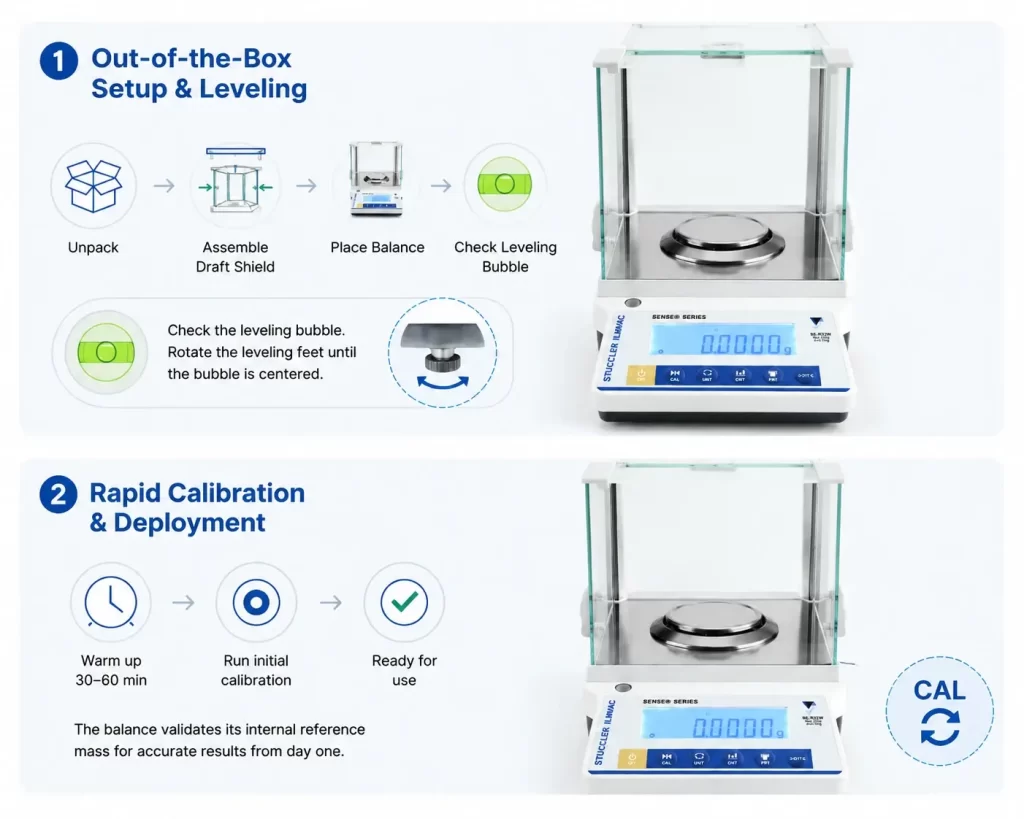
Out-of-the-Box Setup & Leveling
Unpack the unit carefully on a stable surface. Assemble the draft shield panels and place the stainless steel weighing pan onto the center support cone. Before powering on, check the leveling bubble located at the base or front panel. Rotate the adjustable leveling feet until the bubble sits perfectly centered within the indicator ring. An unlevel balance introduces vector forces that skew mass calculations.
Rapid Calibration & Deployment
Once powered and allowed to warm up (typically 30–60 minutes for electronic thermal equilibrium), execute an initial calibration run. You can utilize the factory calibration certificate parameters or trigger the one-touch internal calibration function. Once complete, the system validates its internal reference mass, allowing the new instrument to seamlessly take over daily operations on the day of delivery.
Usage & Maintenance Best Practices: How to Maintain High Precision
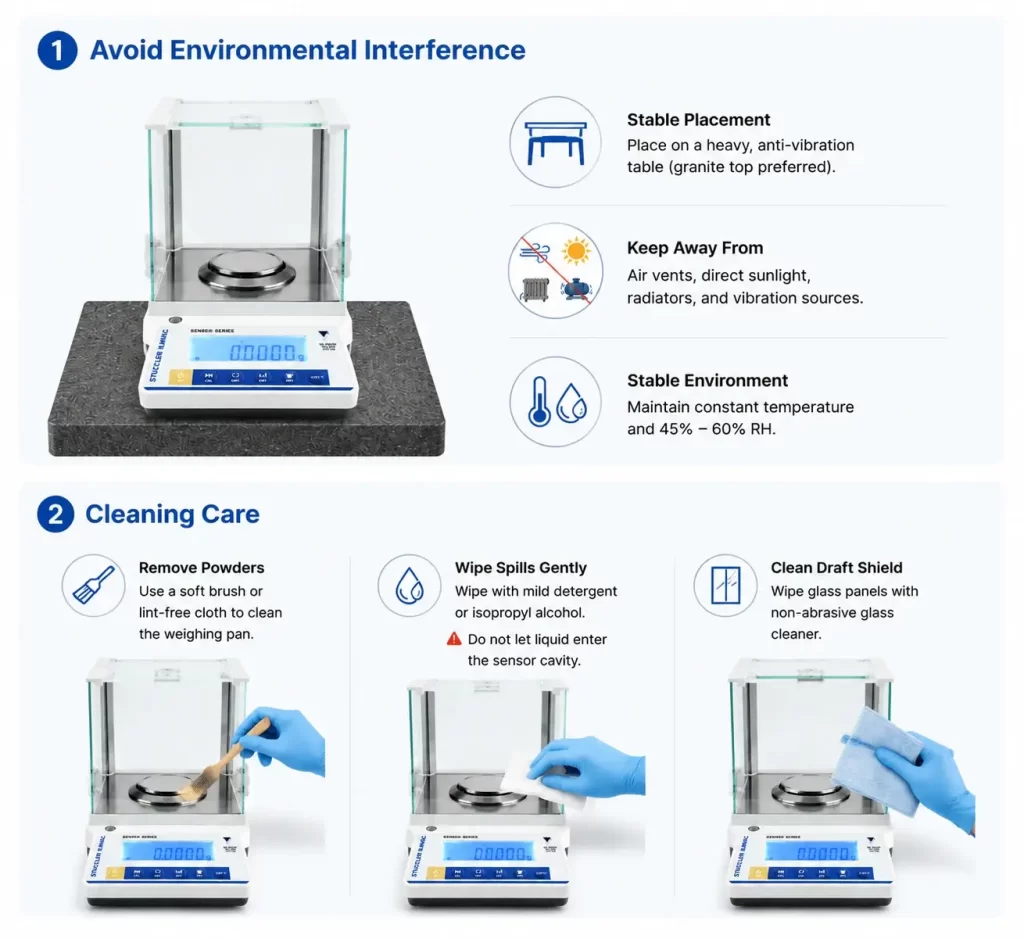
Avoiding Environmental Interference
- Placement: Position the balance on a heavy, dedicated anti-vibration table (granite top preferred).
- Location: Keep the unit clear of air conditioning vents, direct sunlight, radiators, and high-frequency equipment like centrifuges or vacuum pumps.
- Environmental Control: Maintain consistent ambient room temperature and relative humidity (45% – 60% RH helps dissipate static charges naturally).
Cleaning Protocols for Weighing Pans & Draft Shields
- Routine Cleaning: Turn off the display before cleaning. Use a soft brush or lint-free micro-fiber cloth to sweep loose powders off the weighing pan toward the outer perimeter.
- Handling Spills: For liquid or chemical spills, gently remove the stainless steel pan and drip tray. Wipe surfaces with a mild detergent or isopropyl alcohol. Never spill liquids directly into the sensor cavity beneath the pan support.
- Draft Shield Care: Clean glass draft shield doors with non-abrasive glass cleaner to avoid scratching anti-static coatings.
Procurement Support & Contact Information
Upgrading your laboratory infrastructure requires reliable hardware backed by technical expertise and long-term service support.
Supplier Capabilities
As a leading precision balance manufacturer and certified analytical balance supplier, Stuccler delivers high-performance laboratory weighing instruments engineered for demanding research, pharmaceutical, and industrial applications. Backed by our dedicated manufacturing factory, we enforce rigorous multi-stage quality control protocols to ensure every unit meets strict repeatability and linearity standards before shipment. Whether you need a single-unit lab replacement or bulk OEM distribution, our role as a trusted precision balance supplier guarantees factory-direct pricing, long-term technical support, and a comprehensive 3-year warranty on all electronic balances.
Partner with Us for Your Upgrade
Ready to eliminate weighing errors and boost your lab’s testing throughput?
- Request a Quote: Contact our technical team today to receive a formal quotation tailored to your specifications.
- Download Catalog: Access our complete product catalog to review full technical datasheets across all precision and analytical series.
- Expert Consultation: Speak directly with a product specialist to determine the exact model, capacity, and calibration options required for your specific workflow.