

In high-throughput laboratories and demanding industrial environments, standard benchtop scales often fail under constant heavy loads and harsh conditions. High capacity top loading balances engineered for heavy-duty use bridge the gap, combining high-precision accuracy with rugged structural durability to streamline continuous weighing operations.
1. What Defines a “High-Capacity Top-Loading Balance for Heavy-Duty Use”?
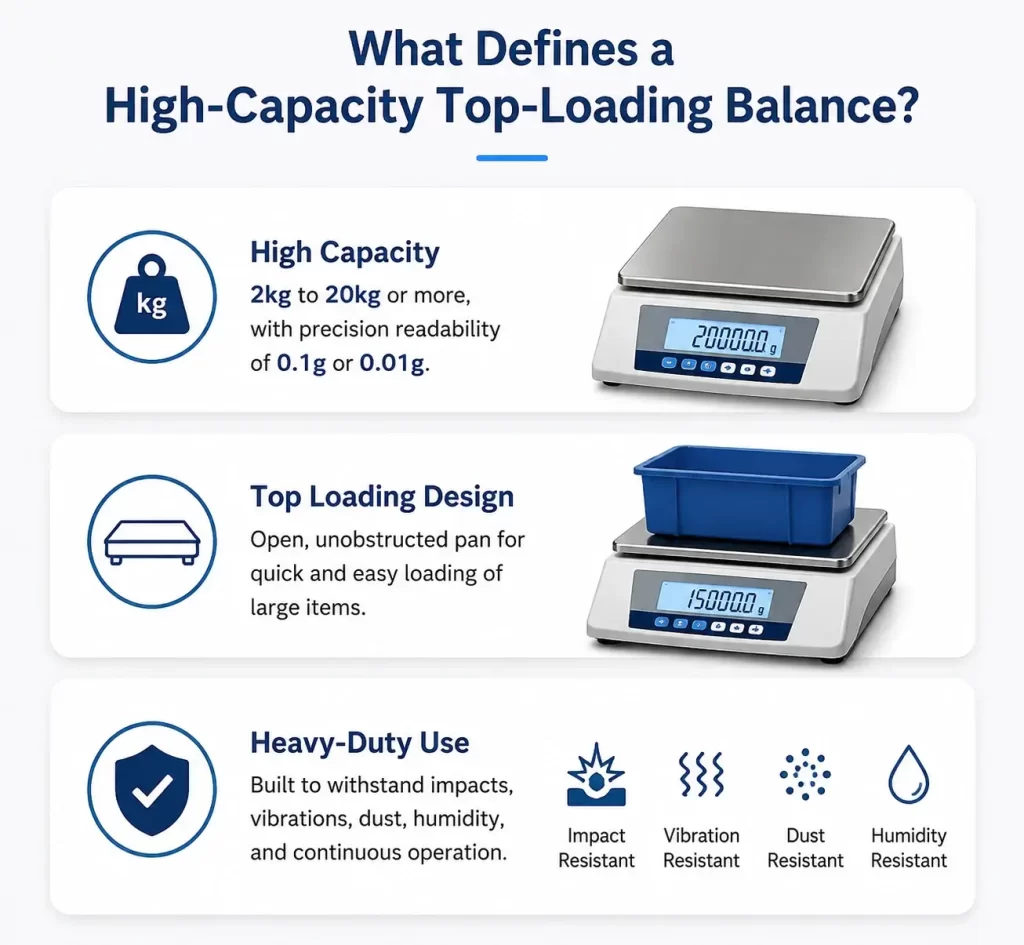
Understanding what separates a heavy-duty top loading balance from standard laboratory equipment comes down to three key design parameters:
- Defining “High Capacity”: While standard laboratory top loading balances typically operate in the 300g to 1500g range, heavy-duty applications demand capacities from 2kg up to 20kg or more. Crucially, these instruments deliver this expanded mass range without sacrificing precision, maintaining readabilities of 0.1g or 0.01g for heavy, bulky materials.
- Deconstructing “Top Loading”: Unlike delicate analytical balances constrained by glass draft shields, a top loading balance features an unobstructed, open-pan architecture. This allows technicians and assembly line operators to rapidly load and unload large containers, bulk totes, or bulky mechanical parts, drastically improving throughput in high-frequency workflows.
- Explaining “Heavy-Duty Use”: “Heavy-duty” reflects the actual environment where these balances operate. They are engineered to endure accidental impacts, mechanical floor vibrations, airborne dust, ambient humidity, and continuous multi-shift operations while maintaining tight calibration stability.
2. Core Technology Breakdown: How Do These Balances Achieve “Heavy-Duty” Durability?
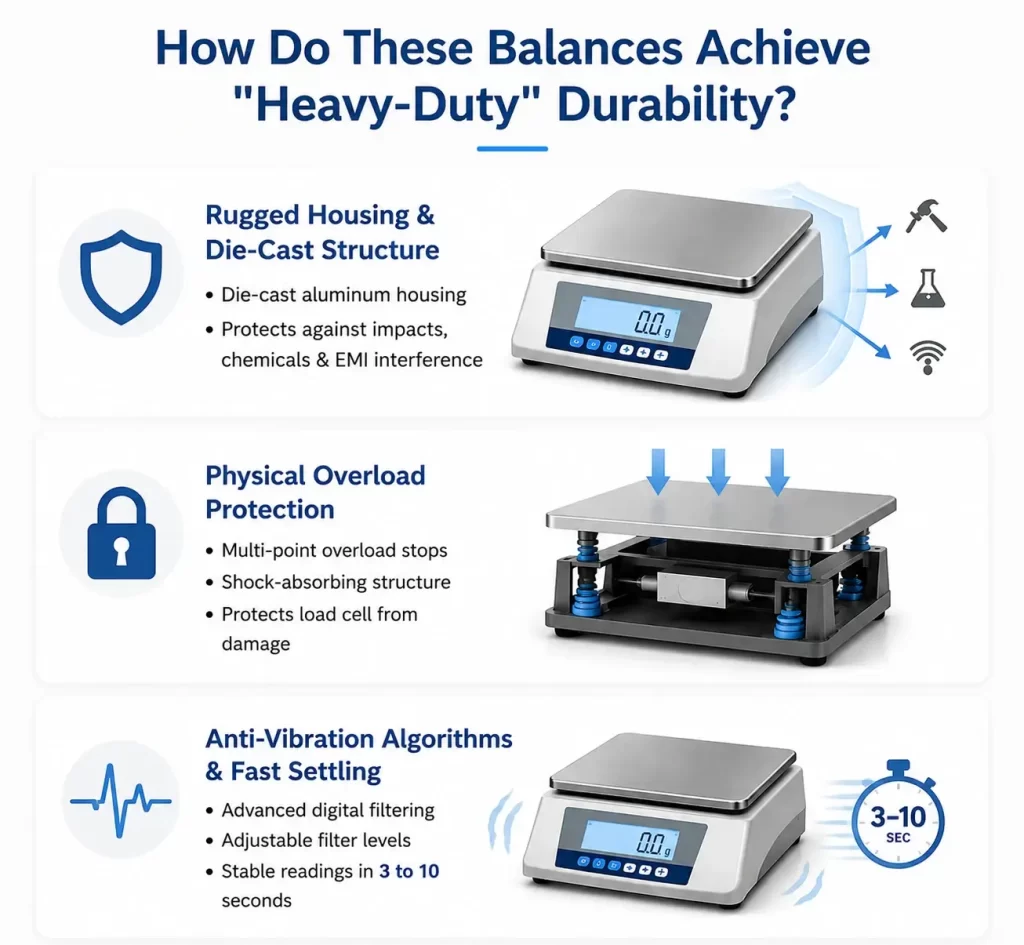
Surviving industrial execution requires purpose-built engineering inside and out. High-performance models incorporate specific structural and electronic design choices to guarantee long-term reliability.
Rugged Housing and Die-Cast Structure
Standard laboratory balances frequently utilize plastic enclosures that degrade, crack, or flex under heavy usage. Heavy-duty top loading balances feature die-cast aluminum alloy housings. This metal casing acts as a physical shield against mechanical impacts and aggressive chemicals, while simultaneously providing built-in electromagnetic interference (EMI) shielding to stabilize internal electronics near industrial equipment.
Physical Overload Protection
Accidentally dropping a heavy container onto an open pan can instantly ruin a delicate weighing sensor. Heavy-duty units integrate multi-point mechanical overload stops beneath the platform along with internal shock-absorbing damping structures. These physical barriers absorb downward and angular shock loads, isolating the high-durability strain gauge load cell from structural damage.
Anti-Vibration Algorithms & Fast Settling
Plant floors and busy prep stations generate continuous ambient vibrations and air movement. Advanced top loading balances utilize multi-stage digital wave filtering algorithms. Operators can adjust filter levels to suppress background noise, enabling stable readings within 3 to 10 seconds so production lines move without interruption.
3. Product Recommendation: Featured Heavy-Duty Top Loader
For facilities seeking an industrial-grade instrument engineered specifically for high-capacity workflows, the following model represents the optimal balance of strength and resolution:
Stuccler High-Capacity Precision Top Loading Balance (2000g – 20000g Series)
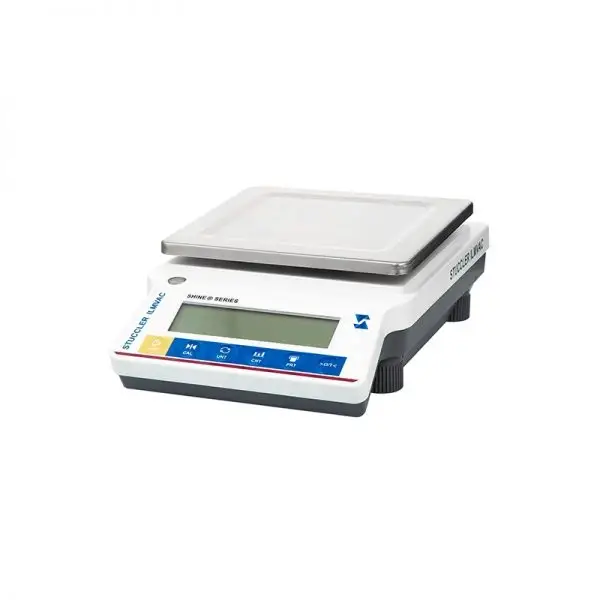
Engineered for continuous heavy-duty service, this flagship top-loading balance combines a high-rigidity structural frame with precise strain gauge technology to handle demanding industrial and research workloads.
- Capacity Options: 2,000g to 20,000g (2kg – 20kg max mass range)
- Readability (d): 0.1g to 0.01g (depending on target capacity configuration)
- Platform Design: 190 X 190 mm heavy-duty stainless steel square pan
- Housing Construction: Fully aluminum die-cast body + rugged ABS front panel
- Sensors & Electronics: High-durability strain gauge load cell with multi-level wave filtering
- System Integration: Built-in RS232 port for direct communication with printers, barcode readers, or PCs
4. Selection Guide: Matching Specifications to High Capacity Needs
Selecting the correct instrument requires balancing total load requirements against the minimum required resolution.
Capacity vs. Readability Matrix
| Application Focus | Capacity Range | Readability (d) | Typical Workflow |
| High-Precision Reagent Prep | 2kg – 5kg | 0.01g | Large-batch chemical formulation, precious metal processing |
| Industrial Parts Counting & QC | 6kg – 12kg | 0.1g | Component batching, checkweighing, hardware packaging |
| Bulk Receiving & Shipping | 15kg – 20kg | 0.1g | Incoming raw material inspection, large package verification |
Platform Selection: Large Square Platforms vs. Small Round Pans
While low-capacity precision scales use small round pans (Φ130mm or smaller), high-capacity heavy-duty applications require a larger, square platform—such as a 190 X 190 mm stainless steel pan. A spacious square platform evenly distributes the center of gravity for oversized containers, trays, or raw ingots, preventing corner-load errors and tipping hazards.
5. Industrial Integration & Data Compliance
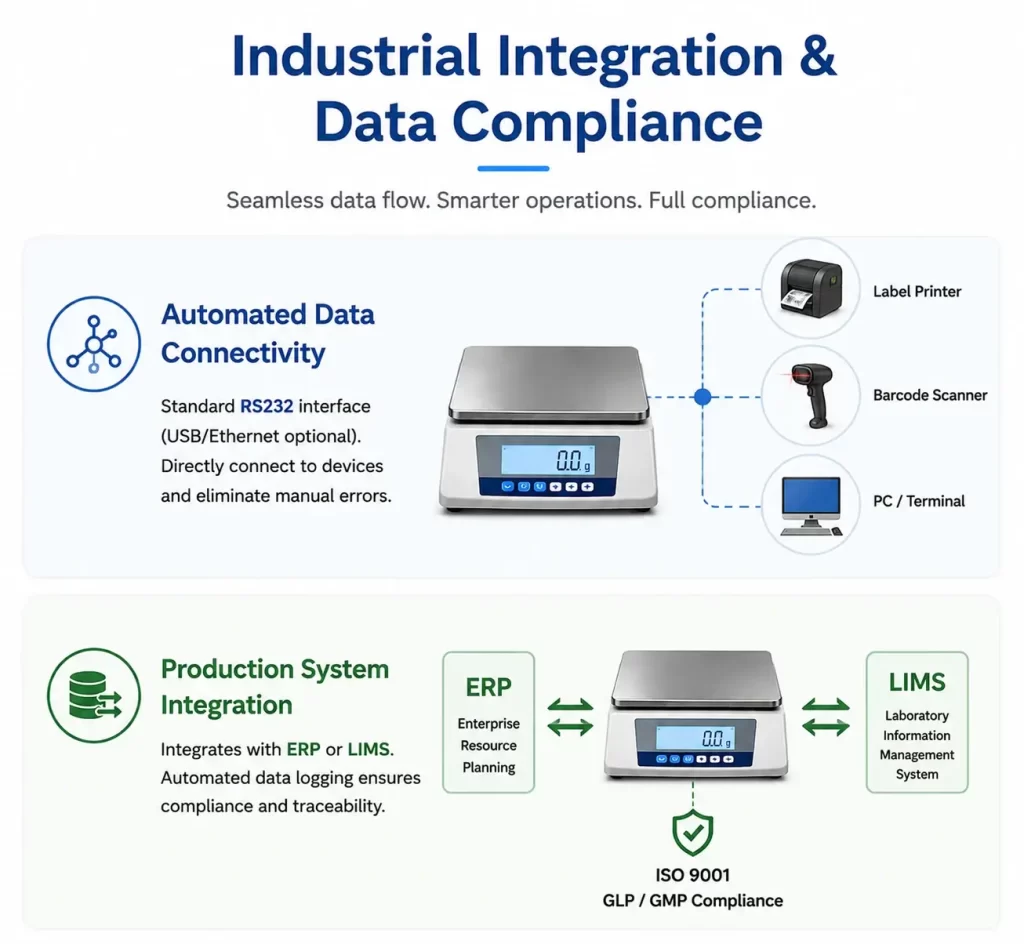
Modern quality assurance demands that weighing data moves seamlessly into broader manufacturing networks without manual intervention.
- Automated Data Connectivity: Heavy-duty balances come standard with industrial RS232 interfaces (along with optional USB or Ethernet modules). This enables direct output to label printers, barcode scanners, or local terminal PCs, eliminating manual transcript errors during fast-paced packing or mixing routines.
- Production System Integration: Bi-directional communication protocols allow direct integration into Enterprise Resource Planning (ERP) or Laboratory Information Management Systems (LIMS). Automated data logging ensures full compliance with ISO 9001 quality management systems and GLP/GMP traceability requirements.
6. Calibration, Maintenance, & Factory-Direct Support
To keep high-capacity top loaders running accurately over years of service, proper upkeep and strong supplier backed technical support are critical.
- Routine Calibration & Care: Heavy-duty balances support external calibration protocols using standardized test weights. Regular zero-point checks and routine cleaning of the removable stainless steel platform prevent debris build-up and maintain measurement accuracy over long operating cycles.
- Factory-Direct Wholesale & Customization: Sourcing directly from an established manufacturer guarantees access to consistent unit quality, direct component replacement, and tailored OEM configurations. Bulk buyers benefit from consolidated supply chain pricing and dedicated technical service.
Summary
High-capacity top loading balances engineered for heavy-duty use provide the ideal balance between high-mass throughput and fine resolution. By combining die-cast aluminum housings, overload protection, digital wave filtering, and open square stainless steel platforms, these balances withstand continuous operations in demanding workshop and laboratory environments. Integrated RS232 connectivity ensures seamless data export for full ISO and GLP/GMP compliance.
As a dedicated top loading balance manufacturer and supplier equipped with our own physical production factory, Stuccler supplies robust top-loading balances built for heavy-duty performance. Contact our engineering team today to request a quote, explore custom OEM configurations, or secure factory-direct wholesale rates for your facility.