

Drifting numbers, jumping powders, and balances that refuse to settle aren’t ghost stories—they’re static electricity. In precision weighing, even tiny electrostatic charges exert phantom forces that steal milligrams of accuracy. Here is how to eliminate the invisible pull and lock in stable readings.
Step 1: Maintain Ambient Laboratory Humidity Between 45% and 60%

Dry ambient air is the primary environmental catalyst for electrostatic buildup around analytical instruments.
- Why Low Humidity Creates Static: When ambient relative humidity drops below 40%, the air loses its natural electrical conductivity. Moisture-thin microscopic layers that normally coat laboratory surfaces vanish. Without this water film, static electricity generated by routine movement cannot bleed off into the environment, causing charges to accumulate on weighing surfaces.
- Effective Moisture Control:
- Run a dedicated ultrasonic or evaporative laboratory humidifier within the weighing room to stabilize room air between 45% and 60% RH.
- Keep room humidity below 65% to prevent hygroscopic reagents from absorbing ambient moisture, which creates a secondary source of weight drift.
Step 2: Stop Using Standard Plastic Weighing Boats and Vessels
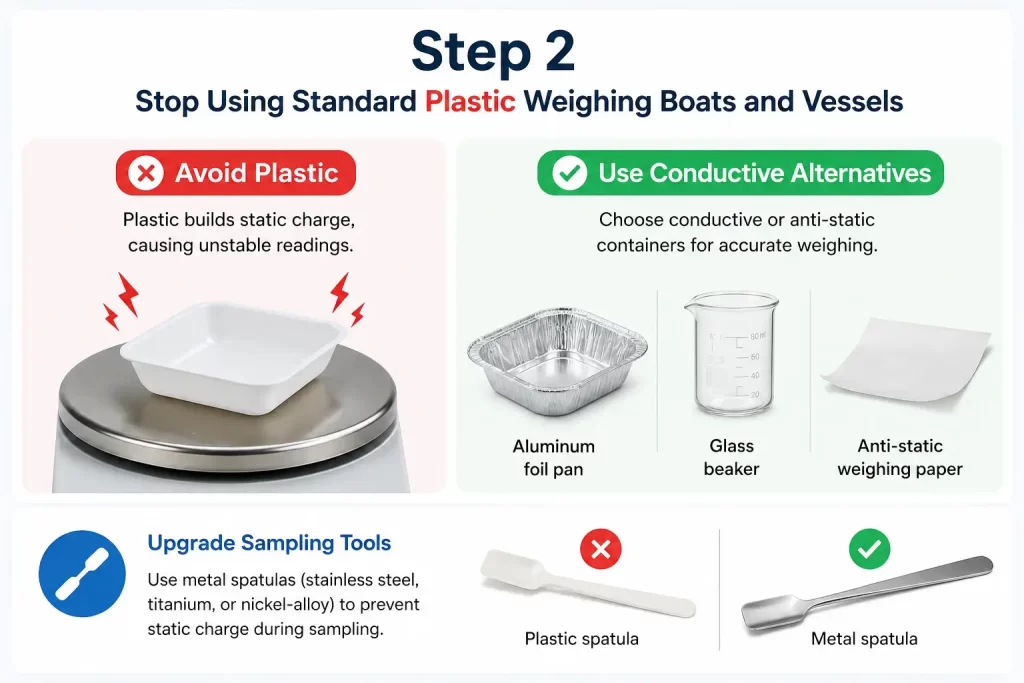
Standard polymers are electrical insulators with high surface resistivities, making them prime generators of static friction.
- The Insulating Properties of Plastic: Handling, stacking, or sliding standard polystyrene weighing dishes generates thousands of electrostatic volts through triboelectric charging. When set onto a stainless steel pan, this charged plastic repels or attracts surrounding metal components, causing erratic display swings.
- Switch to Conductive Weighing Containers:
- Replace disposable polystyrene boats with conductive aluminum foil pans, borosilicate glass beakers, or specialized carbon-treated anti-static weighing vessels.
- For micro-sampling, use high-density, low-ash anti-static parchment weighing paper that releases powders cleanly without clinging.
- Upgrade Sampling Tools: Discard standard disposable plastic spatulas. Switch to grounded stainless steel, titanium, or nickel-alloy spatulas to transfer dry chemical standards without inducing frictional charges during powder scooping.
Step 3: Use an Ionizer to Actively Neutralize Static Charges
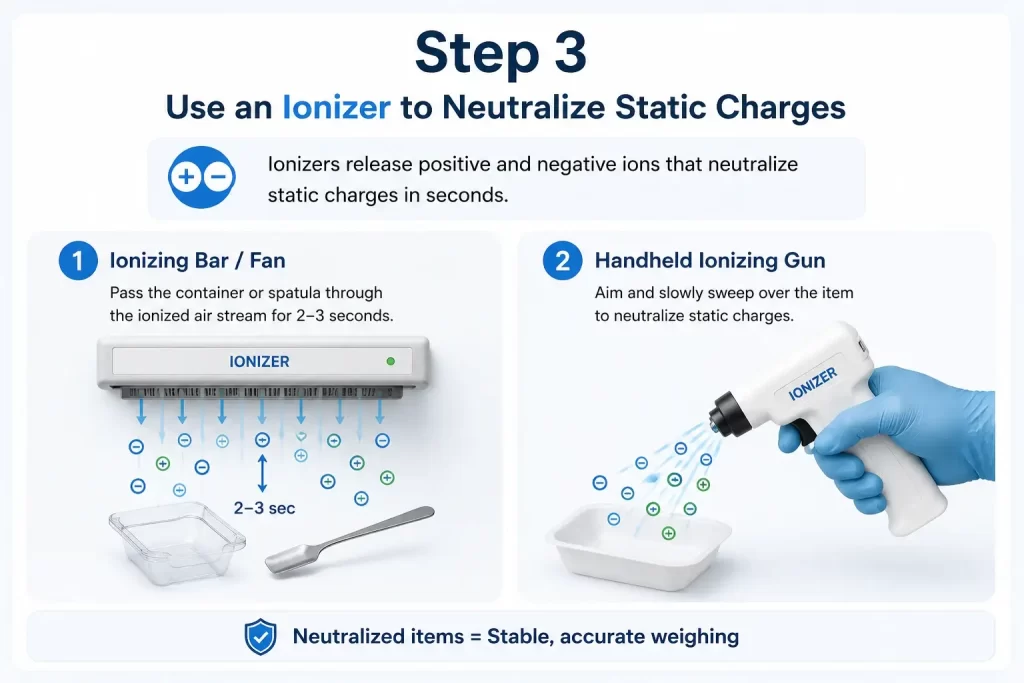
Passive dissipation methods take time, but high-throughput workflows require active deionization to balance net electrical charges instantly.
- How Ionization Technology Works: Deionizing hardware generates high-voltage alternating or direct current across internal emitter needles, breaking nearby air molecules into balanced clouds of positive and negative ions. As these ions wash over a charged vessel, opposite polarities attract and cancel out the surface charge within seconds.
- Selecting the Right Ionizing Equipment:
- Integrated or Benchtop Bar Ionizers: Position a point-source or ionizing fan bar adjacent to the balance opening. Pass the tare container or spatula through the targeted ionized air stream for 2 to 3 seconds before opening the glass door and placing the vessel onto the weighing pan.
- Piezoelectric Anti-Static Guns: Handheld ionizing pistols provide portable charge elimination without requiring benchtop power cords. Squeezing and slowly releasing the trigger over a problematic plastic vessel discharges positive and negative ions, neutralizing deep electrostatic pockets across complex container profiles.
Step 4: Verify the Power Grounding of Your Scale

Precision analytical instruments rely on physical earth grounding to discharge stray electrostatic and electromagnetic potential away from sensitive load cells.
- Why Earth Grounding Protects the Sensor: High-precision balances feature cast-metal chassis and stainless steel draft assemblies designed to route parasitic charges away from the internal electromagnetic force restoration (EMFR) sensor. If the wall outlet lacks a functional ground, static charges pool on the weighing pan and metal draft plates, interfering with internal flexures and generating phantom weight readings.
- Verifying Ground Integrity:
- Always connect your laboratory balance directly to an industrial three-prong grounded AC outlet. Avoid ungrounded extension cords, unshielded multi-outlet strips, or two-prong adapter plugs.
- Use a digital receptacle tester or multimeter to confirm that ground impedance remains low and that no reverse-polarity wiring faults exist at the balance workstation.
- For setups in dry climates, connect a dedicated copper grounding wire from the external earth grounding terminal on the balance rear panel directly to a certified laboratory ground bus.
Step 5: Follow Proper Daily Handling Habits

Careful operational protocols prevent static interference from contaminating precision weighing results.
- Select Natural Apparel: Wear lab coats crafted from 100% pure cotton or certified ESD-safe, carbon-threaded fabric. Avoid synthetic polyester, nylon, and acrylic sweaters that shed electrons and generate electrostatic fields as you walk across epoxy or vinyl lab floors.
- Eliminate Dry Wiping: Never scrub draft shield glass panels or the draft ring with dry paper towels. Dry friction charges dielectric glass panels rapidly, creating an electrostatic cage that pulls on the pan from above. When cleaning, wipe down surfaces with a lint-free task wipe moistened with mild reagent-grade alcohol or dilute soapy water, allowing the moisture film to dry naturally.
- Maintain Weighing Discipline:
- Transfer samples using smooth, deliberate movements to minimize air turbulence and contact friction.
- Always close draft shield sliding doors immediately after loading samples.
- Watch the display terminal and wait until the balance stability indicator symbol locks solid before recording analytical values.
Consistent Results Depend on Instrument Quality
Eliminating static interference requires controlling room humidity, switching to conductive sample vessels, utilizing targeted ionizing blowers, verifying outlet grounding, and practicing non-frictional cleaning. Controlling these variables removes electrostatic drift, ensuring your laboratory balances deliver fast settling times, repeatable sample weights, and steady calibration curves across every analytical run.
When demanding applications call for dependable precision and rugged sensor architecture, choosing the right instrument hardware makes all the difference. As an established laboratory balance manufacturer and global supplier, Stuccler builds analytical balances, precision milligram scales, and high-capacity laboratory balances engineered for stable thermal performance, robust internal calibration, and high electromagnetic noise immunity.
Whether your facility requires bulk wholesale orders for multi-station laboratories, custom OEM private labeling, or specialized instrument configurations built to your technical specifications, partner with Stuccler to equip your workstations with high-precision weighing systems designed to perform.