

More decimal places don’t always mean a better workflow. While a 0.001g balance delivers critical milligram precision, an open-pan 0.01g balance offers the speed and high capacity needed for daily bulk weighing. Here is how to choose the right precision level without paying for resolution you can’t use.
1. 0.01g vs. 0.001g: Key Technical Specifications Compared
Both 0.01g and 0.001g instruments are categorized under international metrological standards as precision balances. They are distinct from analytical balances, which deliver 0.0001g (0.1mg) readability and strictly require four-sided glass draft chambers.
While 0.01g units function primarily as open-pan workhorses, 0.001g units cross into milligram territory, where physical design must account for atmospheric disturbances.
| Technical Specification | 0.01g Precision Balance | 0.001g Milligram Balance |
| Readability (d) | 0.01 g (10 mg) | 0.001 g (1 mg) |
| Typical Capacity Range | 600 g to 5,000 g+ | 100 g to 500 g |
| Weighing Pan Design | Large open pan (approx. 120–180 mm) | Compact pan (approx. 80–100 mm) |
| Draft Shield Requirement | None required (open top-loading) | Essential (ring shield or glass chamber) |
| Stabilization Time | Fast: 1 to 2 seconds | Moderate: 2 to 4 seconds |
| Primary Sensor Type | Strain Gauge (EMFC for high-cap) | Strain Gauge or EMFC |
2. Sample Weight vs. Tolerance: Which Precision Level Does Your Target Require?
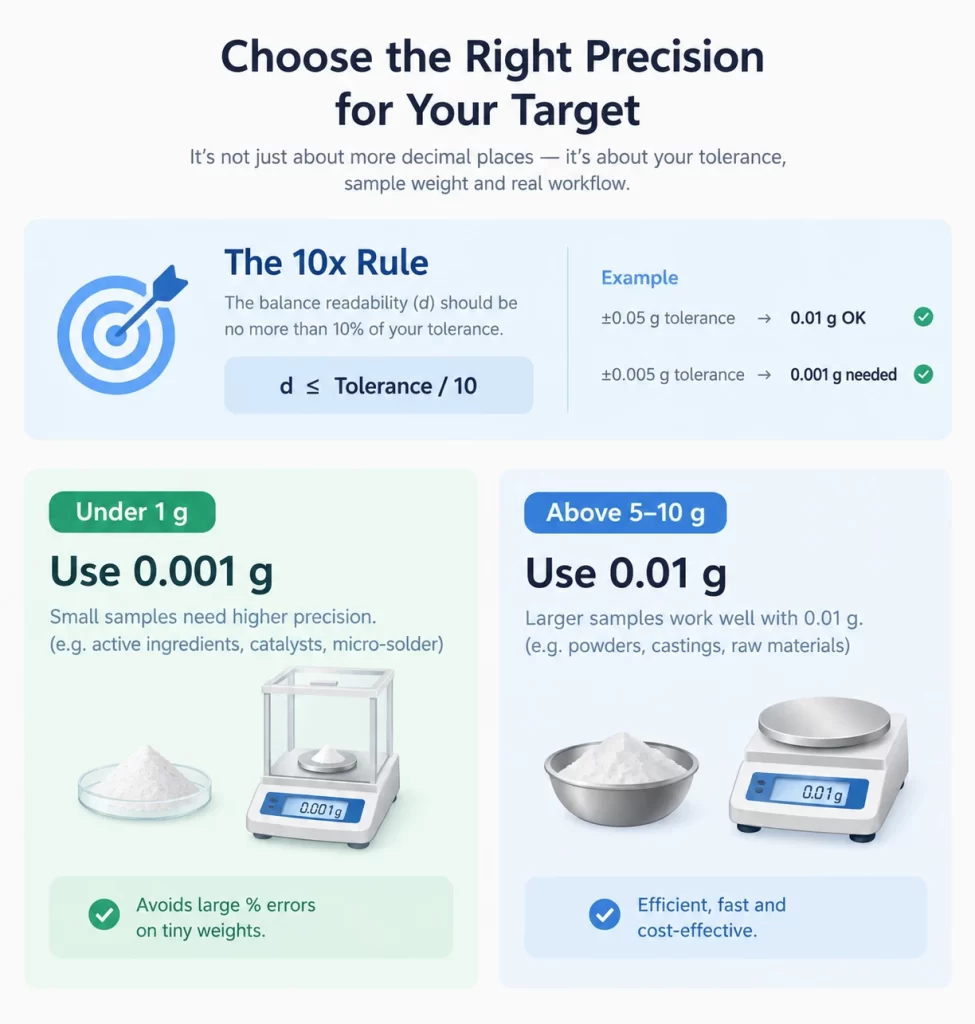
Determining whether you need a two-decimal or three-decimal instrument starts with process tolerance rather than display resolution.
The 10x Accuracy Rule
A universal standard in measurement science is the 10x Rule: the readability (d) of your precision balance must be no more than 10% (one-tenth) of your allowable process error.
Required Readability (d) <= Acceptable Process Tolerance / 10
If your protocol permits a total margin of error of ±0.05 g, a balance with d = 0.01 g introduces a maximum single-digit rounding variance of 0.01g—well within safe measurement limits. However, if your tolerance window narrows to ±0.005 g, a 0.01g instrument cannot resolve the necessary margins, making a 0.001g unit mandatory.
Quantifying the Sample Weight Threshold
The relationship between minimum sample weight and acceptable variance dictates your selection:
- Sample Weights Under 1g (Mandatory 0.001g): When measuring active ingredients, fine chemical catalysts, micro-solder, or small gemstones, a standard 0.01g display digit jump represents a massive percentage of the total mass. On a 0.10g target, a one-digit bounce (0.01g) constitutes a 10% measurement error. Here, a 0.001g balance is required to keep fluctuations within an acceptable sub-percentage range.
- Sample Weights Above 5g to 10g (0.01g is Optimal): When weighing bulk powders, heavy metal castings, or raw compounding materials, a 0.01g resolution yields an uncertainty level below 0.1% to 0.2%. Paying the price premium for a 0.001g model adds negligible practical value to these yields while drastically slowing your measurement pace.
3. Capacity and Container Weight: Will a 0.001g Balance Limit Your Usable Range?
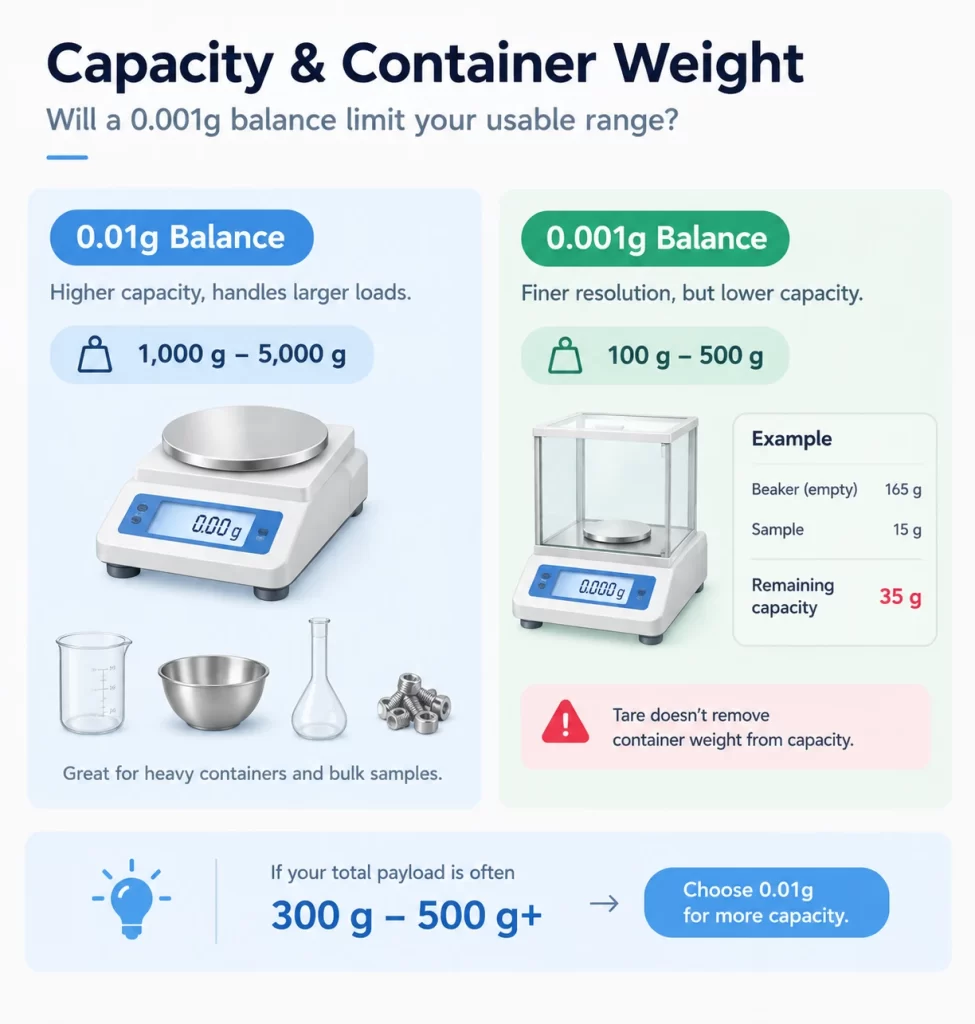
A frequent oversight during equipment procurement is assessing sample weight while forgetting the tare vessel.
The Capacity Advantage of 0.01g Balances
Because their sensors handle higher mechanical strain without losing stability, 0.01g top-loading balances commonly support weighing capacities from 1,000g up to 5,000g. This wide gross range accommodates heavy borosilicate glassware, stainless steel mixing vessels, large volumetric flasks, and bulk hardware without risking overload errors.
The Tare Weight Trap of 0.001g Balances
Milligram balances trade maximum load capacity for fine resolution. Most 0.001g models top out between 100g and 500g.
Consider this standard laboratory scenario:
- You intend to dispense 15g of compound into a 250mL thick-walled glass beaker.
- The empty beaker weighs 165g.
- You place the beaker on a 200g capacity, 0.001g balance and press Tare.
- The display reads zero, but the internal sensor is already supporting 165g of physical mass.
- Your remaining usable capacity is only 35g before the sensor hits its limit and displays an Err or Overload message.
If your combined payload—container, fixture, stirring rod, and sample—routinely exceeds 300g to 500g, a 0.01g balance is the structurally sound choice.
4. Open-Pan Speed vs. Draft Shield Precision: Which Matches Your Daily Workflow?
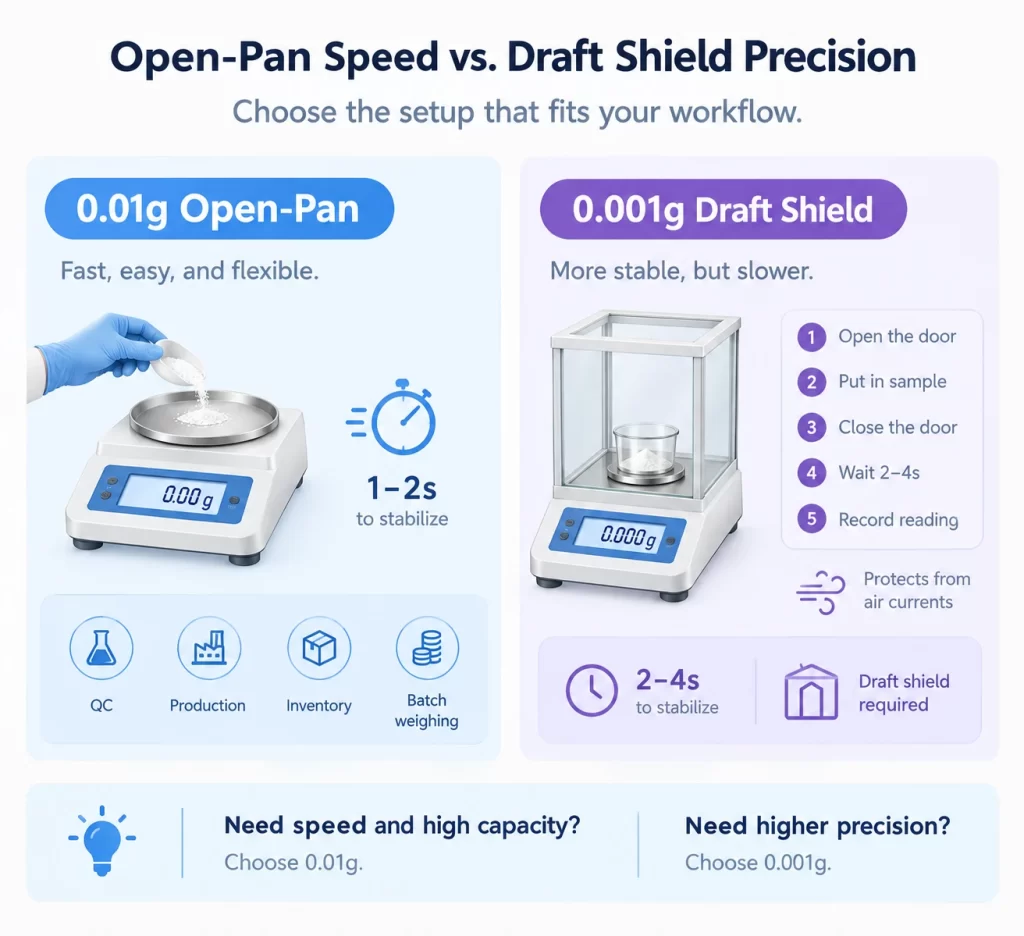
The mechanical footprint of the balance dictates your day-to-day throughput.
0.01g Open-Pan Speed
Top-loading 0.01g units feature wide, completely unobstructed weighing pans. Operators can add, pour, spatulate, or remove materials from any angle without physical restriction. Readings settle cleanly in 1 to 2 seconds.
This unrestricted format is built for fast-moving environments: continuous quality-control checkpoints, production-line packaging, inventory parts counting, and large-batch formulation.
0.001g Draft Shield Precision
At the 1mg level, a balance no longer registers mass alone—it detects local air currents. A gentle HVAC breeze, an open door, or the operator’s own breathing will send a 0.001g reading into an endless upward or downward drift.
To maintain repeatability, a 0.001g unit must use a glass or acrylic draft shield. This introduces a multi-step routine for every single measurement:
- Slide the draft door open.
- Place the sample inside the chamber.
- Slide the draft door completely shut.
- Wait 2 to 4 seconds for internal air turbulence to subside.
- Record the stabilized reading.
If your workstations are situated directly underneath climate-control vents, or if technicians need to process hundreds of samples per shift, the draft shield requirement will cut production speed in half if applied to tasks that only require 0.01g accuracy.
5. Cost vs. Reliability: Choosing the Right Sensor Type for 0.01g and 0.001g
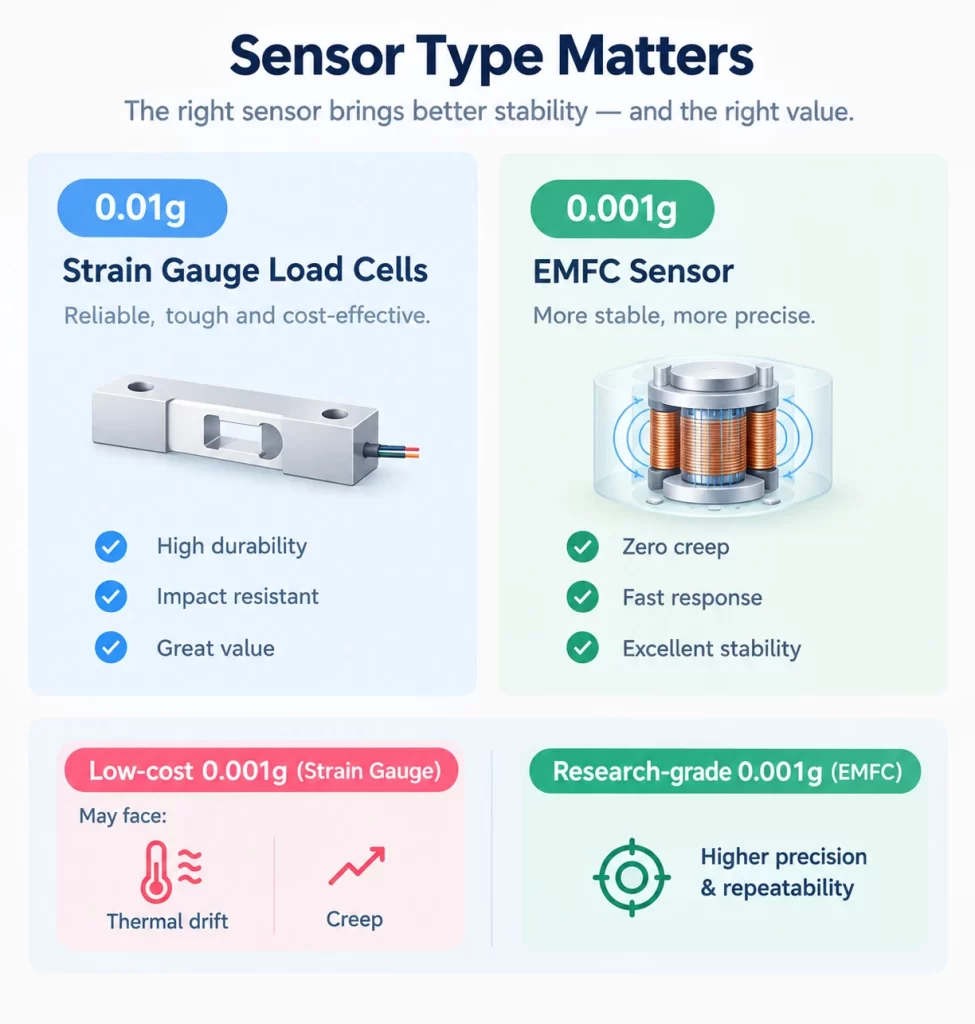
Not all precision balances are engineered alike under the chassis. The sensor technology inside the unit governs long-term calibration stability and cost.
- Strain Gauge Load Cells: Best for 0.01g balances and routine 0.001g tasks. They offer high mechanical robustness, strong impact resistance, and an accessible price point.
- Electromagnetic Force Compensation (EMFC): Best for research-grade, critical 0.001g milligram tasks. They provide zero mechanical creep, rapid response, outstanding thermal stability, and superior repeatability.
Strain Gauge Load Cells in 0.01g Instruments
For 0.01g applications, high-precision strain gauge sensors provide exceptional cost-to-performance. Modern strain gauge technology handles industrial handling, offers strong shock absorption against accidental pan strikes, and holds external calibration well within 0.01g limits. For standard manufacturing and teaching facilities, it remains the most economical, durable design.
The Pitfall of Low-Cost 0.001g Balances
Engineering a strain gauge to read down to single milligrams requires pushing physical metal foil and adhesives to their limits. In low-cost 0.001g balances, this frequently results in:
- Thermal Drift: Ambient laboratory temperature changes of just 2°C cause the display zero-point to wander.
- Creep: Leaving a mass on the pan for 60 seconds causes the final digit to tick upward or downward continuously
If your documentation demands strict repeatability (standard deviation <= 0.001 g), ensure your 0.001g instrument utilizes an Electromagnetic Force Compensation (EMFC) sensor. EMFC mechanisms use electromagnetic coils suspended in a permanent magnetic field rather than bending metal. This architecture eliminates mechanical fatigue and thermal drift, explaining why research-grade 0.001g EMFC units sit at a higher price tier than entry-level strain gauge models.
6. Real-World Applications: When to Choose 0.01g vs. 0.001g by Industry
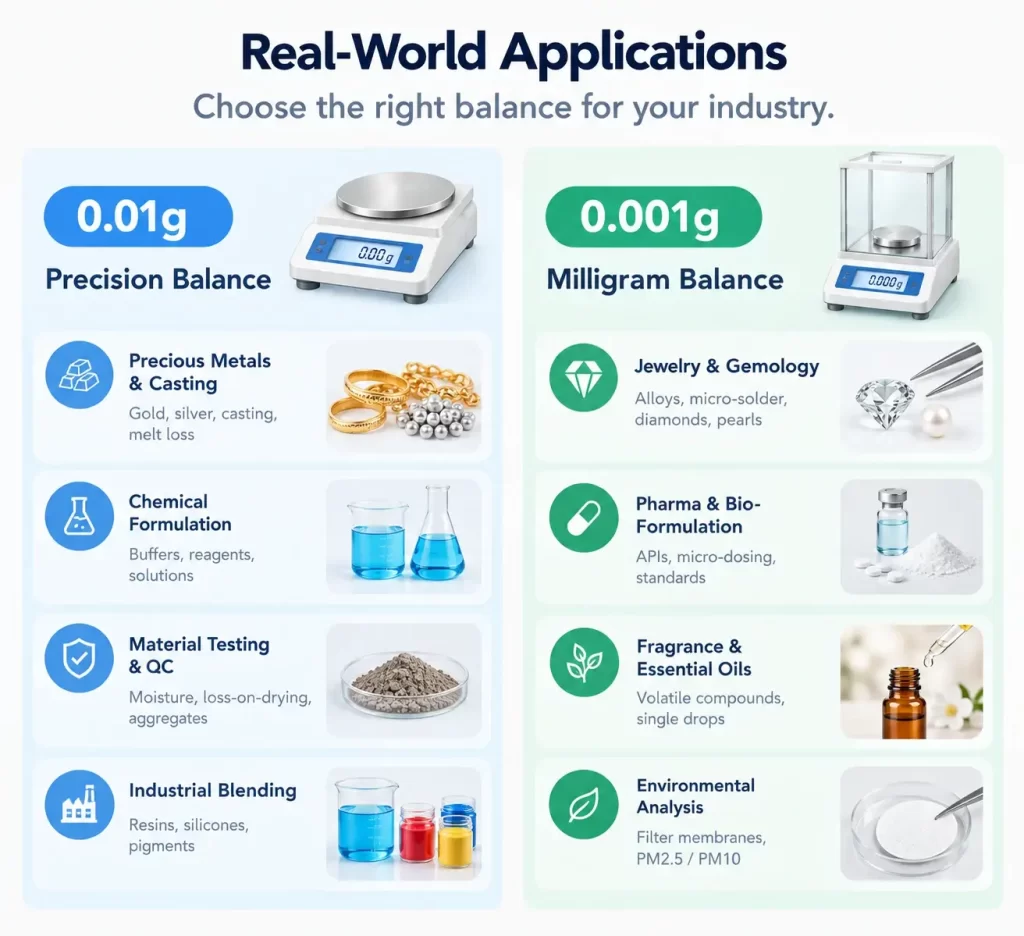
Selecting the correct model is easier when mapped to established industry practices.
Choose a 0.01g Precision Balance For:
- Precious Metal Scrap & Casting: Weighing gold scrap, pouring silver shot, casting jewelry trees, and tracking melt losses where items weigh between 50g and 2,000g.
- Bulk Chemical Formulation: Compounding standard lab buffers, preparing agricultural nutrient solutions, and blending reagents in 1L to 5L volumes.
- Material Testing & QC: Performing ASTM moisture-determination steps, loss-on-drying tests, and weighing asphalt, aggregates, or soil samples.
- Industrial Blending: Measuring liquid resins, silicone bases, polyurethane molds, and pigments where broad vessel clearance is needed.
Choose a 0.001g Milligram Balance For:
- Jewelry Benchwork & Gemology: Precision alloying with master alloys, cutting micro-soldering pallions, weighing rough diamonds, and sorting high-value pearls.
- Specialty Pharmaceutical & Bio-Formulation: Preparing clinical trial active pharmaceutical ingredients (APIs), micro-dosing compounding powders, and handling analytical standards.
- Fragrance & Essential Oil Formulation: Dropping volatile aromatic compounds and concentrated essential oils where a single drop changes an olfactory profile.
- Environmental Filtration Analysis: Weighing 47mm air monitoring filter membranes to quantify trace particulate matter (PM2.5 / PM10) capture.
7. Decision Checklist: Should You Buy a 0.01g or 0.001g Precision Balance?
Review these four practical checkpoints before finalizing your specification:
- What is your minimum sample mass?
- Under 1g: Select 0.001g.
- bove 5g–10g: Select 0.01g.
- What is the total tare weight of your heaviest container?
- Above 300g: Select a high-capacity 0.01g balance.
- Under 100g (or using small weigh boats): A 0.001g balance will provide sufficient overhead.
- What are your environmental and throughput conditions?
- Fast-paced bench, open air, frequent additions: Select 0.01g.
- Stable room, minimal drafts, low-volume analytical runs: Select 0.001g.
- What level of measurement tolerance must you satisfy?
- Strict regulatory reporting with tight tolerance bands (±0.005 g or tighter): Select an EMFC-equipped 0.001g balance.
- General commercial formulation and internal process control: A strain gauge 0.01g balance is the practical, cost-effective tool.
Ready to Configure Your Workbench?
Shop 0.01g Precision Balances — High-capacity, open-pan productivity for general weighing and bulk formulation.
Shop 0.001g Milligram Balances — Fine-accuracy weighing equipped with stable draft shields for critical precision.
The divide between 0.01g and 0.001g precision balances comes down to balancing raw resolution against physical capacity and daily workflow efficiency. A 0.01g top-loading balance delivers high throughput, heavy tare accommodation, and rugged usability across general laboratory, industrial, and workshop tasks. A 0.001g milligram balance provides the fine resolution required for micro-samples, critical compounding, and sensitive precious materials—provided you give it a draft-free environment.
If you are sourcing dependable weighing equipment for your business, facility, or distribution network, partner with Stuccler. As a dedicated precision balances manufacturer and supplier, Stuccler provides reliable strain gauge and electromagnetic precision balances engineered for repeatable accuracy. Beyond direct equipment sales, Stuccler supports growing brands and operations worldwide with flexible bulk wholesale and comprehensive private label OEM/ODM manufacturing services. Explore our precision product lines or contact our technical team today to secure the ideal configuration for your exact operational standards.