

Weighing hygroscopic substances on an analytical balance often triggers a frustrating drift, where readouts climb continuously as the sample rapidly absorbs ambient moisture. Unlike erratic electrostatic fluctuations, this linear weight gain compromises quantitative accuracy before you even begin. Mastering a few critical handling techniques and vessel choices will eliminate reading drift and ensure stable, reliable measurements every time.
I. Preparation of the Environment and Tools Before Weighing
Accurate micro-weighing begins well before opening a reagent container. Managing environmental factors and selecting proper containment materials are critical steps for isolating moisture-sensitive compounds.
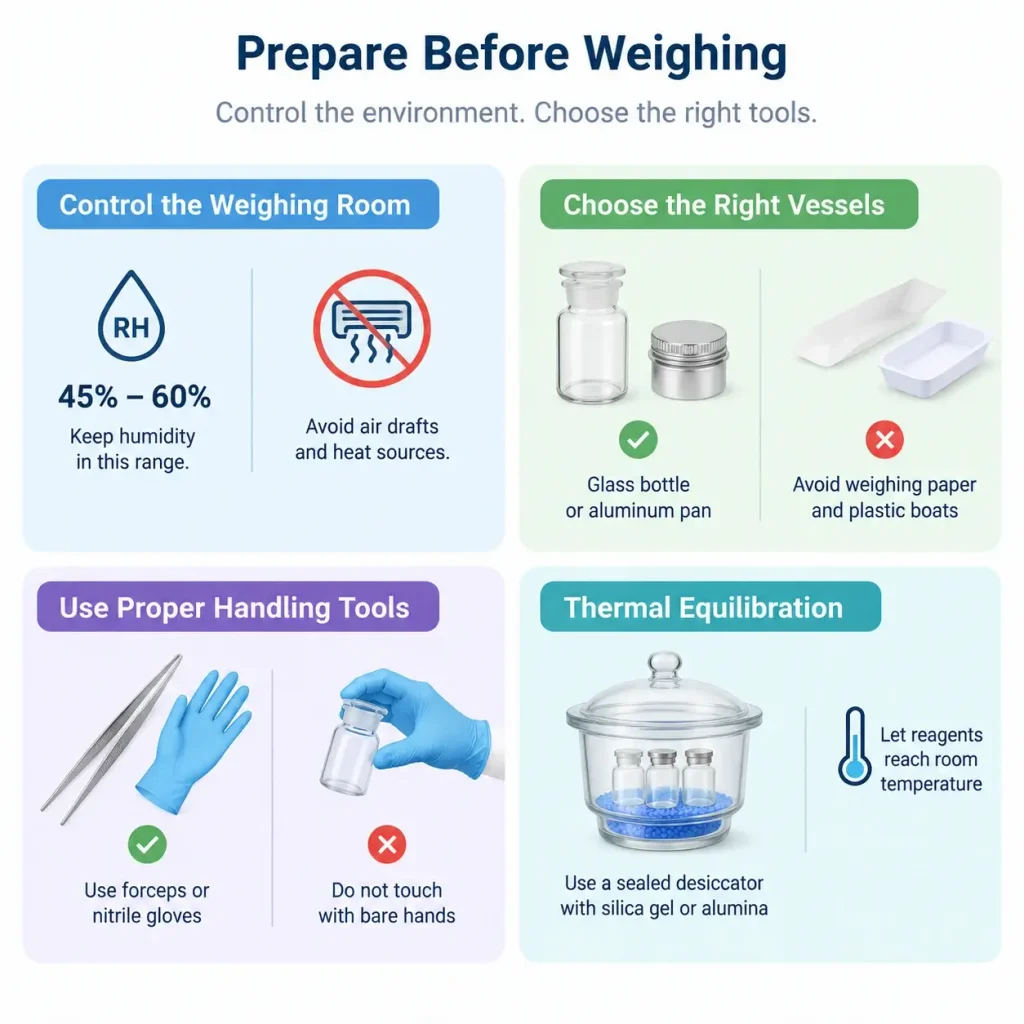
Environmental Control in the Weighing Room
- Maintain balanced humidity: Keep room relative humidity (RH) strictly between 45% and 60%. If ambient humidity drops below 40%, the air becomes excessively dry, dramatically increasing static electricity charges on glassware and balance pans. Conversely, if humidity exceeds 65%, powder samples absorb moisture at accelerated rates.
- Eliminate air turbulence and thermal gradients: Position analytical balances away from heating and air conditioning vents, laminar flow hoods, and direct sunlight. Air currents disrupt mechanical balance stability, while radiant heat creates localized convection currents inside the weighing chamber.
Selection of Weighing Vessels
- Recommended vessels: Always use cylindrical glass weighing bottles fitted with ground-glass stoppers, or lightweight micro-aluminum pans featuring airtight screw caps. Ground joints create a hermetic seal that traps internal air, isolating the dry compound from room humidity.
- Vessels to avoid: Never use open weighing paper or disposable polystyrene weighing boats. Weighing paper absorbs atmospheric moisture itself, while plastic boats generate high static charges during handling and offer zero barrier protection.
Auxiliary Handling Tools
- Forceps and gloves: Always handle weighing vessels using non-magnetic stainless steel forceps, laboratory tongs, or lint-free nitrile gloves. Never handle weighing bottles with bare fingers; skin oils and body heat transfer directly to the glass, causing microgram-level deviations and convective thermal draft inside the draft shield.
- Thermal equilibration: Ensure vessels and reagents have fully equilibrated to ambient room temperature inside a sealed desiccator charged with active silica gel or activated alumina before transferring them to the balance.
II. Standard Operating Procedure: Weighing by Difference
Direct addition (adding powder incrementally onto a tared vessel sitting on the balance pan) fails when handling hygroscopic substances because the container remains open to the air throughout the process.
The industry gold standard is the weighing-by-difference method. This technique relies on taking high-precision readings only when the sample is securely sealed inside a closed vessel. Any water absorbed during the brief pouring stage enters the destination flask rather than altering your initial dry mass reference.
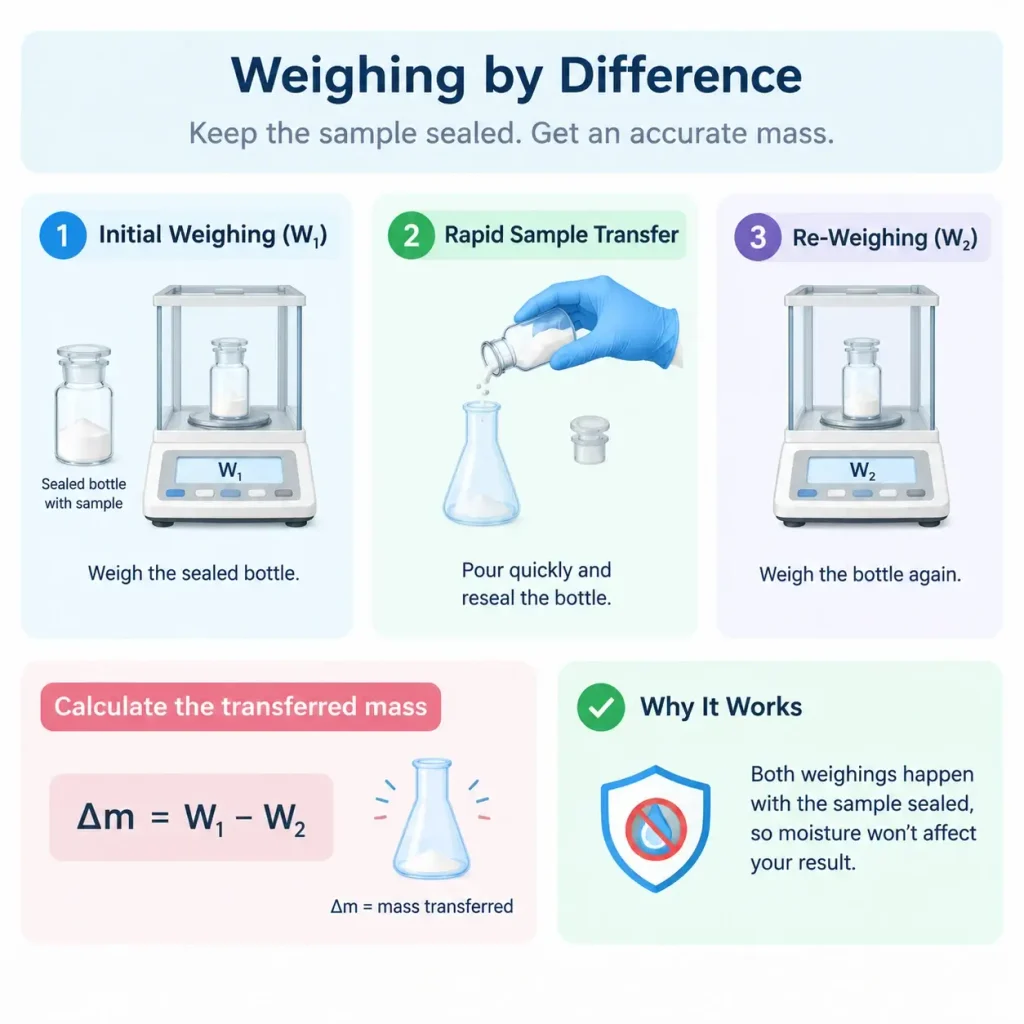
Step 1: Initial Weighing (W1)
Transfer your dried sample into a glass weighing bottle inside a dry preparation area, and seat the ground-glass stopper firmly. Slide open the analytical balance draft shield, center the sealed weighing bottle on the weighing pan, and close the draft shield completely. Allow the balance mechanism to stabilize. Once the stability symbol illuminates, record this initial total mass as W1.
Step 2: Rapid Sample Transfer
Carefully remove the sealed bottle from the balance chamber using forceps. Hold the bottle at a slight angle over your receiving vessel (such as a volumetric flask or beaker). Gently tap the rim of the weighing bottle with its stopper to dispense the estimated amount of powder. Immediately replace and twist the stopper back into place. The entire dispensing action should take no longer than 3 to 5 seconds.
Step 3: Re-Weighing and Calculation (W2)
Return the resealed weighing bottle to the center of the analytical balance pan, close the draft shield, and let the reading settle. Record the remaining mass as W2.
Calculate the exact mass (Δm) transferred to your receiving vessel using the formula:
Δm = W₁ – W₂
Why This Method Succeeds
Because W1 and W2 are both measured while the sample is hermetically sealed within the ground-glass bottle, ambient moisture never comes into contact with the powder during reading acquisition. Even if the transferred portion absorbs moisture inside the receiving flask, your quantified dry-basis mass (Δm) remains completely accurate.
III. Static Electricity Neutralization and Draft Shield Management
Electrostatic charges and air drafts compound the difficulty of weighing hygroscopic materials. Applying proper containment discipline keeps balance mechanics stable.
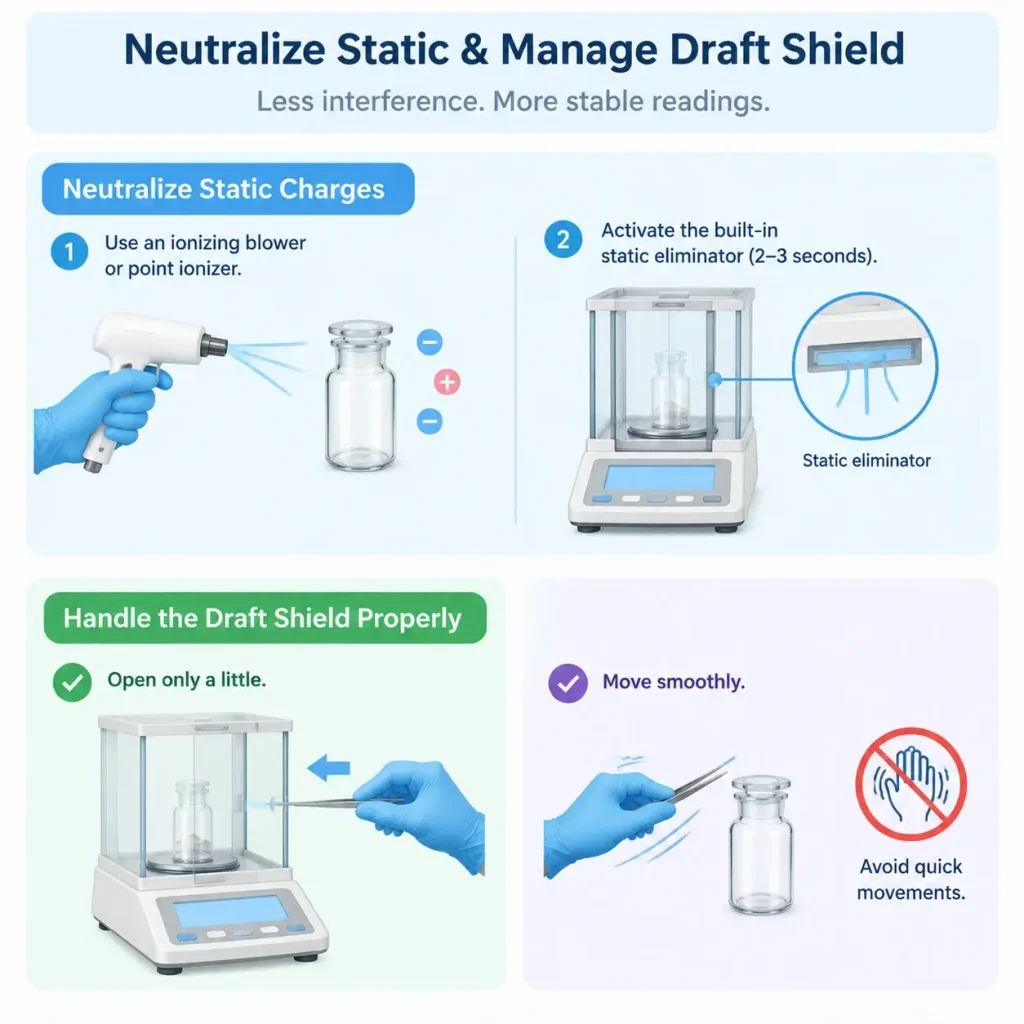
Neutralizing Static Charges
Dry, powdered compounds and borosilicate glassware accumulate significant frictional static charges during transport and handling. Static charges exert artificial attractive or repulsive forces on the balance pan, mimicking weight changes.
Before loading the weighing bottle onto the balance:
- Pass the closed vessel through an external ionizing blower or across a deionizing point ionizer.
- If your analytical balance features an integrated static eliminator (such as an embedded neutralization strip or high-frequency AC ionizer inside the draft shield), activate it for 2 to 3 seconds prior to recording values.
Proper Draft Shield Handling
- Minimize opening geometry: Never open the draft shield doors entirely. Slide open only the side door corresponding to your dominant hand, opening it just wide enough to pass your tweezers through. Keeping the draft shield largely closed preserves the internal microclimate and minimizes moisture ingress.
- Smooth movement: Move hands and instruments smoothly. Rapid hand motions create micro-vortices and pressure drops within the weighing enclosure, prolonging stabilization times.
IV. Alternative Approaches for Highly Hygroscopic or Deliquescent Materials
Certain chemical compounds—such as anhydrous aluminum chloride (AlCl₃), lithium halides, potassium hydroxide pellets, and phosphorus pentoxide—deliquesce within seconds of ambient exposure, liquefying as they pull water from air. Standard laboratory bench protocols are insufficient for these chemicals.
| Method | Target Sample Types | Core Operating Mechanism |
| Inert Gas Glove Box | Pyrophoric salts, lithium catalysts, anhydrous AlCl₃ | Weighing is performed entirely inside a sealed chamber purged with dry nitrogen or argon (moisture < 1 ppm). |
| Liquid Sealing Technique | Highly reactive non-aqueous solids, volatile hygroscopic salts | Sample is dispensed directly into a pre-weighed receiving vessel containing a non-reactive, non-volatile inert solvent. |
1. Glove Box Enclosures
When handling compounds that degrade or hydrolyze instantly in air, work must be conducted inside a glove box purged with high-purity nitrogen or argon gas where moisture levels remain below 1 ppm. In this workflow, an analytical balance or microbalance is permanently installed inside the glove box workstation on a heavy balance table to protect it from pump vibration.
2. The Liquid Sealing Method
If your analytical procedure allows dissolving the sample immediately, pre-fill your receiving vessel with a known volume of an inert, dry solvent (such as anhydrous toluene, hexane, or paraffin oil). Tare the solvent-filled vessel on the balance, then introduce the hygroscopic sample directly beneath the liquid surface. The solvent layer forms a physical barrier that prevents atmospheric moisture from reaching the solute.
V. Troubleshooting Common Operational Errors
Even experienced analysts can fall victim to common pitfalls that compromise mass determination on high-resolution balances.
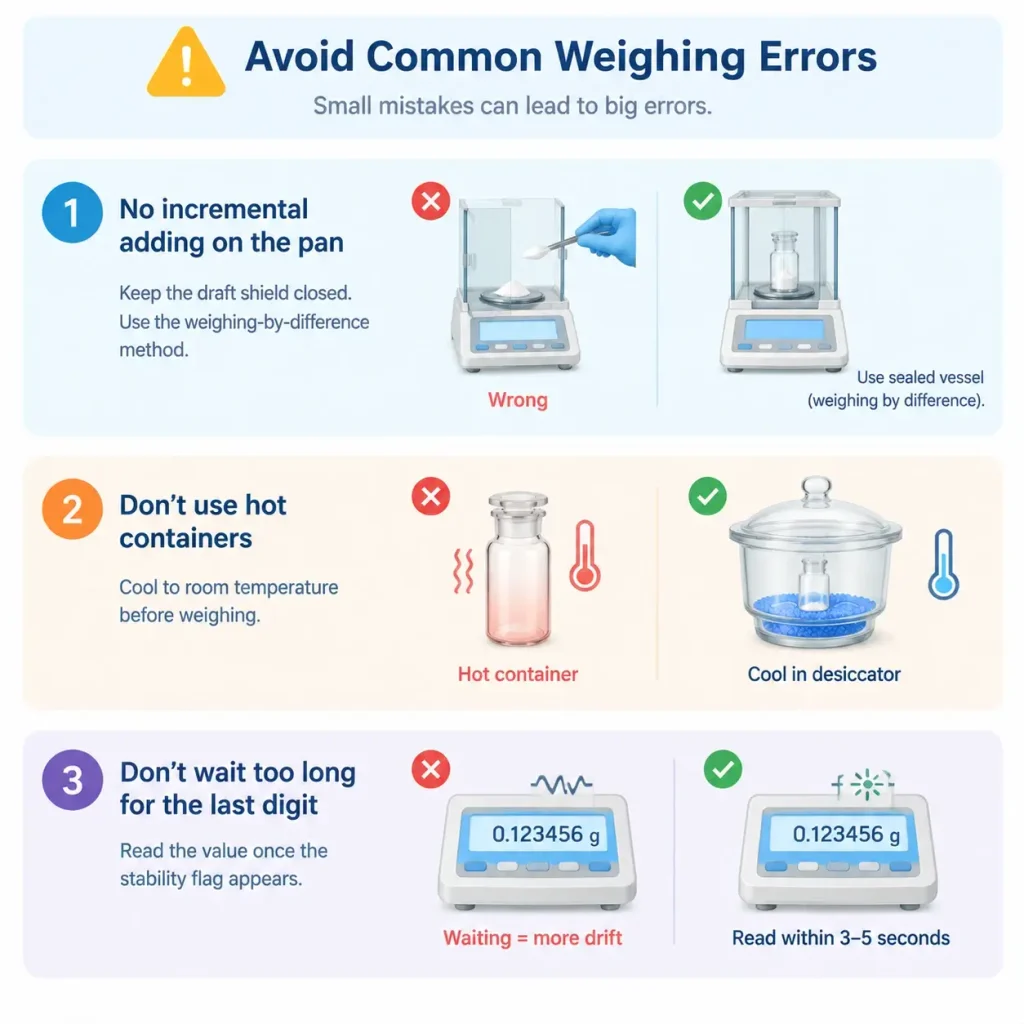
Error 1: Adding Powder Incrementally on the Active Balance Pan
Attempting to reach an exact target mass (e.g., exactly 100.0 mg) by keeping the draft shield open and adding micro-spatulas of powder directly onto the pan guarantees failure. The prolonged exposure causes the powder to absorb water continuously during manipulation. Always aim for a target range rather than an exact figure, using the sealed weighing-by-difference procedure.
Error 2: Ignoring Container Surface Temperature
Transferring a glass weighing bottle directly from a drying oven (105°C) to an analytical balance will cause severe measurement errors. A hot container heats the adjacent air inside the draft shield, producing upward convective thermal currents that push the pan upward, making the vessel appear lighter than it is. Additionally, temperature differentials alter the air buoyancy around the glass. Always cool dry vessels to ambient room temperature inside a desiccator before placing them on the pan.
Error 3: Waiting Excessively for the Final Decimal Place to Freeze
Analysts sometimes wait minutes hoping the final digit of an analytical balance will stop changing. When working with semi-micro or analytical balances (0.01 mg to 0.1 mg resolution), dynamic ambient variables mean minor fluctuations will always occur. Once the balance’s visual stability flag engages, read and log the value decisively within 3 to 5 seconds. Prolonging the observation period increases exposure risk and invites unnecessary measurement drift.
Achieve Reliable Weighing Results with Professional Instrumentation
Handling hygroscopic materials requires combining refined laboratory technique with responsive, stable weighing equipment. Minimizing draft chamber drift, utilizing built-in ionization tools, and maintaining sensor linearity ensure your analytical results satisfy rigorous quality frameworks.
Stuccler is a professional analytical balances manufacturer and supplier of high-precision laboratory weighing instruments, including semi-micro balances. Engineered with high-stability electromagnetic force restoration (EMFC) sensors, robust anti-static glass draft shields, and rapid stabilization algorithms, Stuccler analytical balances help modern testing laboratories reduce measurement error
We partner directly with laboratory distributors, research institutions, and industrial testing operations worldwide, providing:
- Bulk wholesale purchasing with consistent quality verification and direct factory pricing.
- Comprehensive OEM and private-label manufacturing customized to your market’s technical specifications and regulatory requirements.
- Complete calibration documentation and durable structural designs built for high-throughput testing environments.
Contact the Stuccler engineering and sales team today to discuss your technical specifications, request a competitive wholesale quotation, or explore custom OEM solutions tailored to your instrument catalog.