

A standard jewelry scale works fine for a 14K gold ring or a 1-carat center stone, yet freezes at 0.00 or fluctuates wildly the moment you weigh tiny melee diamonds (0.005ct–0.01ct). Your scale isn't broken—it has simply hit the physical and algorithmic limits of entry-level load cells. Here are the 10 engineering reasons why standard jewelry scales fail on micro-diamonds.
Wholesale Jewelry Balances & OEM Supply:
Sourcing high-precision carat scales for diamond parcel sorting desks, retail showrooms, or equipment distribution? As a dedicated manufacturer and supplier of precision jewelry balances, Stuccler offers EMFR milligram balances with private-label and bulk pricing. Explore the Stuccler SENSE-JD Series® Specifications →
1. Tiny Diamonds Weigh Less Than the Scale’s Minimum Threshold
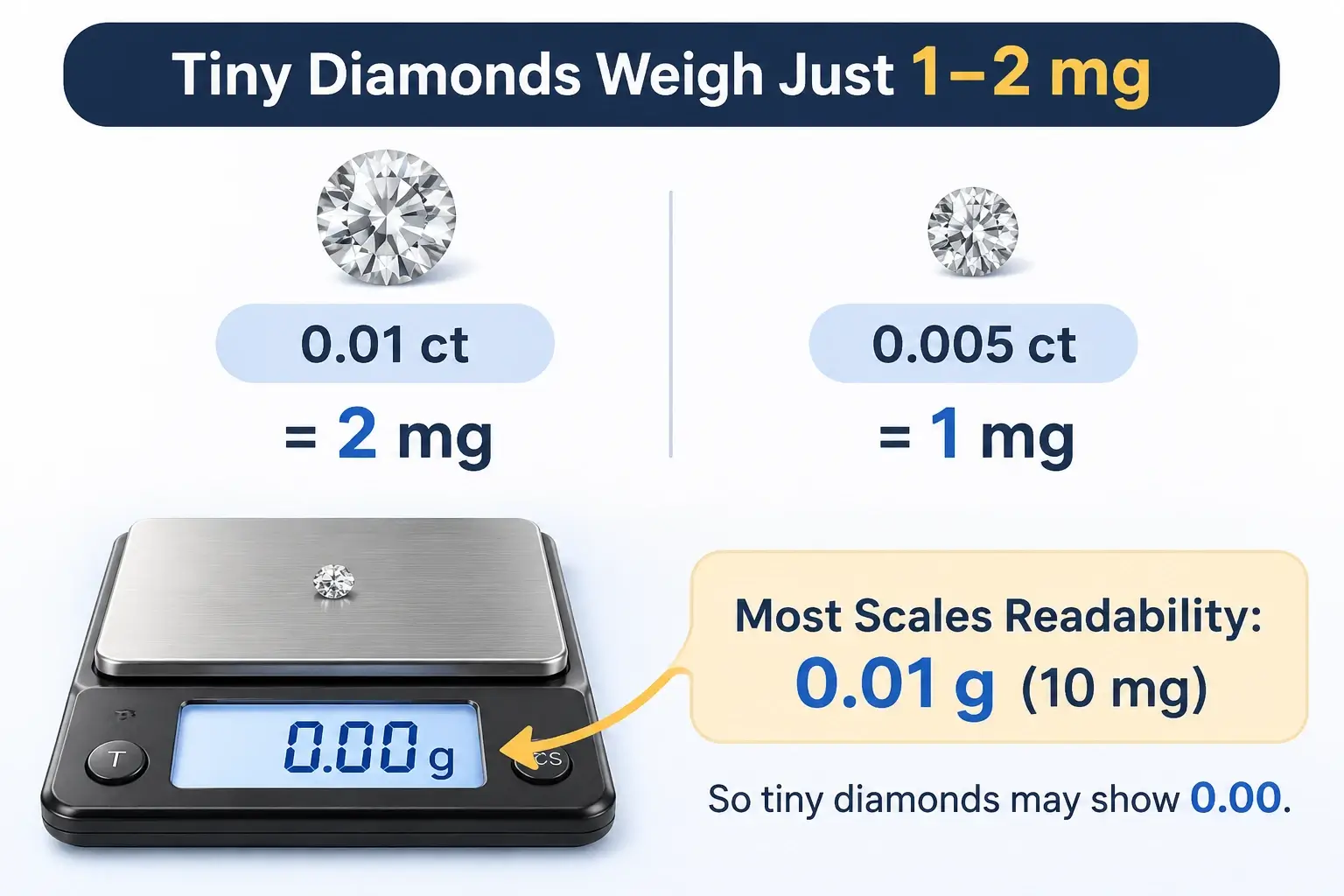
To understand why a scale fails to register a small stone, look at the basic mass conversion: 1 carat (ct) equals 200 milligrams (0.2g). When you break that down into the micro-sizes used in pavé settings and halo designs, the numbers become microscopic:
- A 0.01ct (1-point) diamond weighs 2 milligrams (2mg).
- A 0.005ct (half-point) melee diamond weighs just 1 milligram (1mg)—roughly the mass of a single grain of table salt or a human eyelash.
Most standard digital jewelry scales on the market offer a readability (display resolution) of 0.01g (10mg) or 0.01ct (2mg). Furthermore, in metrology, a scale’s minimum reliable weighing weight is typically 10 to 20 times its readability due to background noise. Because an individual melee diamond falls below the transducer's minimum detectable threshold, the internal sensor cannot register any meaningful change in downward force, leaving the screen stuck at 0.00.
2. Strain Gauge Sensors Lack Sensitivity at Milligram Levels
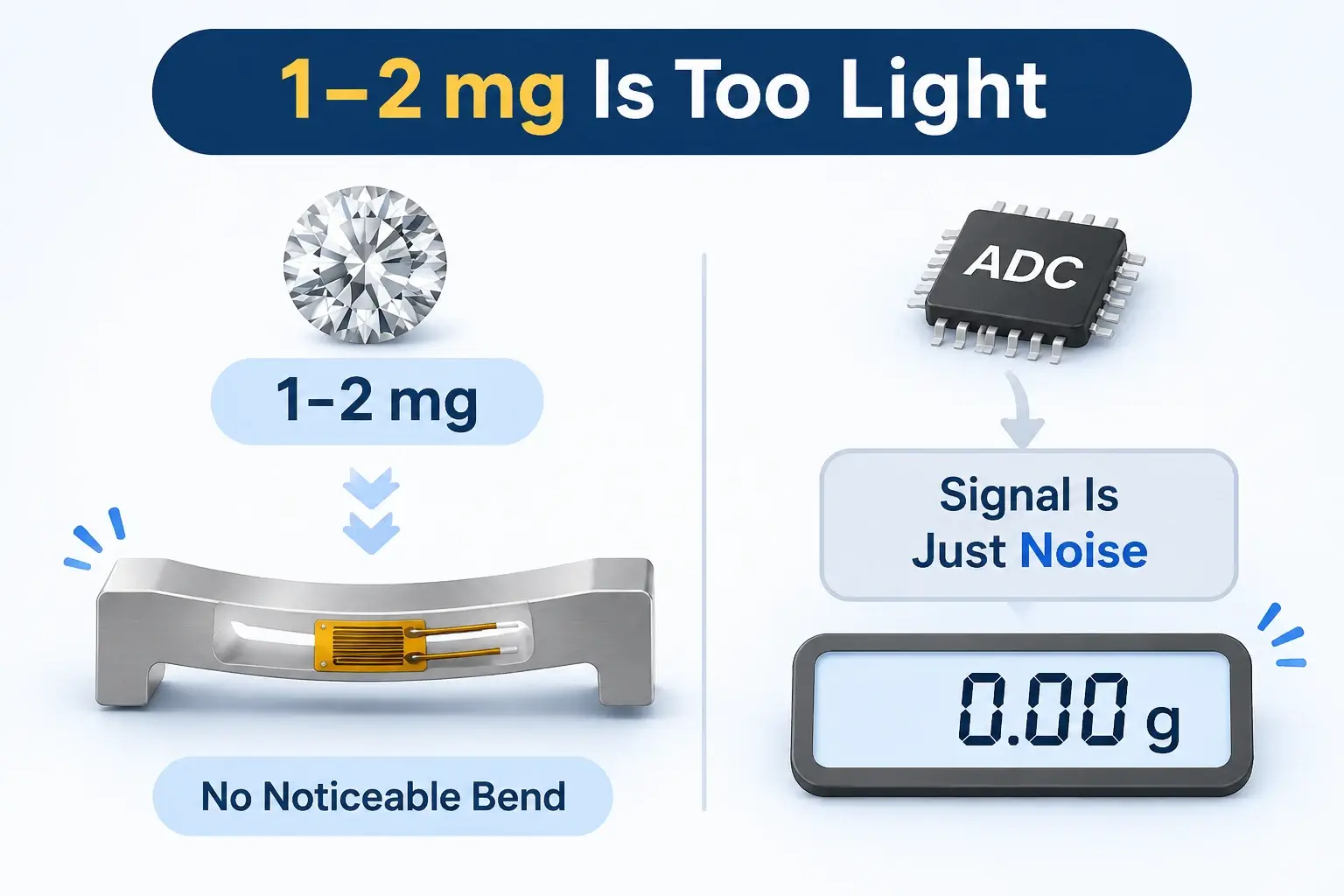
Standard pocket and portable jewelry scales rely on metal strain gauge load cells. These sensors operate by measuring the microscopic physical deformation (bending) of an aluminum or steel beam under weight. As the metal bends, a bonded foil grid stretches or compresses, altering its electrical resistance to generate a weight signal.
While strain gauges are durable and cost-effective for weighing gold chains or finished rings, they lack the mechanical sensitivity required for micro-weighing:
- The downward gravitational pull exerted by a 1mg to 2mg diamond is far too faint to cause measurable structural deflection in a standard metal load cell.
- Because the resulting change in electrical voltage is practically indistinguishable from baseline circuit fluctuations, the scale’s analog-to-digital converter (ADC) treats that minuscule signal as background electrical noise and filters it out entirely.
3. Auto-Zero Tracking Erroneously Discards Tiny Weights
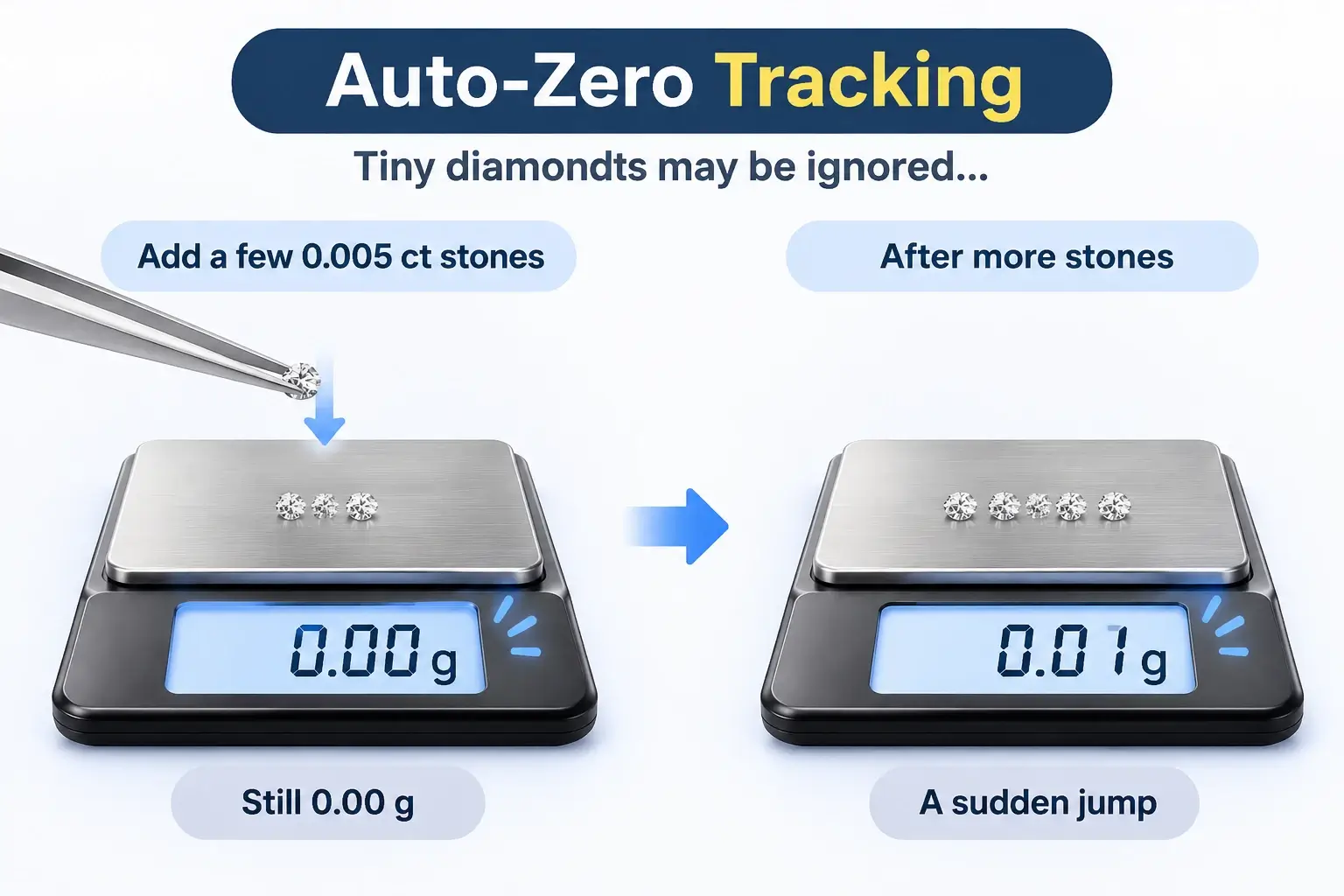
To prevent the digital readout from drifting upward or downward while the weighing pan sits empty, standard jewelry scales run a factory-programmed firmware routine called Auto-Zero Tracking (or zero-band tracking).
This algorithm assumes that any slow, microscopic change near zero is caused by environmental temperature shifts rather than an actual object being placed on the pan—so it automatically resets the display back to 0.00.
During melee diamond sorting, this feature actively works against you:
- When you drop individual 0.005ct stones onto the pan one by one with tweezers, each addition creates a tiny step-change that falls squarely inside the scale’s auto-zero window.
- Instead of accumulating the total carat weight, the microchip silently erases each diamond in the background. You might place three stones onto the pan and still see 0.00, followed by a sudden, inaccurate jump when the fourth stone finally exceeds the zero-tracking threshold.
4. Wide Weighing Capacities Compromise Low-End Resolution
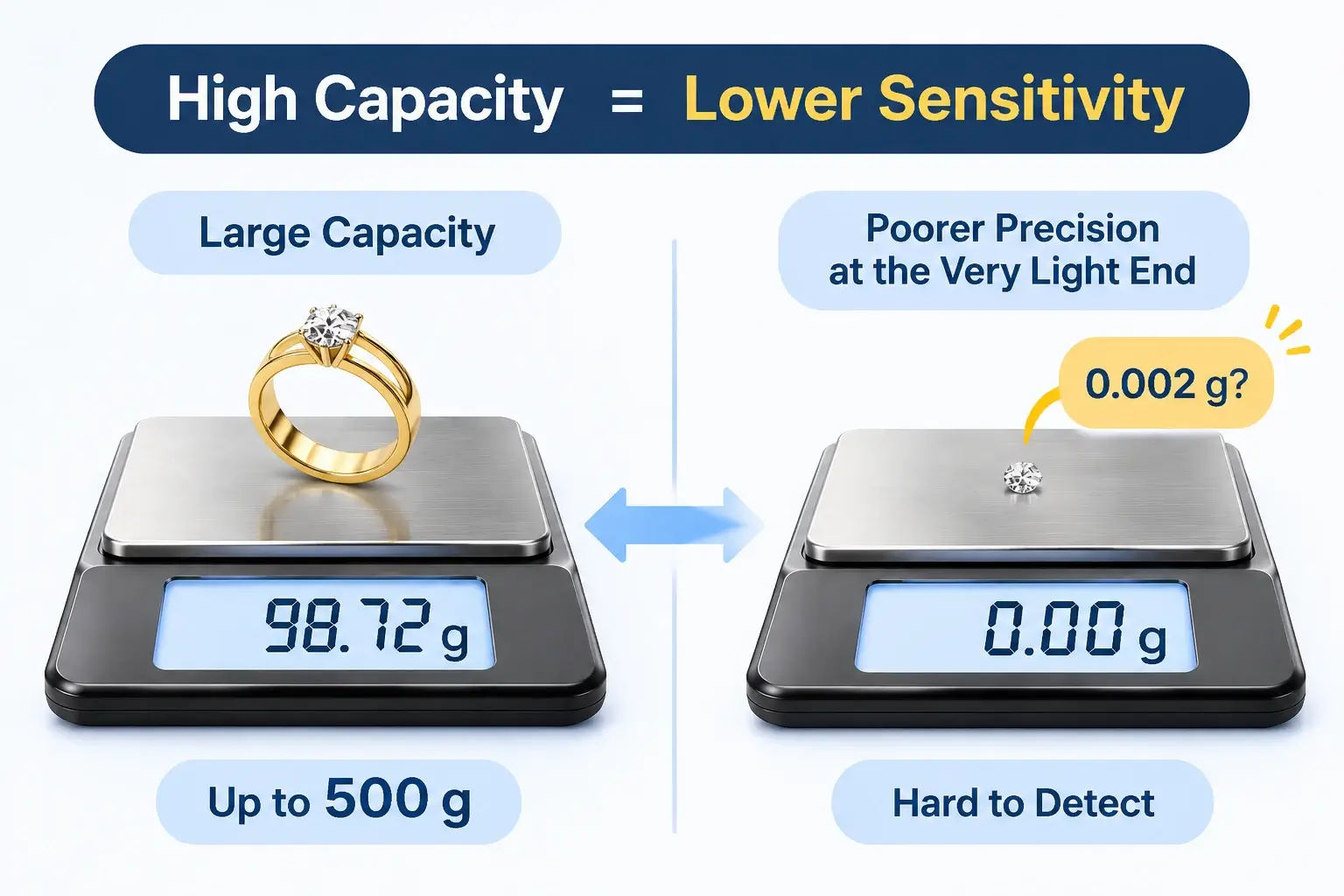
Many general-purpose jewelry scales are built with a maximum weighing capacity of 200g, 300g, or even 500g so bench jewelers can weigh heavy gold castings, scrap silver, and gemstone parcels on a single compact device.
In load cell engineering, there is an unavoidable trade-off between maximum capacity and low-end sensitivity:
- Supporting a 500g load without permanently bending the sensor requires a relatively thick, rigid elastic metal beam.
- That structural stiffness inherently sacrifices resolution at the extreme bottom end of the weighing spectrum (the 0.001g / 1mg tier).
- When you weigh tiny diamonds near zero on a high-capacity scale, non-linearity distortion is magnified—meaning a scale that is accurate to within ±0.02g at 100g can become completely unreliable when measuring 0.002g.
5. Open-Pan Designs Expose Tiny Diamonds to Air Currents

The hinged plastic lids found on standard portable scales serve purely as protective travel covers; they must be flipped completely open during operation. Without a sealed weighing chamber, the pan is directly exposed to ambient room air dynamics.
At the 1-milligram level, air is no longer invisible—it behaves like a physical weight pressing down on the sensor:
- A gentle draft from an overhead HVAC vent, a colleague walking past your sorting desk, or even the exhalation of your own breath while leaning over the scale exerts more downward air pressure on the pan than a 0.005ct diamond itself.
- Because an open-pan jewelry scale has no physical barrier to block these micro-currents, air turbulence continuously pushes and pulls on the pan, causing the carat digits to bounce endlessly and preventing the stability indicator from ever locking in.
6. Off-Center Loading Distorts Micro-Weight Readings
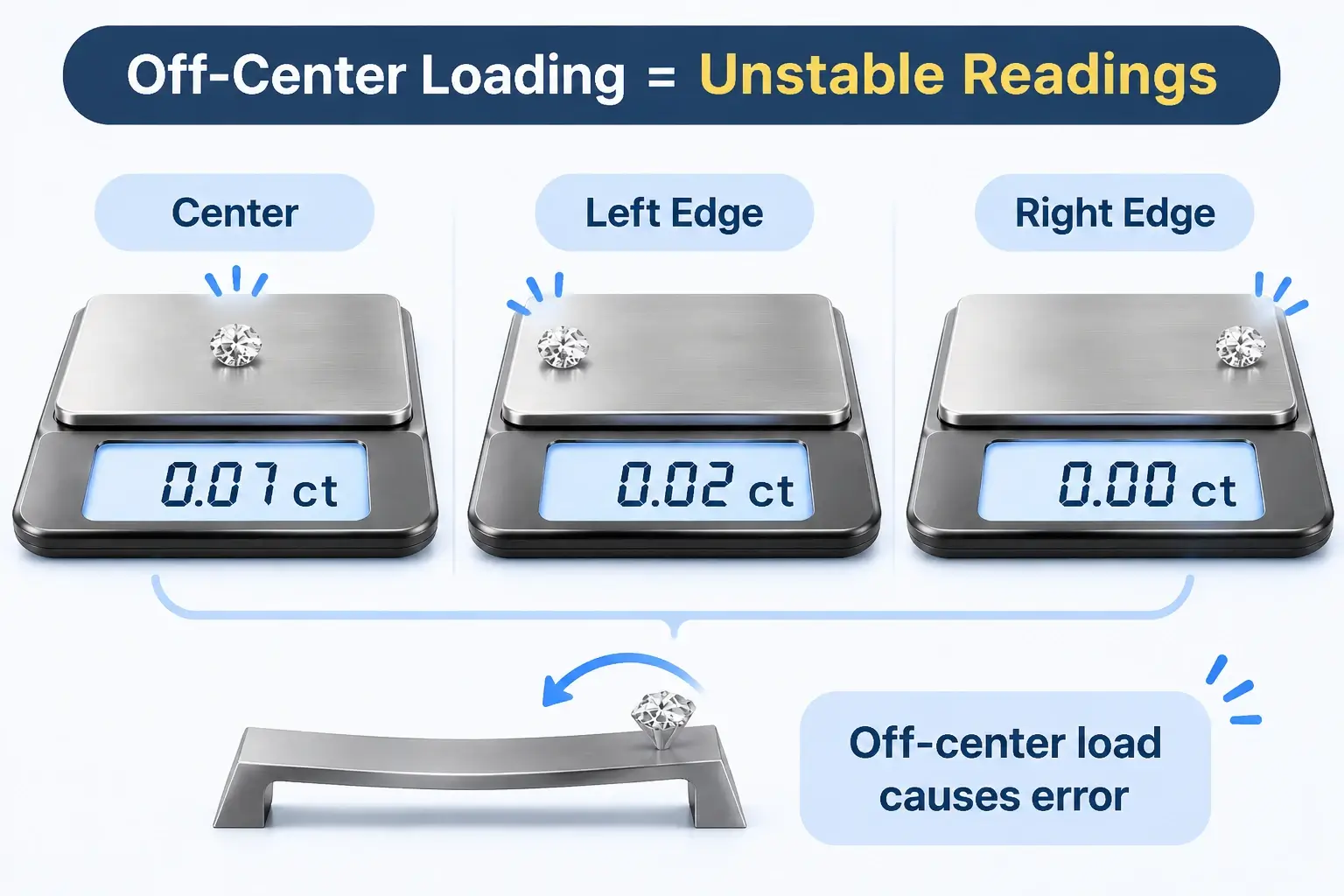
Because melee diamonds measure less than 1.3mm in diameter, placing each stone precisely at the exact geometric center of the weighing pan using tweezers is virtually impossible during high-speed sorting or parcel verification.
Standard jewelry scales typically utilize inexpensive single-point sensors that lack precision corner-load (eccentric load) compensation:
- When a tiny diamond lands just a few millimeters off-center toward the rim of the pan, it creates a slight twisting force (mechanical torque) on the load cell rather than pure vertical compression.
- On a budget sensor, this off-center torque distorts the electrical output—causing the exact same stone to read 0.01ct in the center, 0.02ct on the left edge, or drop back to 0.00 on the right edge.
7. Static Electricity Creates False Pulling Forces
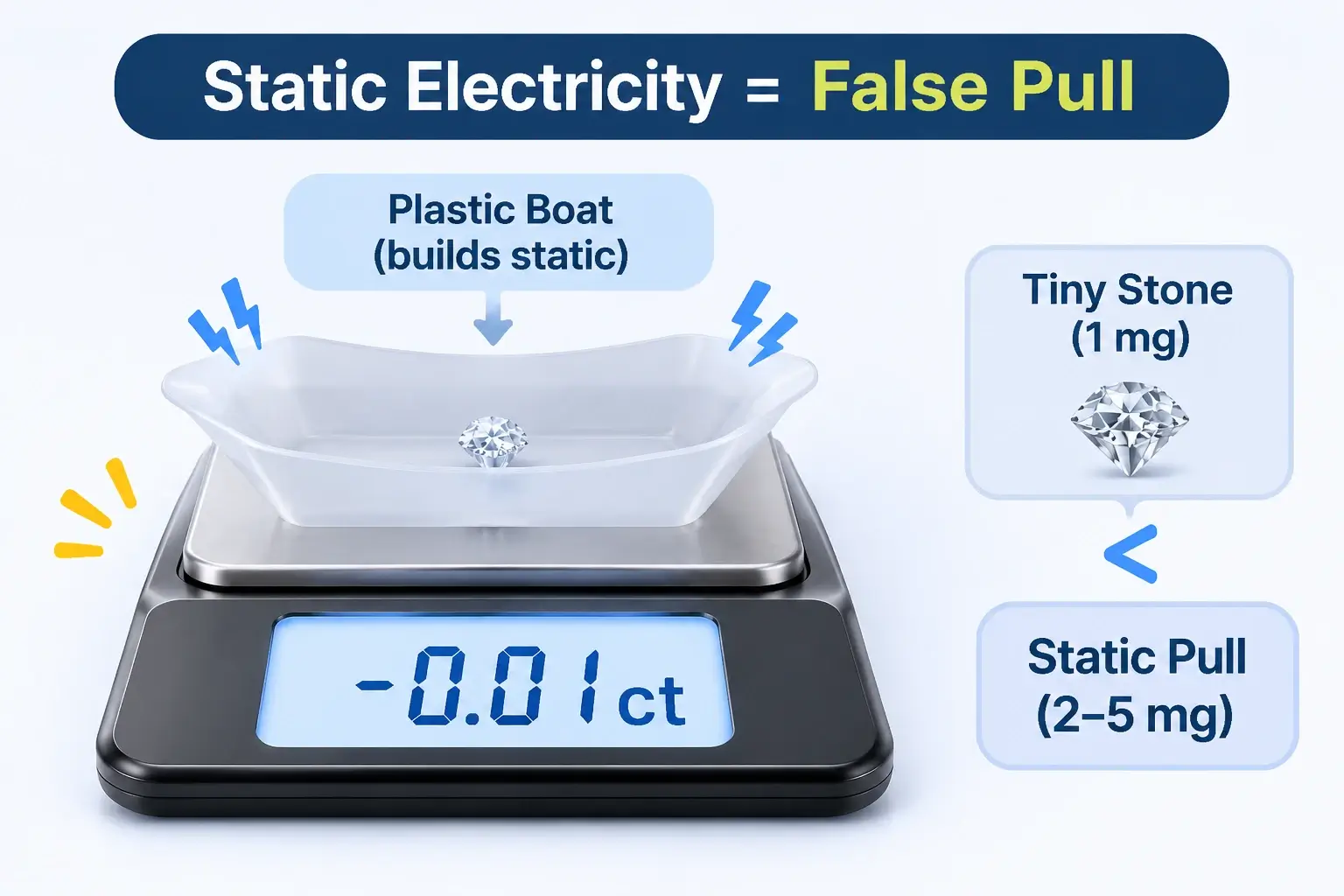
Diamonds are natural electrical insulators that readily accumulate electrostatic charges through friction—especially when handled with metal tweezers, poured from parcel papers, or sorted in dry, air-conditioned showrooms and workshops. To keep tiny stones from rolling away, jewelers frequently pair standard scales with plastic weighing boats or coated pans.
Combining static-prone diamonds with plastic accessories introduces an invisible force that competes directly with gravity:
- Static charge builds up between the plastic weighing boat and the scale’s ABS plastic housing, generating weak electrostatic attraction or repulsion.
- Even if that electrostatic pull equals only 2mg to 5mg, it is enough to overpower the 1mg mass of a 0.005ct diamond—causing the scale to display negative numbers (-0.01ct), freeze mid-measurement, or drift continuously upward without any stones being added.
8. Mechanical Hysteresis Traps Milligram-Level Signals
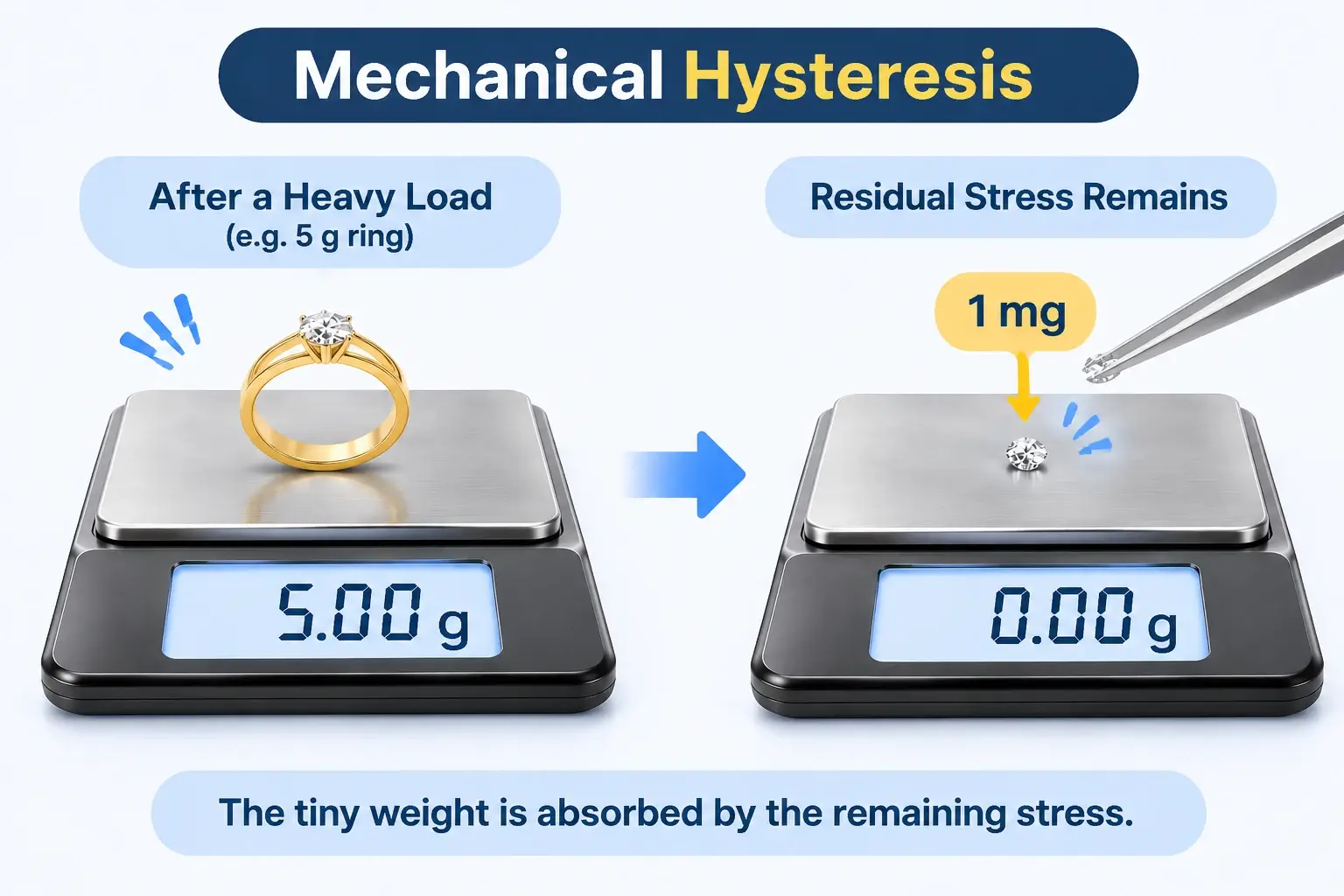
The metal strain gauges inside entry-level scales retain microscopic physical deformation after bearing heavier loads—a material property known in weighing mechanics as mechanical hysteresis (or "metal memory").
In a busy jewelry workshop where one scale handles multiple tasks, hysteresis creates hidden accuracy blind spots:
- Suppose you weigh a 5-gram 14K gold ring or a heavy diamond parcel, remove it, and immediately place a single 1-milligram melee diamond onto the pan.
- The metal beam inside the strain gauge has not yet fully relaxed back to its original microscopic resting state. The faint downward force of the 1mg diamond gets absorbed by that residual mechanical stress, leaving no measurable deflection for the sensor to report.
9. Heavy Digital Filtering Masks Incremental Additions
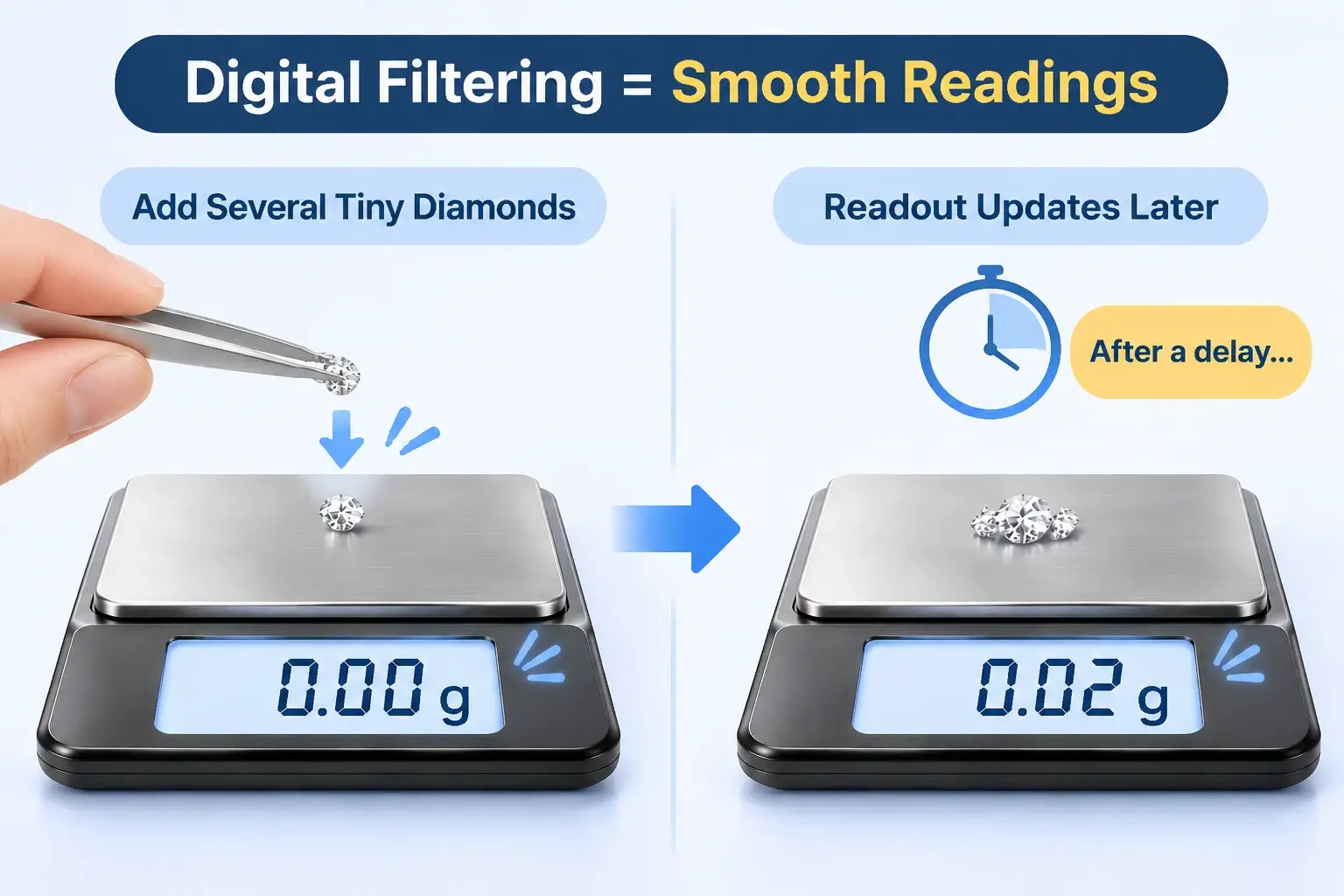
Because low-cost jewelry scales are frequently used on unstable wooden desks, vibrating polishing benches, or glass display counters, manufacturers program aggressive digital damping filters into the firmware to make the display look steady to the naked eye.
While heavy filtering hides desk vibrations, it destroys responsiveness during micro-weighing:
- The algorithm averages out rapid, minute weight changes over a longer time window so the user sees a calm, unchanging number.
- When you add tiny diamonds sequentially to the pan, this damping filter smooths right over the incremental steps. You can often drop three or four 0.005ct diamonds onto the pan before the display registers any change at all—and when it finally updates, the cumulative total often misses the true weight.
10. Lack of Thermal Compensation Causes Zero-Point Drift
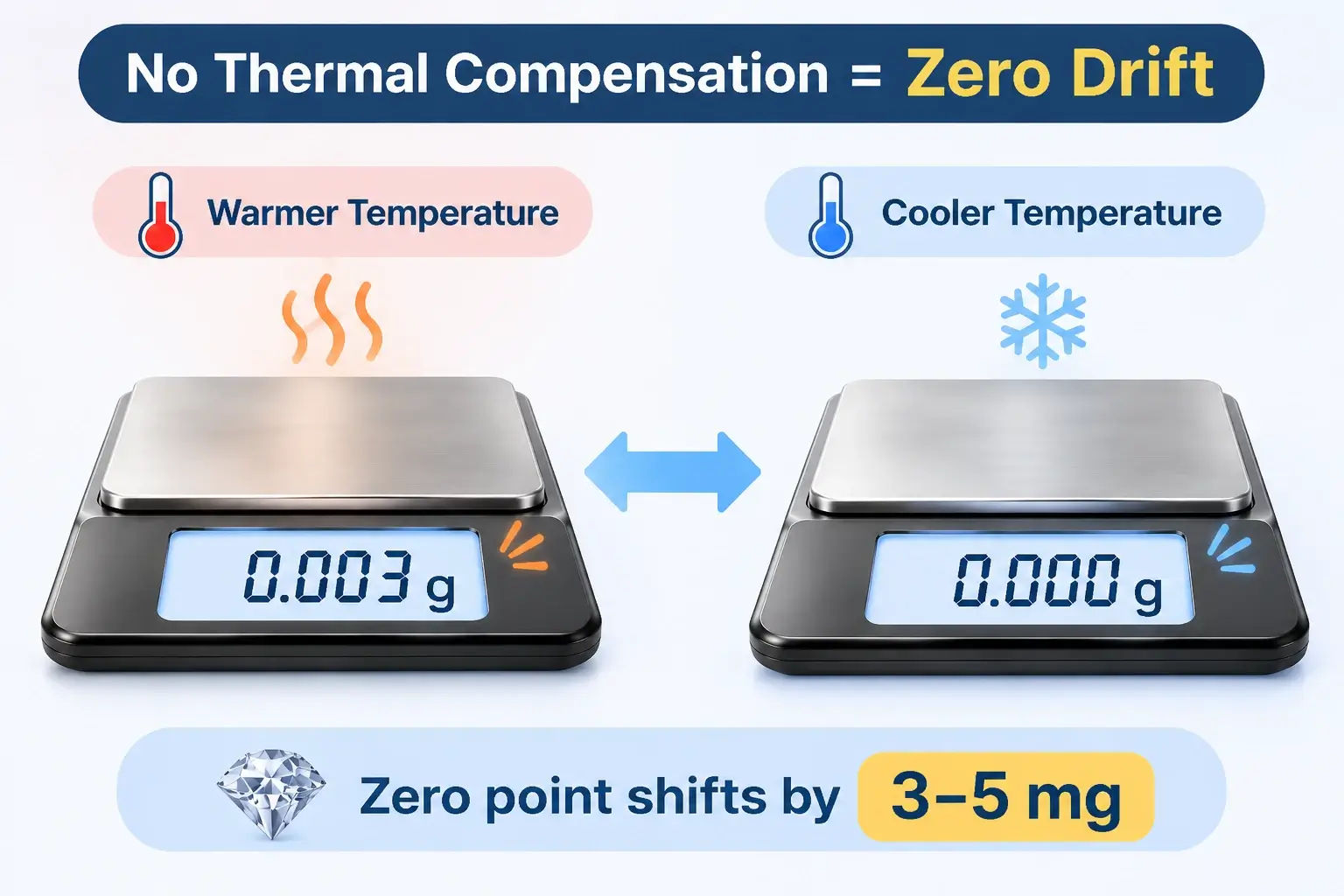
Precision weighing electronics are highly sensitive to even minor fluctuations in temperature. To keep retail prices low, standard portable jewelry scales omit internal temperature sensors and active thermal compensation circuitry.
As a result, temperature shifts directly corrupt your baseline zero point:
- As the scale remains powered on, internal circuit boards generate heat while ambient room temperatures fluctuate throughout the workday.
- This causes the metal strain gauge and analog electronics to expand or contract slightly, shifting the sensor’s zero-point baseline by several milligrams.
- While a 3mg to 5mg drift is completely negligible when weighing a 50-gram gold bar, it exceeds the entire mass of a 1mg melee diamond—making reliable micro-weighing impossible without constant manual re-zeroing.
Upgrading to Reliable Melee Diamond Weighing
The failure of standard jewelry scales on tiny melee diamonds is not a random defect—it is the inevitable physical result of combining metal strain-gauge load cells, auto-zero firmware, and open-pan housings at milligram-level loads.
If your studio, diamond parcel sorting desk, or wholesale operation handles melee diamonds on a daily basis, upgrading to a laboratory-grade precision balance is the only permanent solution. Equipment engineered with Electromagnetic Force Restoration (EMFR) sensors, a fully enclosed glass draft shield, and an anti-static metal weighing pan—such as the Stuccler SENSE-JD Series®—eliminates micro-weight blind spots, stabilizes readings within seconds, and protects your profit margins on every single parcel.
Explore the Stuccler SENSE-JD Series® Specifications →
Partner with a Direct Jewelry Balance Manufacturer
Stuccler is a dedicated manufacturer and supplier of precision jewelry balances, offering private labeling, OEM/ODM customization, and large-scale wholesale supply for global distributors and jewelry equipment dealers.
Request Wholesale Pricing & OEM Details →