

When buying precision top-loading scales, the most expensive sensor technology isn't always the smartest investment. While both strain gauge and electromagnetic force compensation (EMFC) balances have their place, choosing a strain gauge scale in the seven scenarios below delivers reliable accuracy while significantly reducing upfront and maintenance costs.
Top-Loading Balances — Wholesale & Lab Procurement Supply:
Sourcing rugged strain gauge scales or high-precision EMFC balances for laboratories and industrial facilities? As a dedicated manufacturer and supplier of top-loading scales, Stuccler offers factory-direct volume pricing and detailed technical datasheets. Explore our top-loading balance range →
Strain Gauge vs. EMFC Top Loading Scales: Quick Comparison
Before diving into specific application workflows, it helps to evaluate how these two sensor architectures differ at the hardware level. The table below summarizes the core mechanical, operational, and financial trade-offs so procurement teams can benchmark both technologies in seconds.
| Evaluation Factor | Strain Gauge Top-Loading Scales | EMFC Top-Loading Balances |
|---|---|---|
| Core Mechanism | Metal foil strain gauge measuring changes in electrical resistance under load | Electromagnetic coil generating magnetic force to counterbalance the load |
| Typical Readability | 0.01g to 1g | 0.001g (1mg) to 0.01g |
| Capacity Range | Medium to High (e.g., 1kg – 30kg+) | Low to Medium (e.g., 100g – 6kg) |
| Environmental Tolerance | High resistance to vibration, dust, and minor shocks | Highly sensitive to air currents, vibration, and temperature fluctuations |
| Warm-Up & Portability | Minimal warm-up time; low power consumption (battery-friendly) | Requires 30–60 minutes of warm-up; continuous AC power required |
| Purchase & Maintenance Cost | Budget-friendly initial cost; simple and inexpensive to service | 2x to 5x higher initial price; complex internal calibration and repairs |
7 Key Scenarios for Choosing a Strain Gauge Top-Loading Scale
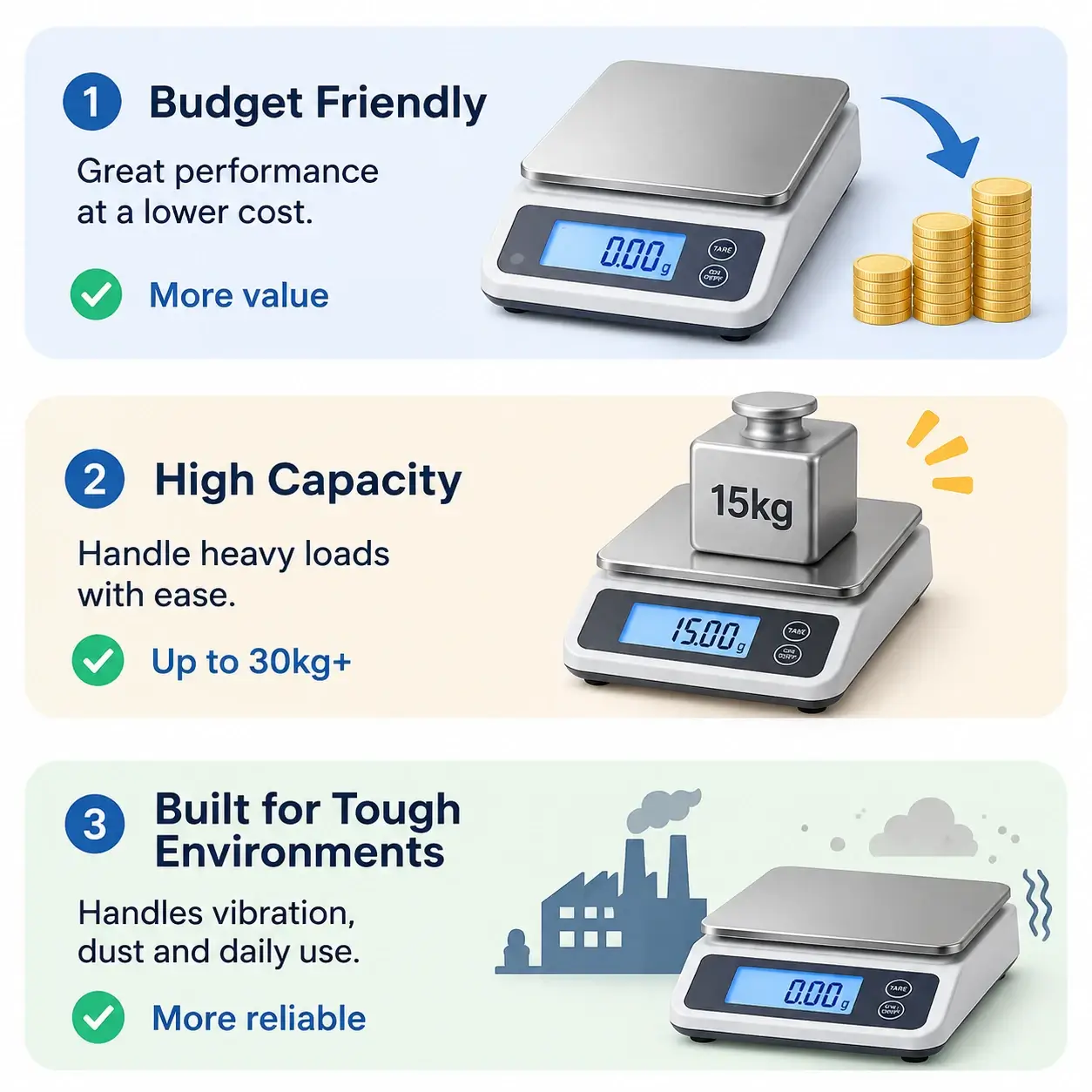
1. You Are Working Within a Tight Procurement Budget
When your application calls for 0.01g or 0.1g readability, strain gauge sensor technology offers mature, repeatable performance at a fraction of the price of an EMFC system. EMFC balances rely on precision-machined monoblock force-transmission levers and rare-earth magnetic assemblies, which drive up manufacturing costs.
For university teaching laboratories, vocational training centers, or quality control departments outfitting multiple workstations, specifying strain gauge scales prevents unnecessary over-engineering. You avoid paying a steep premium for microgram-level sensitivity your technicians will never use, freeing up capital for multi-unit bulk procurement.
2. Your Application Requires High Weighing Capacities
Many industrial and laboratory workflows require weighing heavy loads—such as 3kg, 6kg, 15kg, or even 30kg—while maintaining a practical resolution of 0.01g or 0.1g. The solid elastic body of a strain gauge load cell handles heavy static loads with exceptional structural stability, whereas high-capacity EMFC balances become exponentially more expensive and mechanically complex as maximum capacity increases.
Common high-capacity applications where strain gauge top-loading scales excel include:
- Batching chemical raw materials directly in heavy-walled containers
- Counting metal fasteners, injection-molded parts, or hardware components in bulk
- Verifying the gross weight of large-volume samples prior to packaging or shipping
3. The Scale Operates in Harsh or Uncontrolled Environments
Precision balances rarely live in idealized, climate-controlled metrology rooms. If your scale sits on an active production floor, beside a packaging line, inside a warehouse, or on a jewelry-processing workbench, it will inevitably encounter ambient machine vibrations, HVAC drafts, and airborne dust.
Because a strain gauge scale relies on a rugged, all-metal load cell rather than a delicate suspended electromagnetic coil, it tolerates environmental interference and accidental overload far better than an EMFC balance. Operators spend less time waiting for unstable digits to settle and experience fewer error codes caused by minor benchtop disturbances.
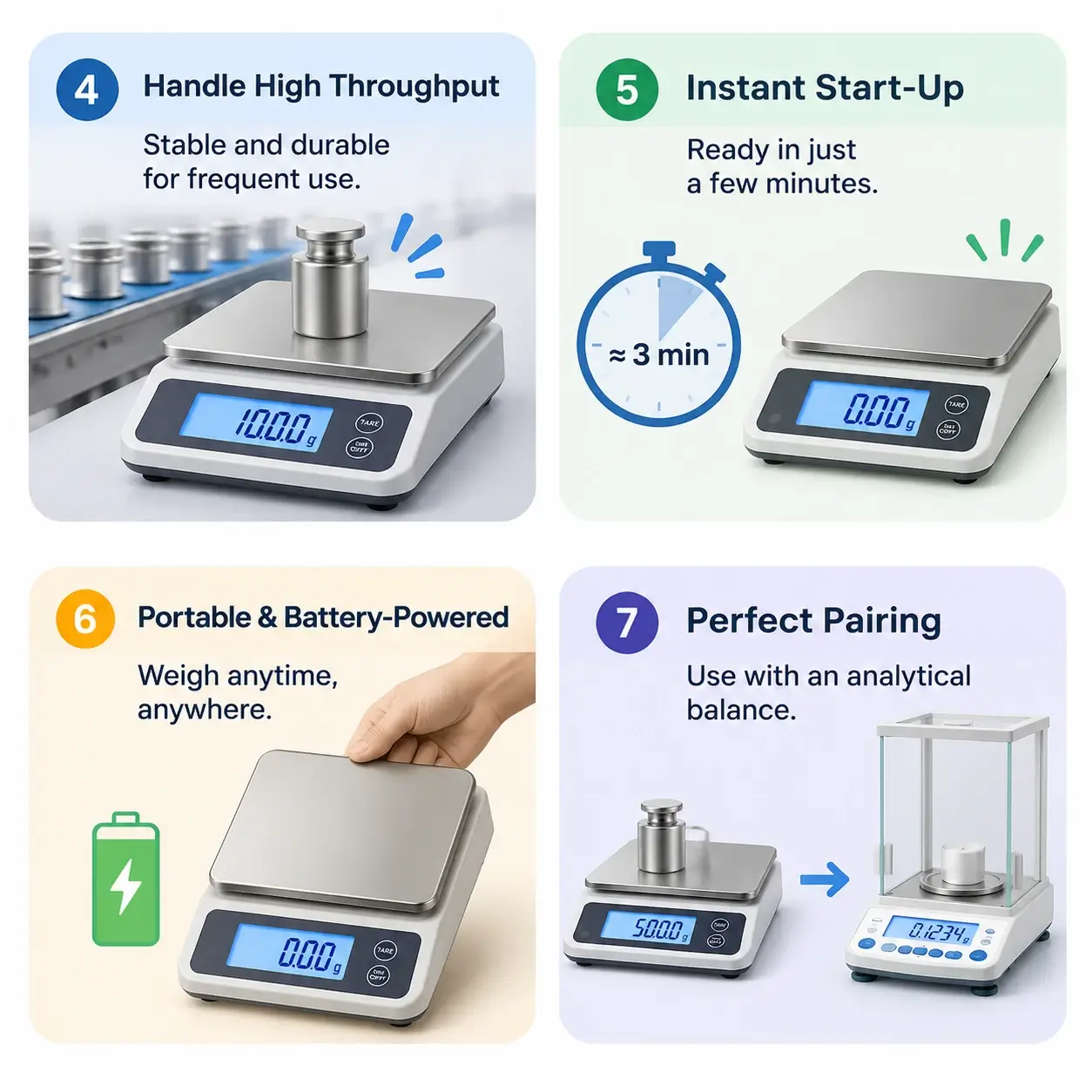
4. You Handle High-Throughput, Fast-Paced Weighing Tasks
In fast-moving environments like production-line sorting, inventory cycle counting, or outbound checkweighing, operators place and remove items dozens of times per minute. Under real-world shift pressure, samples are frequently set down quickly, creating minor vertical shocks on the weighing pan.
Strain gauge sensors are built without the tight mechanical stops and fragile flexures found in EMFC lever systems, allowing them to endure continuous, high-frequency daily use. Subjecting an EMFC top-loading balance to repetitive, rough pan loading risks bending its internal flexure hinges—a failure that typically requires costly factory servicing.
5. You Need Instant Start-Up Without Long Warm-Up Times
Small manufacturing workshops, incoming inspection bays, and mobile quality stations frequently operate on an intermittent, "as-needed" schedule rather than running 24/7. Because EMFC balances depend on maintaining thermal equilibrium across their internal magnet and coil assembly, manufacturers typically require a 30- to 60-minute warm-up period after powering on before the unit achieves its rated linear accuracy.
Strain gauge circuits exhibit minimal thermal drift during start-up. A strain gauge scale stabilizes within just a few minutes of being switched on, making it far more practical for facilities where equipment is powered down between shifts or used sporadically throughout the day.
6. Portability and Battery-Powered Operation Are Required
If your team needs to move scales between different production cells—or weigh materials in areas without reliable wall outlets, such as outdoor yards, temporary receiving docks, or trade show booths—power architecture becomes a deciding factor.
An EMFC balance must continuously draw electrical current to energize its electromagnetic coil and hold the weighing pan in equilibrium, tying it to a permanent AC outlet. By contrast, the Wheatstone bridge circuit inside a strain gauge sensor consumes very little power. Most strain gauge top-loading scales run for dozens of hours on standard dry-cell or built-in rechargeable batteries, and they require no lengthy magnetic re-stabilization after being carried to a new bench.
7. Using It as a Pre-Weighing Companion to an Analytical Balance
For R&D laboratories, formulation centers, and precious metal testing facilities already equipped with high-precision EMFC analytical balances, pairing technologies in a "high-low" workstation setup is one of the smartest ways to protect capital equipment.
Placing an economical strain gauge top-loading scale directly beside an analytical balance lets technicians handle heavy or messy preliminary steps—such as taring large glass beakers, weighing bulk base powders, and rough pre-mixing—before transferring only the final micro-sample to the analytical balance. This workflow division shields your sensitive EMFC sensor from accidental spills and heavy loads while speeding up overall sample preparation.
When Should You Still Invest in an EMFC Balance?
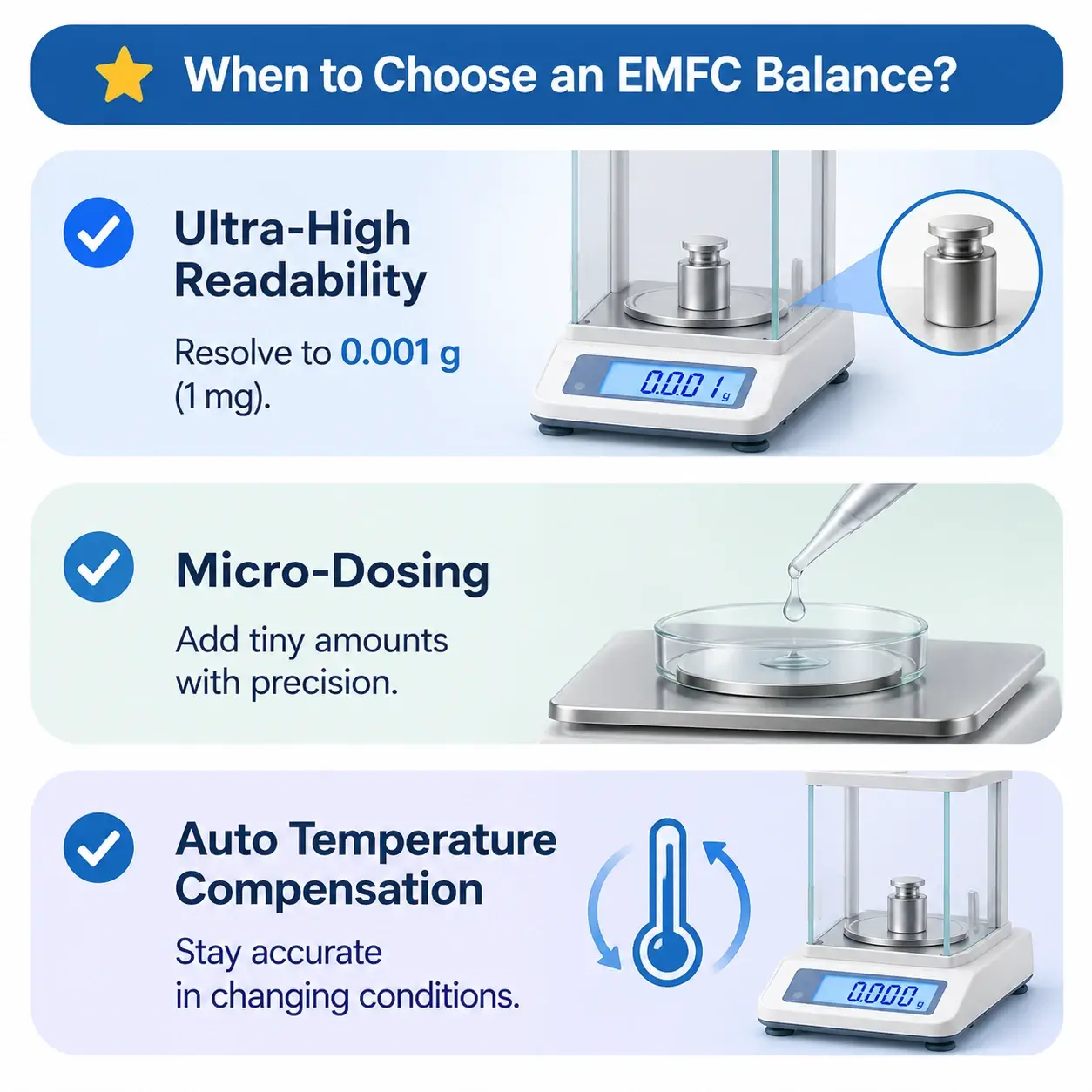
While strain gauge scales cover a wide spectrum of industrial and routine laboratory tasks, certain analytical thresholds strictly demand electromagnetic force compensation:
- Ultra-high readability (0.001g / 1mg or finer): Pharmaceutical R&D, trace chemical reagent preparation, and high-value precious metal assaying require the sub-milligram resolution that only an EMFC sensor can reliably resolve.
- Micro-dosing and incremental formulation: When technicians must add powders or liquids drop-by-drop or milligram-by-milligram into a heavy tared vessel, EMFC balances respond almost instantaneously to tiny mass changes with superior linearity.
- Strict automatic temperature-drift compensation: In laboratories experiencing noticeable day-to-night ambient temperature swings, high-precision EMFC balances equipped with motorized internal calibration weights automatically adjust for thermal drift to maintain regulatory compliance around the clock.
Quick Selection Checklist for B2B Buyers
Use these four checkpoints to validate whether a strain gauge top-loading scale fits your procurement specifications:
- Check Capacity vs. Readability: Are you targeting a readability of 0.01g or 0.1g with a maximum capacity between 1kg and 30kg? Opt for a strain gauge scale.
- Evaluate Workspace Conditions: Will the unit sit on a standard lab bench, a busy production table, or an area exposed to minor vibrations and air currents? Opt for a strain gauge scale.
- Confirm Usage Frequency and Power Requirements: Do operators need immediate start-up without warm-up delays, high-speed loading/unloading, or cordless battery portability? Opt for a strain gauge scale.
- Review Budget and Unit Volume: Are you working under strict per-unit cost ceilings or sourcing multiple scales for facility-wide deployment? Opt for a strain gauge model.
Source Rugged & High-Precision Top-Loading Scales from Stuccler
As a manufacturer and supplier of top-loading scales, Stuccler produces both rugged strain gauge models built for high-capacity daily reliability and high-precision EMFC balances equipped with RS232 data interfaces for seamless lab integration. Wholesalers, laboratory procurement managers, and equipment distributors are invited to contact our engineering and sales team for detailed technical datasheets, model recommendations, and volume pricing.
View Top-Loading Balance Models & Request Quote →Conclusion
Selecting the right weighing technology is not about chasing the highest specification sheet; it is about aligning sensor durability, capacity, and readability with your actual operating environment and budget. Both sensor architectures play vital roles across modern manufacturing and quality control—when matched to the right benchtop task.