
Gold’s timeless allure—whether as an investment, a treasured piece of jewelry, or raw material for crafting—often sparks a key question: how do you weigh it accurately? Do you need costly, specialized equipment, or will a standard scale do the job? The answer isn’t black-and-white. While some scenarios demand high-precision instruments, many everyday gold-weighing tasks can be handled with reliable, accessible scales.
Accurate weighing is critical to ensure you’re getting what you paid for, selling at a fair price, or crafting with precision. In a world where every milligram of gold carries significant value, getting it right is about more than convenience—it’s about financial trust and peace of mind.
Can You Weigh Gold on a Kitchen or Food Scale?
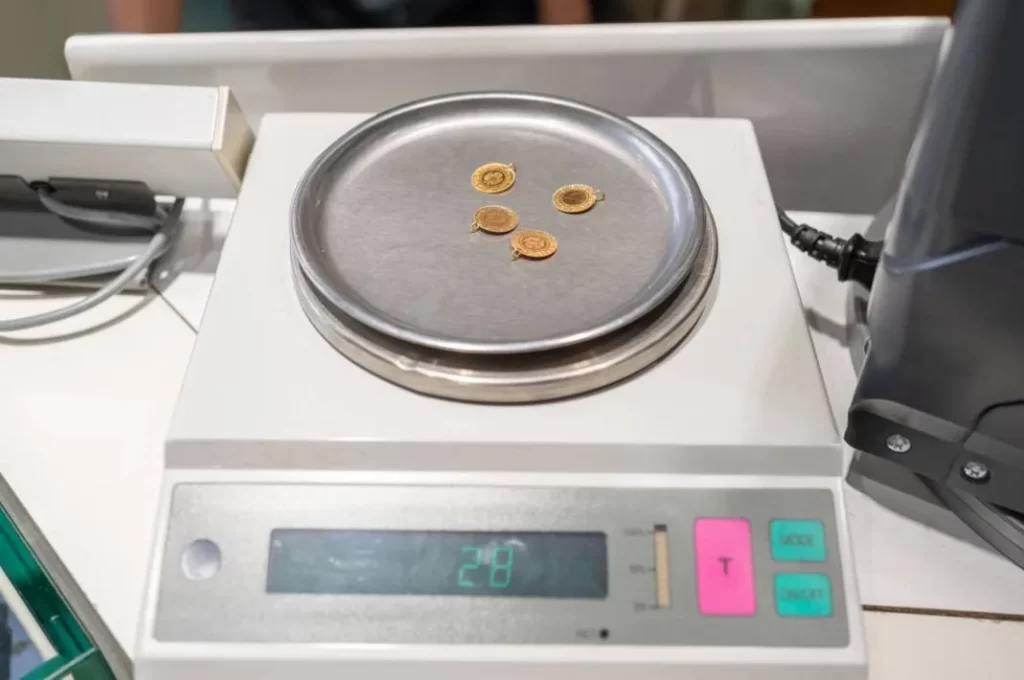
The short answer is no. While you might wonder how to weigh gold at home using a standard kitchen or food scale, doing so is highly inaccurate and risky. Kitchen scales typically measure in 1-gram increments. Because gold is so valuable, being off by just one gram can mean a difference of hundreds of dollars. To accurately measure gold weight and protect your investment, you must use a high-precision digital jewelry scale (measuring to 0.01g or 0.001g).
I. Understanding Gold Weight Measurements
Before exploring scale options, it’s vital to understand the units and concepts used in gold measurement.
A. Units of Measurement
Gold isn’t weighed in pounds or kilograms. Its high value and often small quantities call for specialized units.
- Troy Ounce (ozt): The global standard for precious metals like gold, silver, and platinum. One troy ounce equals roughly 31.103 grams. Don’t confuse it with the avoirdupois ounce (used for everyday items like food), which is about 28.35 grams. Always check that your scale measures in troy ounces for gold transactions.
- Gram (g): A metric unit widely used for gold, especially in jewelry and small-scale dealings. Many digital scales display grams, making this a practical choice for most users.
- Pennyweight (dwt): Common in North America’s jewelry trade, particularly for scrap gold or alloys. One pennyweight is 1/20th of a troy ounce, or about 1.555 grams.
- Grain (gr): The smallest unit, equal to roughly 0.0648 grams. Grains are rarely used for significant gold quantities but may appear in niche applications requiring ultra-fine measurements.
B. Precision vs. Accuracy: The Gold Standard
Precision and accuracy aren’t the same, and both are crucial when weighing gold.
- Precision means consistency. If you weigh the same gold piece multiple times and get identical readings, your scale is precise.
- Accuracy means the reading matches the true weight. A scale can be precise but inaccurate, consistently giving the wrong value.
Picture selling a troy ounce of gold. An inaccurate but precise scale might repeatedly undervalue or overvalue it, costing you money. For gold, you need a scale that delivers both precision and accuracy to protect your investment.
II. Types of Scales and Their Suitability for Gold
Not all scales are suited for gold. Your choice depends on your specific needs.
A. Best Scales for Weighing Gold: Milligram Scales (0.001g)
When people ask about “special scales,” they usually mean these high-precision tools.
- Features: These scales offer extreme sensitivity, often measuring to 0.01 grams (hundredths) or even 0.001 grams (milligrams). Many include a draft shield to block air currents that can skew tiny measurements. They typically support multiple units, like grams, troy ounces, and pennyweights.
- Best Use: Ideal for weighing small quantities—think fine jewelry, scrap gold, gold dust, or flakes. Jewelers, gold buyers, refiners, and serious collectors rely on these for accurate valuation and transactions.
- Why they are “special”: Their advanced sensors and calibration systems detect minute weight variations, critical when even a fraction of a gram affects value.
B. Pocket Scales / Digital Scales: The Practical Option
For many gold-weighing tasks, a quality digital scale is surprisingly effective.
- Features: Compact and portable, these scales typically offer precision to 0.1 or 0.01 grams. They’re user-friendly, often battery-powered, and widely available.
- Best Use: Perfect for larger items like gold coins, small bars, or heavy jewelry (e.g., necklaces or bracelets) where milligram-level precision isn’t critical but accuracy still matters. They’re great for checking a coin collection’s weight or verifying larger gold items.
- Are they “special”? Not specifically. Unlike milligram scales, they aren’t tailored for precious metals, but a reliable 0.01g-precision digital scale can handle many gold-related tasks at a lower cost.
C. Kitchen Scales / Bathroom Scales: Not for Gold
These scales are designed for entirely different purposes and have no place in gold weighing.
- Features: Kitchen scales measure in 1-gram increments, while bathroom scales use even larger steps (e.g., 0.1 kg or 0.1 lb). They’re built for bulk items like food or body weight.
- Why They’re Unsuitable: Gold’s high value demands far greater precision. A single gram’s difference could mean hundreds of dollars. These scales lack the sensitivity needed, making them impractical and risky for gold.
How to Weigh Gold Accurately at Home (Step-by-Step)
- Prepare a Stable Environment: Place your digital scale on a flat, solid surface away from drafts, vibrations, or AC vents, as high-precision milligram scales are extremely sensitive.
- Calibrate the Scale: Before weighing, use a standard calibration weight to ensure your scale is perfectly accurate.
- Select the Right Unit: Press the ‘Mode’ button to select Troy Ounces (ozt) or Grams (g) depending on your standard. Place the gold gently on the center of the pan (or inside the draft shield) and wait for the reading to stabilize.
III. Factors to Consider When Choosing a Scale for Gold
Picking the right scale goes beyond precision. It’s about aligning the tool with your needs and ensuring consistent performance.
A. Amount and Form of Gold
- Small Items (Jewelry, Dust, Flakes): High precision is essential. A scale with 0.001g (milligram) or 0.01g accuracy is critical to capture the full value.
- Larger Items (Bars, Coins, Heavy Chains): While accuracy remains important, a 0.01g-precision scale often suffices for a 1-ounce gold bar, as milligram scales may be overly sensitive and prone to environmental interference with heavier weights.
B. Purpose of Weighing
Your goal shapes the scale you need:
- Buying/Selling: Financial transactions require top-tier accuracy and precision. Even small errors can lead to significant losses, making professional jewelry scales a must.
- Inventory/Personal Collection: For cataloging or verifying your collection, a 0.01g-precision digital scale may be enough if transactions aren’t immediate.
- Crafting/Alloying: Jewelers and artisans need precise measurements to ensure consistency and avoid wasting costly materials. Milligram scales are often the best choice.
C. Budget
High-precision scales can be pricey, but they’re an investment that prevents costly errors. While digital scales are more affordable, cheap models can lead to expensive mistakes. At Stuccler, we offer quality jewelry scales that balance precision and value to fit various budgets.
D. Calibration: The Key to Accuracy
Even top-tier scales lose accuracy over time. Regular calibration is essential.
- Why It Matters: Calibration aligns your scale with a known standard, ensuring accurate readings. Without it, even precise measurements can be off.
- How to Calibrate: Most quality scales include or specify a calibration weight. Place the weight on the scale and adjust it to match the known value, following the user manual’s instructions.
E. Environmental Factors
Sensitive scales are affected by their surroundings:
- Drafts: A slight breeze can disrupt milligram-level readings, which is why many precision scales include a draft shield.
- Vibrations: An unstable surface or nearby machinery can cause errors.
- Temperature: Extreme temperature changes can affect a scale’s internal components, leading to inaccurate readings. Always use your scale in a stable environment.
IV. Conclusion & Professional Solutions
Do you need special scales to weigh gold? Absolutely. For the most accurate and reliable results, high-precision jewelry or milligram scales are mandatory. Standard kitchen scales will only lead to costly mistakes.
Pro Tip for Jewelry Businesses & Gold Dealers
Are you upgrading your shop’s equipment or starting a gold trading business? Using non-certified or cheap scales can damage your reputation and profit margins.
As a leading global manufacturer and supplier, Stuccler provides factory-direct, high-precision laboratory and jewelry balances (0.001g). We support professional B2B wholesale and OEM/ODM solutions.