

In a professional studio, “near enough” is a financial leak. Whether handling gold dust, fragrance oils, or dental alloys, limited space and expensive materials demand extreme accuracy. Choosing the right precision scale reduces waste, ensures perfect formulations, and protects your bottom line.
Step 1: Define Your “Precision Threshold”
The most common mistake is confusing readability with accuracy. This is a critical pitfall. Just because a digital display shows 0.001g does not mean the internal sensor can reliably repeat that result. True accuracy depends on the quality of the load cell and its linearity.
Choose Bas ed on Your Craft
You must match your scale’s capability to your specific materials. A scale that is “too precise” can be as frustrating as one that isn’t precise enough, as it will react to every vibration in the building.
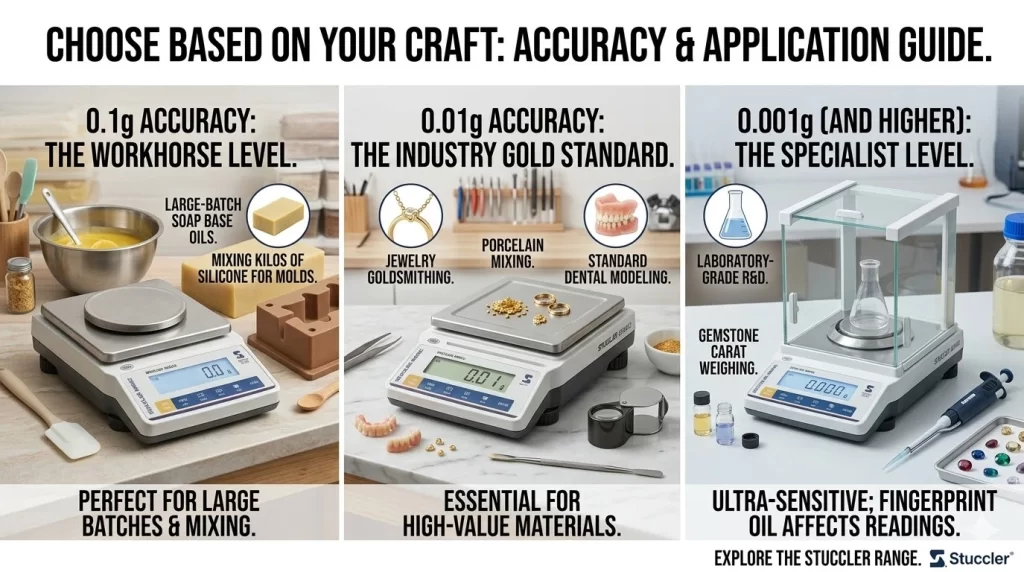
- 0.1g Accuracy: This is the workhorse level. It is perfect for large-batch wax casting or measuring base oils for handmade soaps. If you are mixing kilos of silicone for molds, this is your entry point.
- 0.01 Accuracy: This is the industry gold standard. It is essential for jewelry goldsmithing where every milligram of gold counts. It is also the benchmark for standard dental modeling and porcelain mixing.
- 0.001 (and higher): This level is for specialists. Use this for laboratory-grade R&D, high-concentration fragrance blending, and gemstone carat weighing. At this level, even the oil from your fingerprint can change the reading.
Step 2: Evaluate Your “Studio Space” Constraints
Your studio environment is a living, breathing space. This affects how your scale performs. A precision balance is a sensitive instrument, not just a piece of furniture.
Consider the Footprint
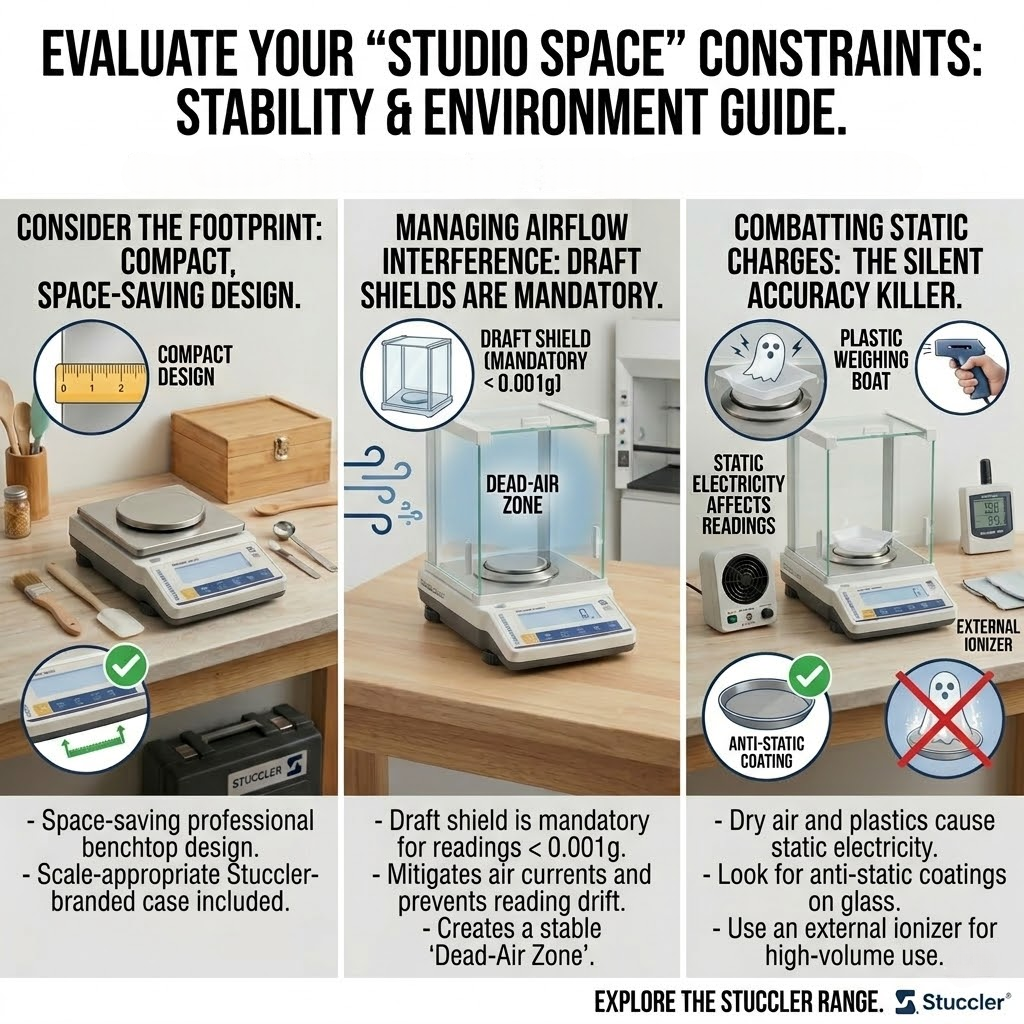
Workbench space is precious. Most professionals prefer a compact, space-saving design
Managing Airflow Interference
Does your studio have air conditioning? Do you work near a window or under a fume hood? At high levels of precision, even the faint air current from a person walking past can cause readings to drift.
- The Solution: If you are working with 0.001g or finer, a draft shield (glass or plastic housing) is mandatory. It creates a dead-air zone. Without it, your numbers will “dance” on the screen, making a stable reading impossible.
Combatting Static Charges
Dry studio air—especially in winter—and plastic mixing containers are a recipe for static. Static electricity is a silent accuracy killer. It creates an invisible force that pulls the weighing pan toward the sensor or pushes it away.
- The Expert Tip: Look for a balance with an anti-static coating on the glass. For high-volume studios, an external ionizer (static eliminator) is a wise investment. It neutralizes the charge on your containers in seconds.
Step 3: Identify Key “Studio Features”
Efficiency is the heartbeat of a productive studio. Your tools should make your life easier, not add steps to your workflow.
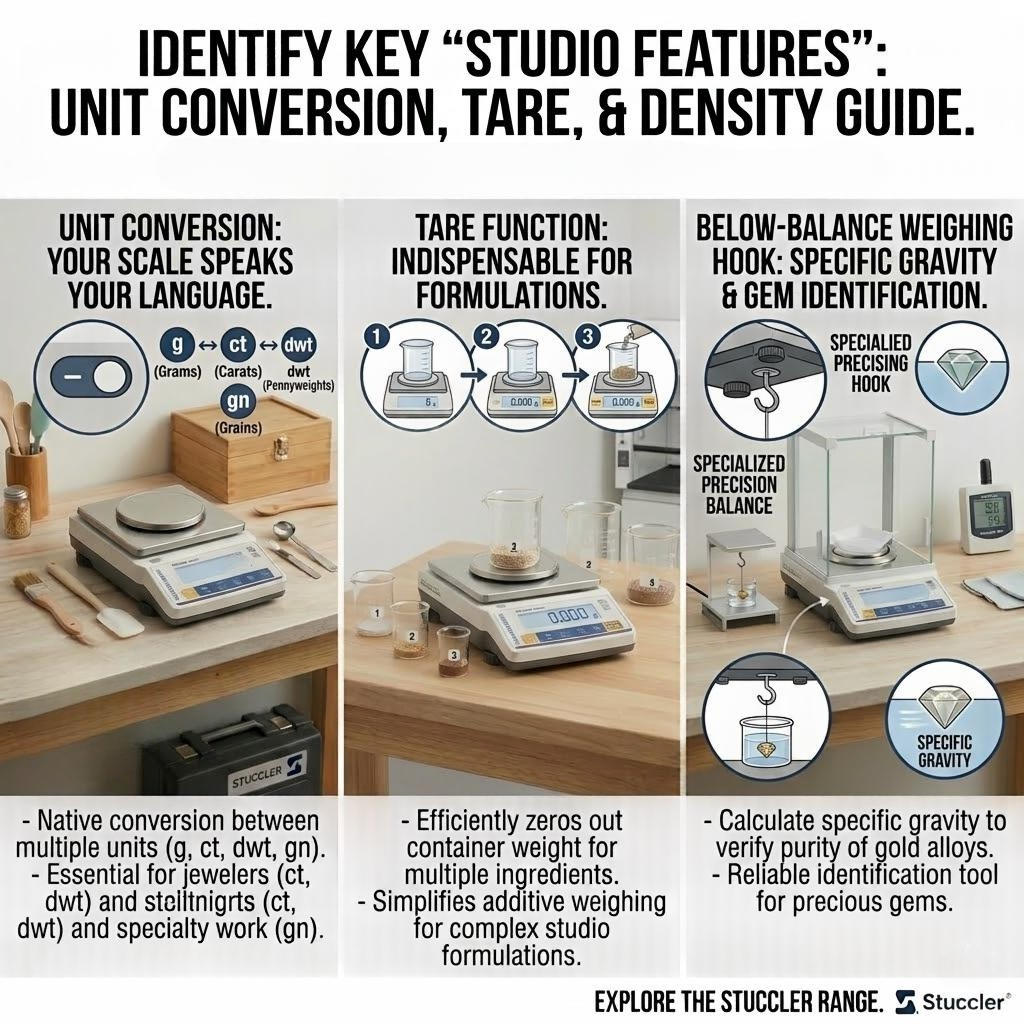
- Unit Conversion: Your scale must speak your language. A jeweler needs to toggle between grams (g), carats (ct), and pennyweights (dwt). A reloader or specialty chemist might need grains (gn). Ensure these are native settings.
- Tare Function: This is an indispensable tool. A professional Tare function allows you to zero out the weight of a beaker, add an ingredient, and zero it again. This “additive weighing” is crucial for complex formulations.
- Below-Balance Weighing Hook: This is a specialized feature located at the bottom of the scale. It allows you to weigh items suspended in a liquid. For jewelers, this is the only reliable way to calculate specific gravity to verify the purity of a gold alloy or identify a gemstone.
Step 4: Budget and Brand Reliability
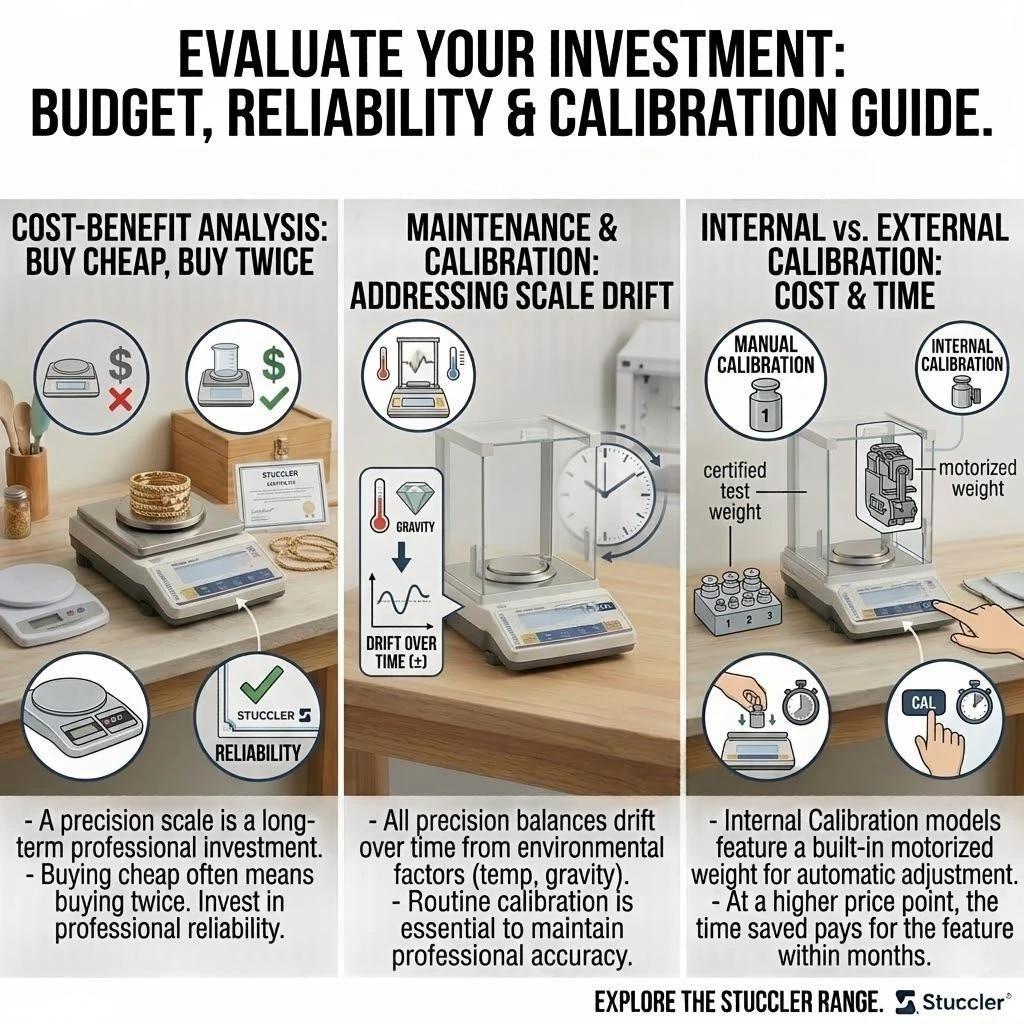
A precision scale is a long-term investment. Buying cheap often means buying twice.
Cost-Benefit Analysis
Entry-level models are fine for hobbyists. However, for professional output, a premium brand like Stuccler
Maintenance and Calibration: Internal vs. External
All scales drift over time due to changes in temperature and gravity.
- Manual Calibration: Requires you to own a set of certified test weights and perform the routine yourself.
- Internal Calibration: These models feature a built-in motorized weight. While they have a higher price point, they eliminate the daily hassle. With one click, the scale adjusts itself to perfection. In a busy studio, the time saved pays for the feature within months.
Conclusion
Choosing the right tool is about balance. You need enough precision for your finest materials, but enough durability for daily studio life. Don’t just buy a “scale”—buy a solution that stabilizes your results and protects your bottom line.
Ready to upgrade your workspace? Visit the official Stuccler website to explore our professional range. Whether you need a single unit for a private studio or B2B bulk purchasing.