

The precision balance is an essential instrument in the laboratory, serving as the foundation for reliable data across diverse applications. Its role is critical in the following seven key areas.
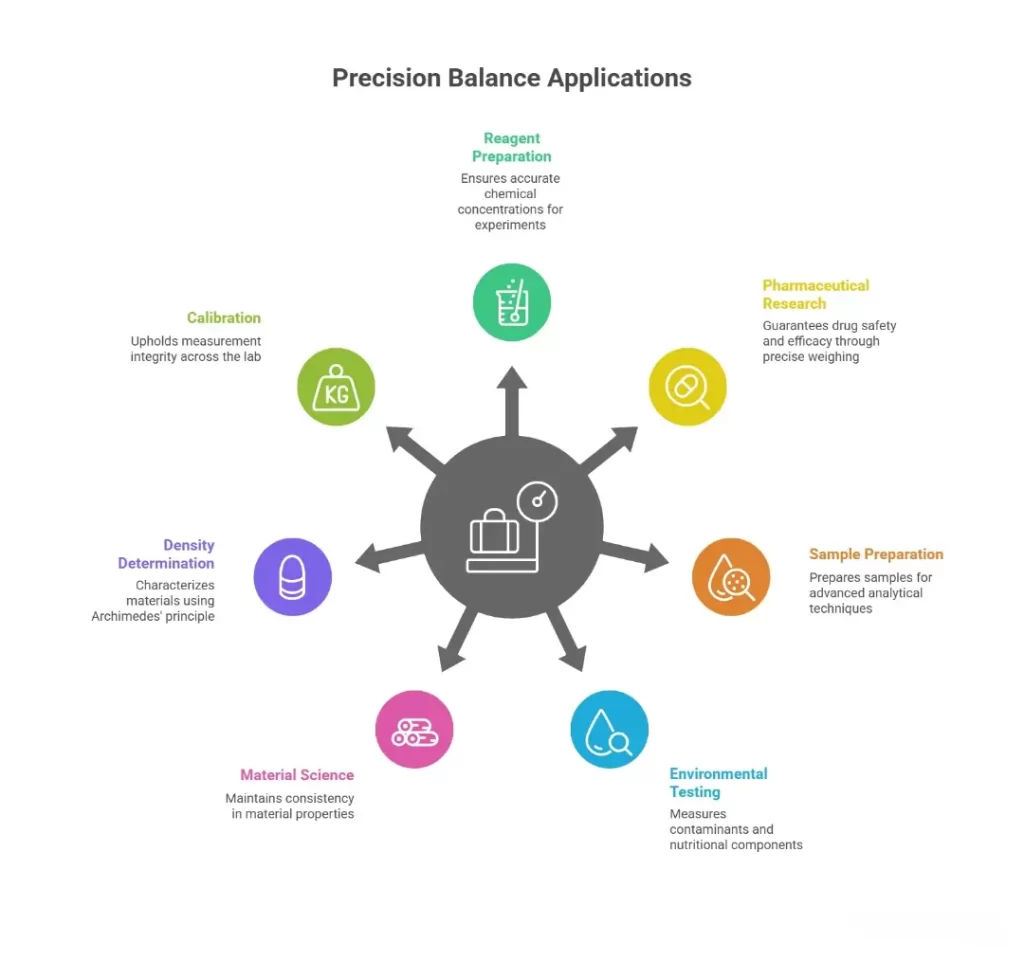
1. Reagent and Chemical Preparation
The accuracy of any solution-based experiment begins here.
- Role: Weighing solid solutes for standard solutions, buffers, and culture media.
- Impact: Directly ensures accurate concentrations, safeguarding experimental validity and reproducibility.
2. Pharmaceutical Research and Formulation
Where patient safety is measured in milligrams.
- Role: Precisely weighing Active Pharmaceutical Ingredients (APIs) and excipients during R&D and compounding.
- Impact: Guarantees the safety, efficacy, and consistency of every drug dose.
3. Sample Preparation and Weighing
Before any sophisticated analysis can take place, the sample must be prepared meticulously.
- Role: Accurately weighing raw samples and extracts for techniques like HPLC, GC, and spectroscopy.
- Role: Managing pre-treatment steps (dissolution, dilution) to ensure the sample is ideally presented to analyzers.
4. Environmental and Food Testing
Measuring trace amounts with major implications.
- Role: Quantifying filter residues, contaminants, and nutritional components in air, water, soil, and food samples.
- Example: Weighing TSP/PM filter membranes for air quality data and conducting nutritional analysis.
5. Material Science and Quality Control
The precise recipe defines the material’s properties.
- Role: Weighing polymers, composites, and powders to ensure batch-to-batch consistency.
- Role: Enabling proportioning experiments to develop new alloys and high-performance materials.
6. Density Determination
Unlocking a key physical property through a classic principle.
- Role: Using Archimedes’ principle to find density by weighing a sample in air and then submerged in fluid.
- Value: A simple, effective method for characterizing solids, liquids, and porous materials.
7. Calibration and Verification
Upholding the entire lab’s measurement integrity.
- Role: Serving as a reference standard to calibrate other equipment like pipettes and smaller scales.
- Value: Ensures all weighing data across the facility is reliable, traceable, and compliant.
Conclusion: The Indispensable Tool
The precision balance is the silent guardian of data integrity. Its role in enabling diverse applications—from basic prep to advanced R&D—is irreplaceable.
Maintaining Performance
To preserve this critical asset, regular calibration and meticulous maintenance are as important as the initial investment in a quality instrument.
Ready to enhance your lab’s capabilities?
Explore the full range of high-performance Precision Balances at Stuccler to find the perfect match for your application needs.