

In pharmaceutical compounding, precision directly defines patient safety, where even milligram-level deviations can alter drug potency. Selecting the right analytical balance requires meeting strict pharmacopeial compliance (such as USP <41> and GLP) while ensuring draft resistance and long-term repeatability. This guide covers the essential selection criteria and highlights top models from the Stuccler SE Series.
I. Compliance Standards to Check Before Choosing a Compounding Balance
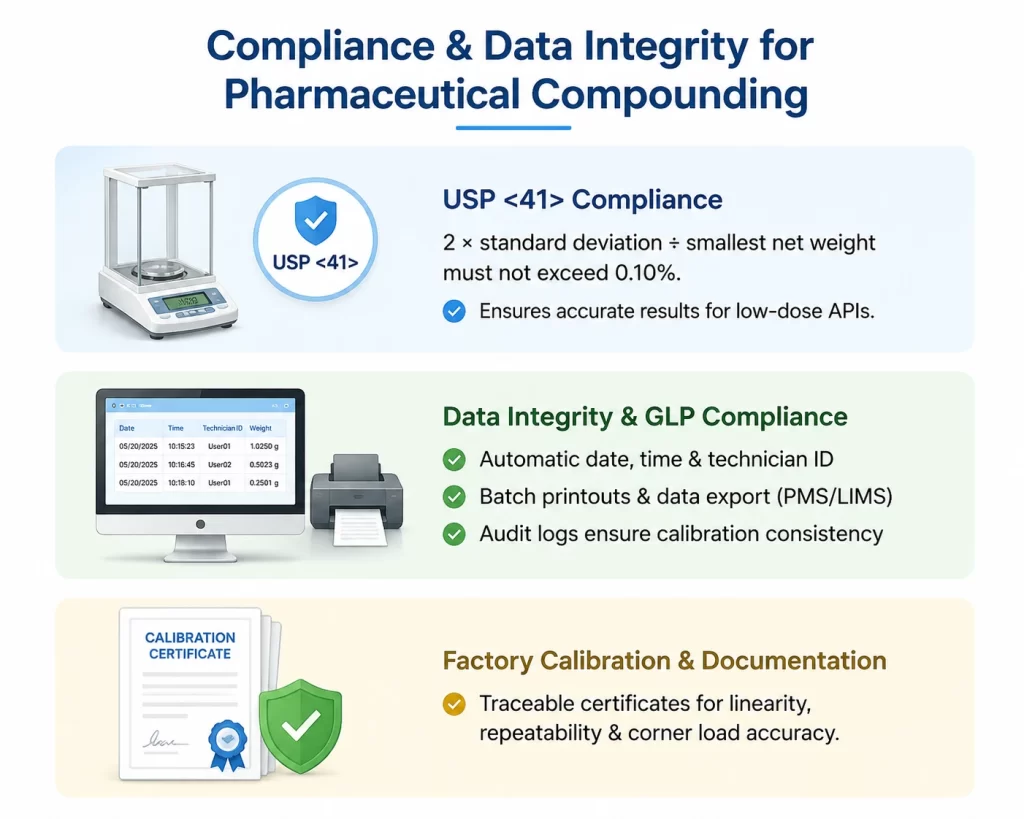
USP <41> Balances and Minimum Weight Verification
The United States Pharmacopeia (USP) General Chapter <41> defines the standard for analytical balances used to weigh materials for quantitative analysis. Repeatability is deemed acceptable if two times the standard deviation divided by the smallest net weight does not exceed 0.10%. Choosing an analytical balance with proven repeatability ensures that trace APIs and low-dose compounds remain well within the validated minimum sample weight threshold.
Data Integrity, Batch Records, and GLP Compliance
Pharmaceutical dispensing requires continuous data traceability under Good Laboratory Practice (GLP) standards:
- Accurate generation of weight records featuring automatic date, time, and technician identifiers.
- Support for physical batch printouts and direct data export to pharmacy management systems (PMS) or laboratory information management systems (LIMS).
- Detailed internal audit logs to confirm calibration consistency across dispensing shifts.
Factory Calibration and Quality Documentation
To clear state board inspections and quality audits, always verify that the analytical balance is backed by traceable factory calibration certificates covering linearity, repeatability, and corner load accuracy.
II. Core Balance Specifications Required for Accurate Drug Formulation
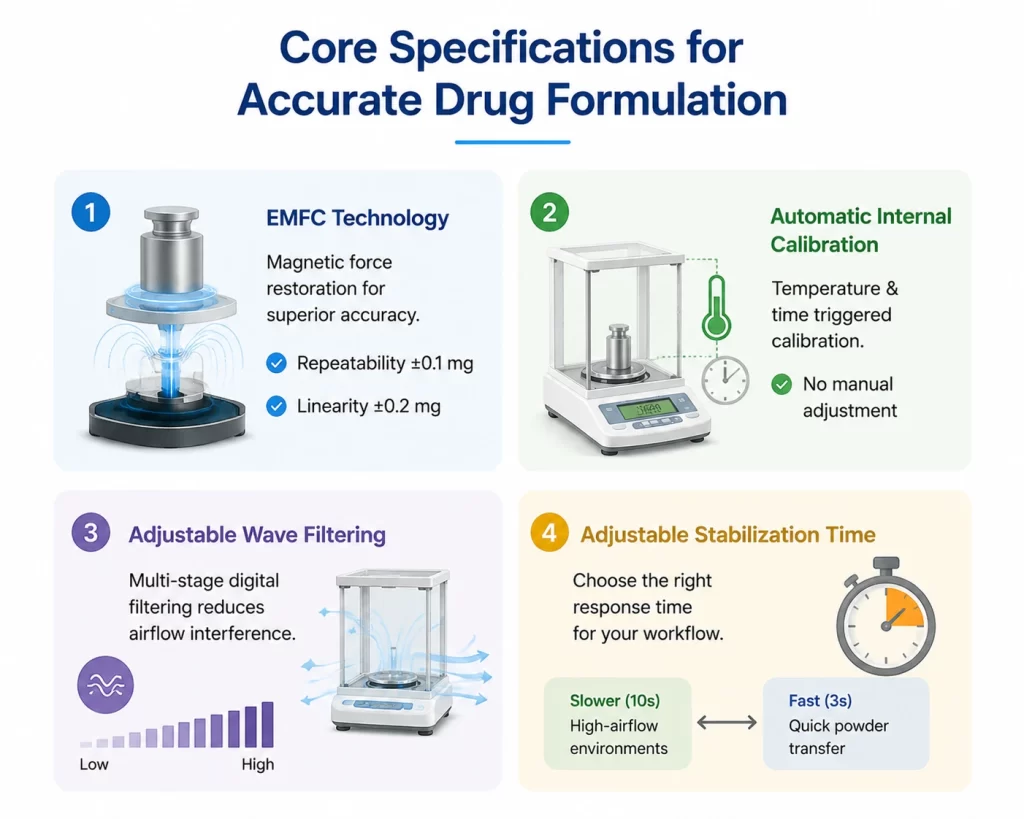
- Electromagnetic Force Compensation (EMFC): Unlike standard strain-gauge sensors that exhibit mechanical hysteresis and thermal drift, EMFC technology uses magnetic force restoration. This provides the tight repeatability (±0.1 mg) and linearity (±0.2 mg) needed for high-potency APIs.
- Fully Automatic Internal Calibration (Internal CAL): Ambient cleanroom temperature shifts directly cause sensor drift. Selecting a balance with automated, temperature-triggered and timer-controlled internal calibration eliminates manual adjustments and prevents off-spec measurements.
- Adjustable Wave Filtering for Controlled Airflow: Compounding inside biological safety cabinets (BSCs) or laminar flow hoods exposes balances to turbulent airflow. Multi-stage digital filtering stabilizes the readout without introducing lag.
- Adjustable Stabilization Time (3–10s): Balances must offer adjustable integration times—slower filtering for high-airflow hoods, or rapid 3-second readouts for fast powder transfer routines.
III. Housing and Draft Shield Design for Cleanroom and Pharmacy Protection
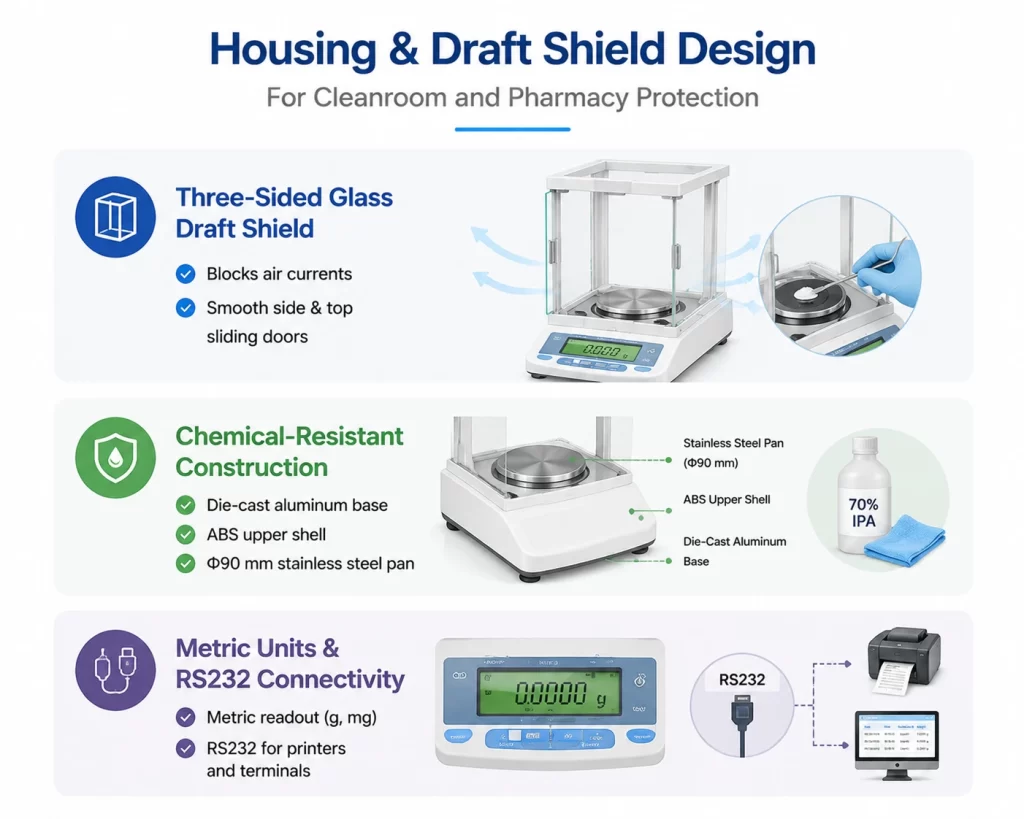
- Three-Sided Glass Draft Shield: High-transparency, anti-static glass chambers block air currents from HVAC vents and laminar flow units while providing smooth side and top sliding doors for comfortable spatula handling.
- Chemical-Resistant Sub-Base & Stainless Steel Pan: A die-cast aluminum sub-housing paired with an ABS upper shell and a Φ90 mm stainless steel weighing pan withstands daily sanitization with 70% isopropyl alcohol and resists corrosive active ingredients.
- Metric Weighing Units & RS232 Connectivity: Standard metric readouts (g and mg) eliminate conversion errors, while standard RS232 interfaces allow plug-and-play connection to thermal label printers and compounding terminals.
IV. Top Analytical Balance Recommendations for Pharmaceutical Compounding
SE-R22W (220g / 0.1mg) — Best Overall Choice for Daily Prescription Compounding
The SE-R22W is the primary recommendation for independent compounding pharmacies and hospital outpatient dispensaries handling standard prescription volumes.
- Application Focus: Daily capsule filling, oral liquid formulation, and routine non-sterile powder dispensing.
- Key Selection Features: The 220 g capacity at 0.1 mg readability comfortably accommodates standard glass beakers, plastic weighing boats, and spatulas. Fully automated temperature-triggered calibration maintains accuracy during long work cycles.
SE-R32W (320g / 0.1mg) — Best High-Capacity Balance for Heavy Containers and Bulk Batches
The SE-R32W is engineered for pharmacies and compounding facilities that prepare bulk formulations or use heavier glass vessels.
- Application Focus: Bulk topical ointments, suppository bases, and high-volume excipient pre-weighing.
- Key Selection Features: Delivers an extended 320 g capacity while maintaining 0.1 mg analytical readability. This extra tare capacity allows pharmacists to weigh large volumes directly into heavy compounding jars without splitting batches.
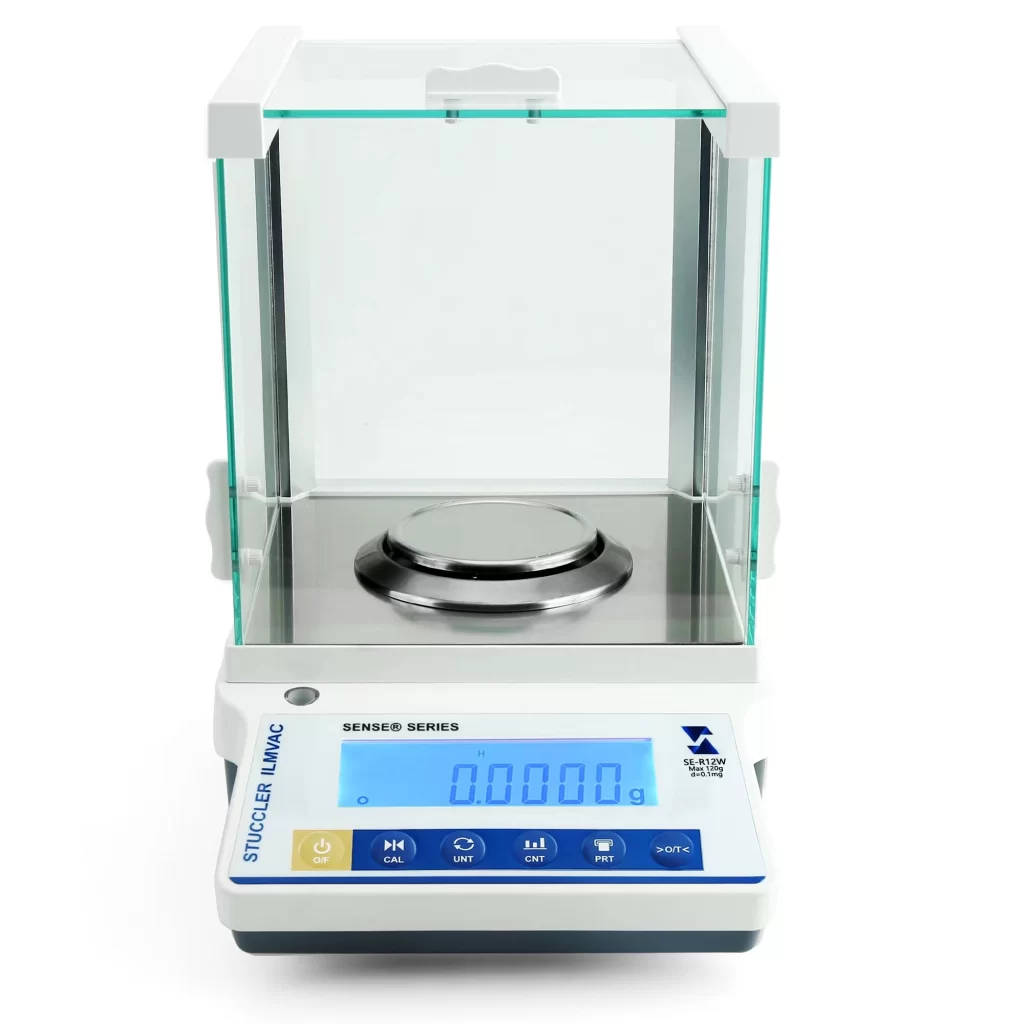
SE-R12W (120g / 0.1mg) — Best Compact Balance for Hood Placement and Trace API Dosing
The SE-R12W is designed for restricted-space environments such as laminar flow hoods, isolators, and clean benches.
- Application Focus: Hormone replacement formulations, micro-dosing high-potency APIs, and sterile compounding suites.
- Key Selection Features: Features a compact base design with rapid EMFC sensor response. Its adjustable digital filtering quickly counteracts the forced airflow inside containment hoods.
V. Technical Comparison Matrix: Selecting the Right SE Series Model
| Recommended Model | Readability (d) | Max Capacity | Sensor Technology | Calibration Method | Repeatability / Linearity | Ideal Compounding Scenario |
| SE-R22W | 0.1 mg (0.0001 g) | 220 g | EMFC Monoblock | Fully Automatic Internal (Time/Temp) | ±0.1 mg / ±0.2 mg | Standard prescription compounding, capsules, and oral solutions |
| SE-R32W | 0.1 mg (0.0001 g) | 320 g | EMFC Monoblock | Fully Automatic Internal (Time/Temp) | ±0.1 mg / ±0.2 mg | Large batches, topical ointment bases, and heavy tare containers |
| SE-R12W | 0.1 mg (0.0001 g) | 120 g | EMFC Monoblock | Fully Automatic Internal (Time/Temp) | ±0.1 mg / ±0.2 mg | Micro-dosing active ingredients, clean bench, and hood operations |
VI. Best Operational and Maintenance Practices to Maintain Weighing Accuracy
Balance Leveling and Pre-Operation Warm-Up
- Level Verification: Check the leveling bubble on the rear indicator and adjust the leveling feet to center the bubble before every operating shift.
- Warm-Up Cycle: Keep the analytical balance connected to power or allow a 30 to 60-minute warm-up period to achieve thermal equilibrium across the internal EMFC electromagnetic coils.
Routine Daily Performance Checks (SOP)
- Verify sensitivity and off-center loading using certified Class E2 standard weights before dispensing medications.
- Perform a 4-point corner load check to confirm deviations remain within the allowable ±0.2 mg tolerance. Log all test results in the daily pharmacy balance log.
Cleaning Procedures to Prevent Cross-Contamination
- Disassemble the sliding glass panels and wipe down surfaces using lint-free cloths lightly dampened with 70% isopropyl alcohol.
- Remove the Φ90 mm stainless steel weighing pan and wipe the base ring. Avoid using compressed air or harsh chemicals near the central pan cone to prevent fine powders from entering the internal sensor chamber.
Sourcing and Technical Selection Support
Choosing the ideal analytical balance depends on your daily prescription load, batch sizes, cleanroom airflow configurations, and compliance requirements. As a dedicated analytical balance manufacturer and supplier, Stuccler provides high-precision weighing solutions engineered to meet rigorous pharmaceutical and laboratory standards. Contact our technical team for custom model configurations, factory calibration documentation, or wholesale procurement support.