

When your production line needs to weigh up to 20kg bulk materials but cannot afford to lose 0.01g precision, standard lab balances and bulky bench scales both fail. This objective guide cuts through marketing slogans to help you select a high-capacity industrial precision balance based strictly on sensor architecture, physical rigidity, and anti-vibration algorithms.
I. Core Technical Architecture: Strain Gauge Load Cells vs. EMFR
Many buyers assume a 0.01g readability automatically requires an expensive Electromagnetic Force Restoration (EMFR) sensor. However, their delicate internal leverage mechanisms often fail on a dynamic factory floor.
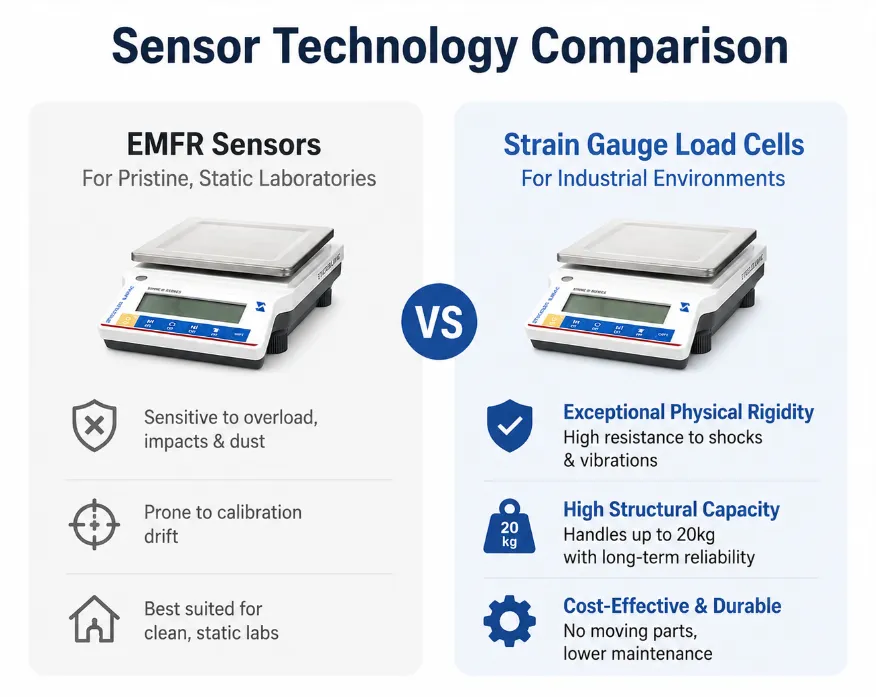
Here is how the two core sensor architectures compare in real-world industrial settings:
- EMFR Sensors: Optimized for pristine, static laboratories. They are highly vulnerable to permanent calibration drift or mechanical damage from sudden overloading, lateral impacts, and workshop dust.
- Strain Gauge Load Cells: Engineered for harsh, heavy-duty industrial environments. Because they measure weight based on the micro-deformation of a solid metal element with no moving parts, they deliver two distinct advantages:
- Exceptional Physical Rigidity: High resistance to physical shocks and high-frequency container impacts on the production line.
- High Structural Capacity: Allows for the engineering of cost-effective scales handling large bulk capacities up to 20kg without sacrificing the operational lifespan of the sensor.
Overcoming Environmental Interference: Historically, strain gauge sensors struggled with stability at fine resolutions. Modern industrial balances solve this via a built-in adjustable wave filter intensity function. This digital processing algorithm dynamically damps out background machinery noise, ensuring a stable, locked readout within 3–10 seconds—even when mounted directly on a vibrating production line.
II. Selecting Industrial Precision Balances: Key Technical Specifications
When evaluating high-capacity industrial weighing equipment, looking at the headline resolution is not enough. Procurement and quality managers should judge equipment based on four specific features:
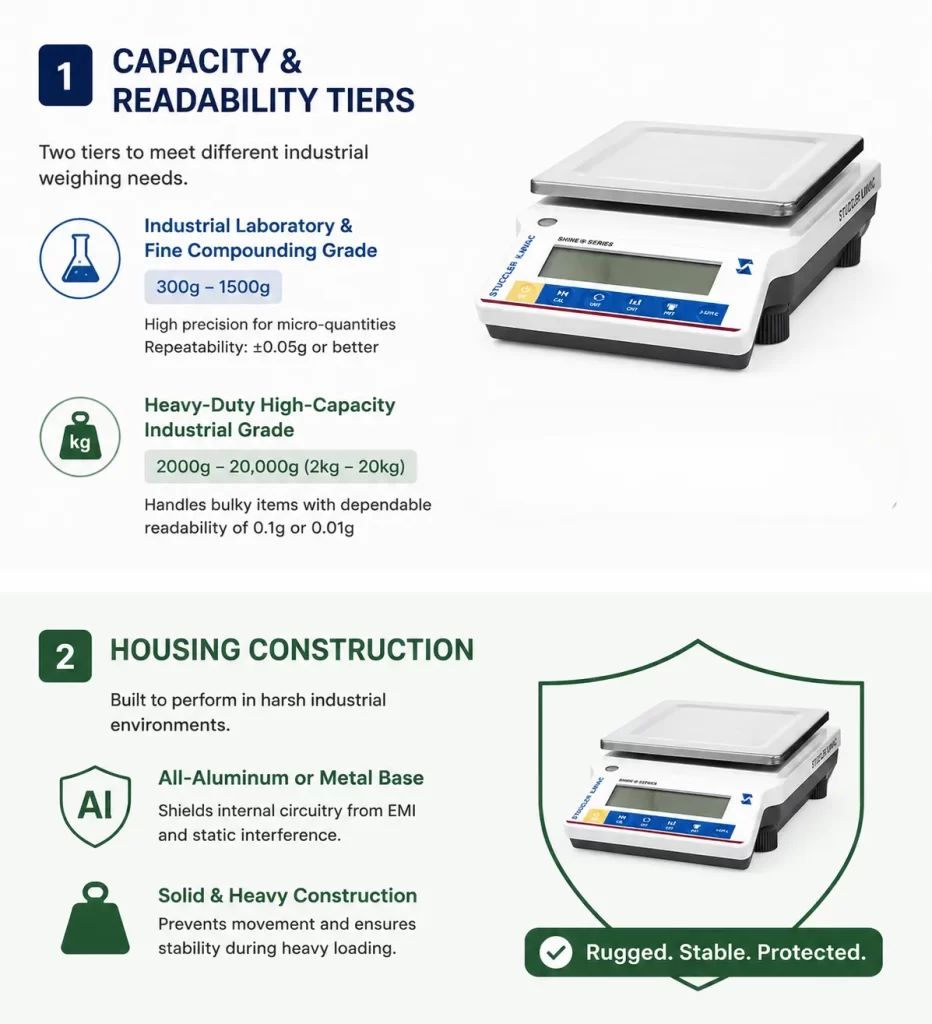
1. Capacity and Readability Tiers
Industrial weighing needs generally fall into two distinct operational segments:
- Industrial Laboratory & Fine Compounding Grade: Handles capacities from 300g to 1500g. The focus here is prioritizing tight linearity tolerances and repeatability (±0.05g or better) for micro-quantities.
- Heavy-Duty High-Capacity Industrial Grade: Scales from 2000g up to 20,000g (2kg to 20kg). These configurations handle bulky metal castings or massive hardware kits while maintaining a dependable readability of 0.1g or 0.01g.
2. Housing Construction: All-Aluminum vs. Plastic
The physical environment of a manufacturing plant is prone to severe electromagnetic interference (EMI) from electric motors and static drift. A qualified industrial balance should feature a die-cast aluminum housing or a heavy metal base rather than a purely plastic structure. Aluminum acts as a natural Faraday cage to shield internal circuitry from stray radio frequencies, while the physical mass of a metal chassis prevents the scale from shifting during heavy loading.
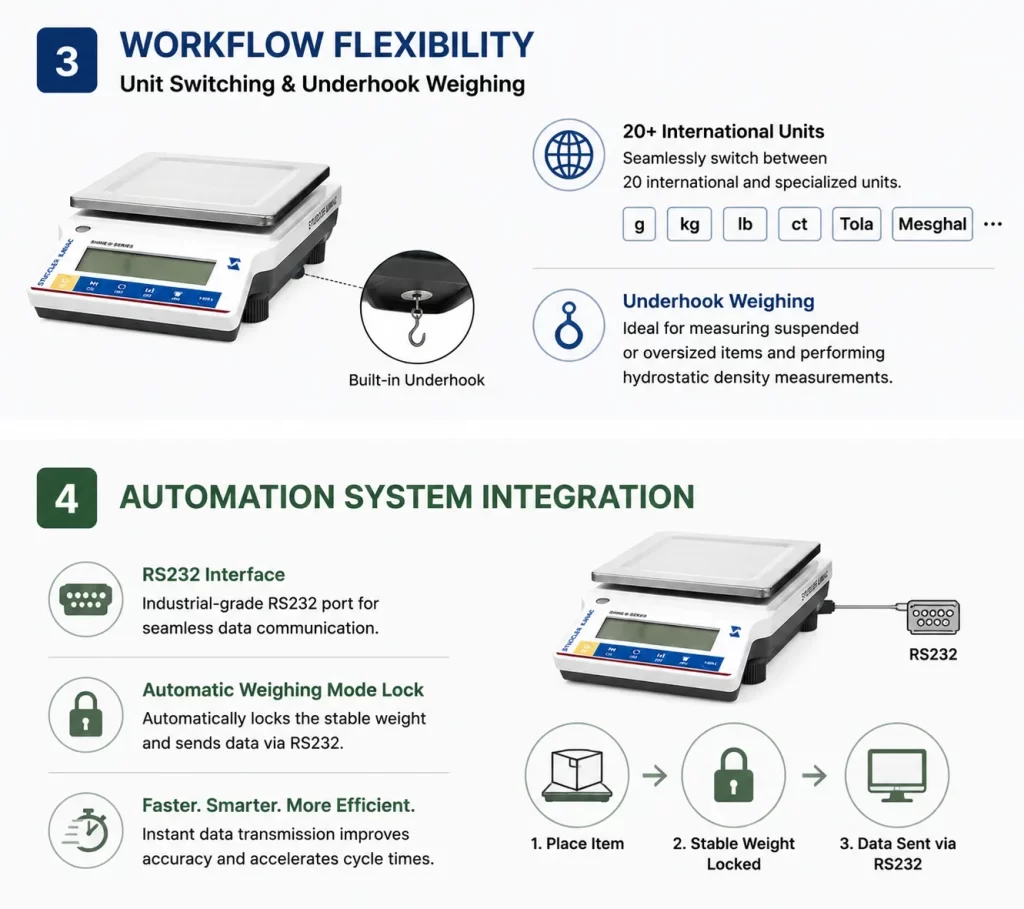
3. Workflow Flexibility: Unit Switching and Underhook Weighing
Globalized manufacturing requires hardware that adapts to international supply chain metrics. A versatile industrial scale should support seamless switching between 20 international and specialized units, including grams (g), kilograms (kg), pounds (lb), carats (ct), and regional standards like Tola or Mesghal. Furthermore, a fit-with-underhook housing allows for below-balance weighing, which is invaluable for measuring suspended, oversized items or performing hydrostatic density measurements.
4. Automation System Integration
To eliminate human error from manual record-keeping, an industrial balance must come standard with an industrial-grade RS232 port. For automated assembly lines or high-speed packaging stations, the scale’s firmware should feature an automatic weighing mode lock. This automatically freezes the stable weight on the display and transmits the data packet via RS232 the moment an object hits the platform, accelerating cycle times.
III. Industry Applications and Model Matching
| Industry Sector | Primary Weighing Challenges | Essential Equipment Features |
| Precious Metals & Jewelry Wholesale | High-value inventory audit; zero room for measurement drift across large bulk batches. | Seamless g to ct conversion; low repeatability deviation; strict linearity compliance. |
| Specialty Chemicals & Paint Formulation | Frequent exposure to harsh solvents; continuous container taring during multi-component pouring. | Heavy-duty SUS304 stainless steel pan; fast tare response; chemical-resistant seals. |
| Automotive & Hardware Parts QC | High-volume sorting of heavy steel fasteners; environmental vibration from stamping presses. | High capacity range (12kg–20kg); advanced piece-counting firmware; high-intensity wave filtering. |
- Precious Metal & Jewelry Wholesale: Bulk traders handling large volumes of gold castings require balances that switch effortlessly between grams (g) and carats (ct). Because a variance of a fraction of a gram represents significant monetary value, these professionals prioritize high repeatability to ensure absolute asset compliance during audits.
- Specialty Chemicals & Paint Formulation: Workers in these environments frequently deal with corrosive liquids and fine pigments. They require large, heavy-duty SUS304 stainless steel weighing pans that resist chemical degradation and stand up to frequent scraping, paired with a wide taring range to back out the weight of heavy mixing vessels.
- Automotive/Hardware Parts QC & Automated Inventory: Facilities managing massive quantities of small fasteners or automotive brackets rely on advanced piece-counting functions. By utilizing high-capacity scales (ranging from 12kg to 20kg), QC technicians can place an entire shipping bulk box directly onto the platform, allowing the scale’s internal processor to compute the exact part count instantly.
IV. Manufacturer Focus: Stuccler SH-R Series Precision Balances
For industrial enterprises looking for a field-tested weighing solution that satisfies these rigid criteria, the Stuccler SH-R Series represents a premier engineering option. As a specialized global manufacturer of industrial precision weighing instruments, Stuccler designed the SH-R line to directly withstand harsh factory environments.

The series is built around a hybrid “fully aluminum base + ABS” housing, giving it excellent structural rigidity and built-in EMI protection. Stuccler divides the SH-R ecosystem into two application-targeted categories:
- Laboratory & Fine Compounding Tiers: Models ranging from the SH-R30B to the SH-R150B accommodate capacities from 300g up to 1500g. These balances feature a specialized φ130mm pan size and keep readability locked at a sharp 10mg (0.01g), engineered specifically for precision chemical labs and fine metallurgy.
- High-Capacity Production Line Tiers: For heavy-duty parts counting, manufacturing quality control, and bulk packaging, the series scales up significantly. It includes rugged 2kg and 3kg options at 0.01g resolution (SH-R200B and SH-R300B), and extends all the way up to an impressive 20kg maximum capacity with 0.1g resolution via the flagship SH-R2000S model.
Every model in the SH-R line comes standard with a highly responsive strain gauge load cell, external weight calibration, and a versatile adjustable wave filter intensity function that allows users to customize stabilization times between 3 and 10 seconds depending on local vibration levels.
Operational features include an integrated underhook for below-balance measurements, an industrial RS232 port for automated data capture, and an ultra-bright VATN backlit LCD screen that remains perfectly legible under poor factory lighting. Because Stuccler operates its own dedicated, in-house manufacturing factory, global B2B distributors and large-scale industrial buyers can access extensive hardware and software customization, including non-standard serial communication protocols, tailored OEM branding packages, and direct bulk purchase discounts.
Conclusion
Choosing a high-capacity precision balance for industrial operations means looking beyond standard consumer specifications. It requires choosing a rugged productivity tool capable of maintaining uncompromising repeatability under fluctuating temperatures, dust, and structural vibration. The Stuccler SH-R series balances these industrial demands, offering a hardened structural footprint without sacrificing high-resolution measurement performance.
Are you looking for a dependable industrial weighing solution that combines structural rigidity with precise high-resolution readouts for your production line? Visit the official Stuccler product catalog to access the complete technical white paper for the SH-R series (300g–20kg), check out global OEM support policies, and request factory-direct pricing for your facility today.