

When processing scrap, bullion, and unrefined metals by the kilogram, your balance is your actual cash register. Forcing high-volume deliveries onto 500g counter scales slows intake to a crawl—and a tiny 0.05g cumulative error quickly erodes thousands in operating margins. For enterprise gold buyers, true heavy-duty jewelry scales demand uncompromising structural rigidity, rapid throughput, and auditable data security.
I. Heavy-Duty Mechanical Construction and Impact-Resistant Design
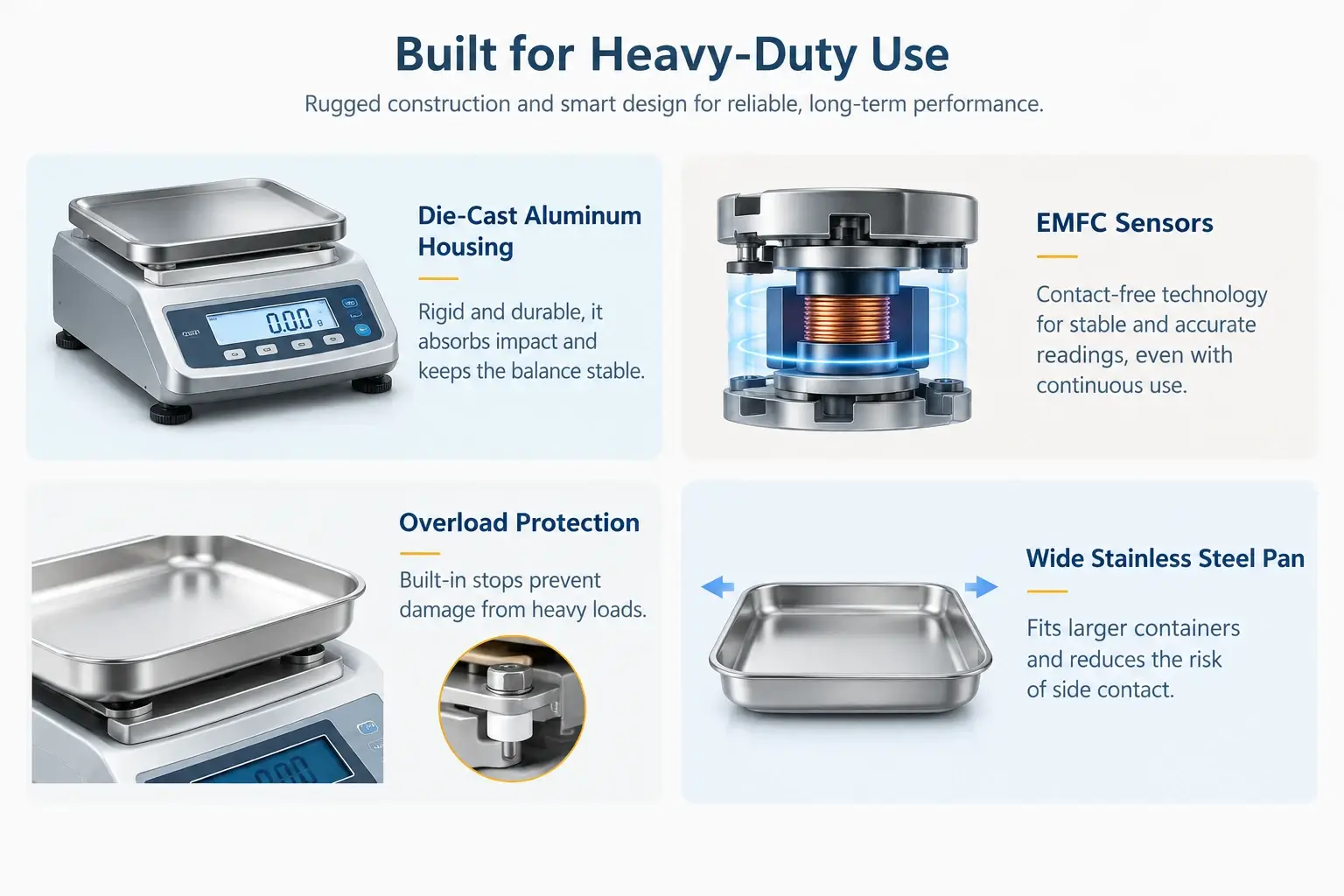
Processing continuous batches of metal scrap requires industrial-tier resilience. Precision instruments built with lightweight consumer plastics quickly degrade under commercial trade conditions.
Die-Cast Aluminum Base and Rigid Housing
Lightweight plastic enclosures flex under load and distort over time when exposed to heavy items. A rigid die-cast metal housing provides the physical mass needed to absorb mechanical energy. When an intake operator unloads a heavy container of scrap rings or raw ingots onto the pan, a rigid aluminum structure isolates internal electronics from shock waves, maintaining zero alignment.
Fatigue Resistance of Electromagnetic Force Compensation (EMFC) Sensors
High-capacity weighing instruments rely on distinct sensor technologies. While common resistance strain gauges are inexpensive, repeated loading causes physical fatigue in the metal elements, producing gradual zero-point drift.
Electromagnetic Force Compensation (EMFC) mechanisms use an active electromagnetic coil floating within a permanent magnetic field. Instead of measuring mechanical deformation, the circuit delivers the exact electrical current necessary to return the counterbalanced beam to zero. This contact-free electromagnetic restoration delivers indefinite operational repeatability, resisting fatigue across continuous daily weigh-ins.
Mechanical Overload Protection and Broad-Surface Pans
Commercial gold evaluation requires large weighing vessels, deep transfer bowls, and melting crucibles.
- Built-In Overload Stops: Heavy-duty balances feature mechanical limiters beneath the spider assembly. These physical stops arrest downward travel before excessive downward thrust damages the internal suspension bands.
- Thickened Stainless Steel Pan: A generous stainless steel surface accommodates wide containers, ensuring samples do not overhang or rub against side walls, which can introduce friction-induced tare errors.
II. Enhanced Material Handling: The Advantage of Three-Door Draft Shield Balances
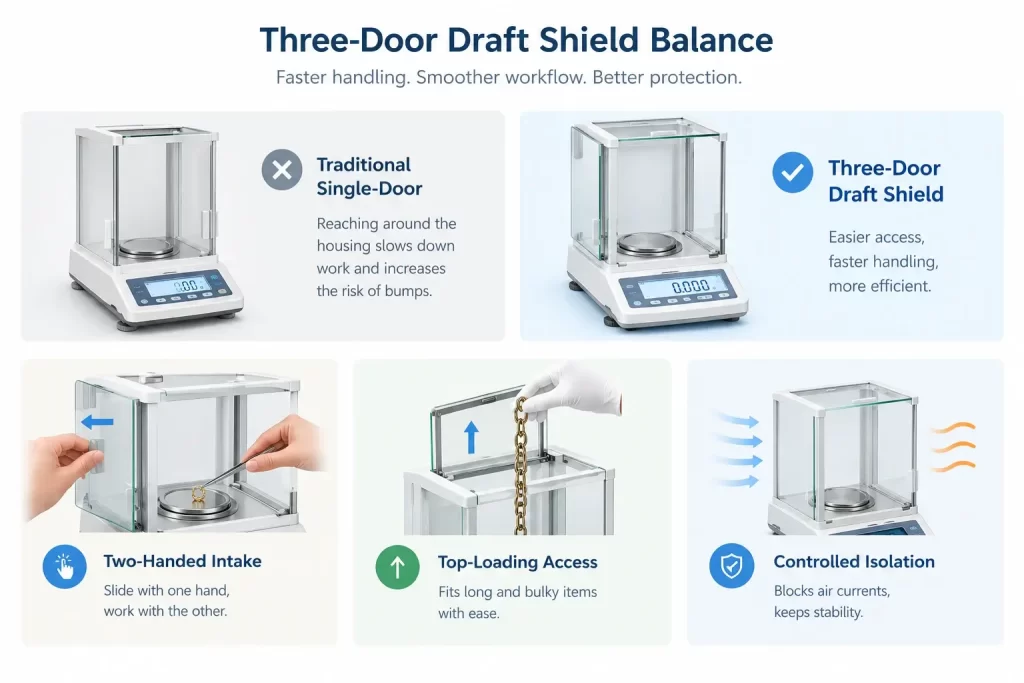
Sensitive balances require draft protection, but clumsy enclosures slow down daily high-frequency transactions.
Bottlenecks of Traditional Single-Door Enclosures
Conventional draft chambers with a single access door or a hinged clam-top disrupt intake workflow. Operators must repeatedly reach around the housing to place samples, slowing down high-volume cataloging and increasing the chance of bumping the enclosure.
Operational Advantages of Three-Door Draft Shield Balances
Modern draft shield balances designed for commercial workstations incorporate three independent sliding panels (left, right, and top):
- Fluid Two-Handed Intake: Technicians can slide open the left panel with one hand while manipulating sorting tweezers or scoops with the right. This direct path speeds up fast pipetting, sorting, and continuous feeding.
- Top-Loading Access for Elongated Stock: Long cast bars, coiled chains, and melt tubes drop in vertically through the ceiling hatch without catching on the side frame.
- Controlled Environmental Isolation: Adjusting the panels to narrow gaps blocks direct HVAC air currents while allowing hot, freshly melted samples to dissipate thermal convection, keeping daily throughput moving efficiently.
III. Overcoming Surface Limits: Under-Hook Weighing Balances for Specialized Testing
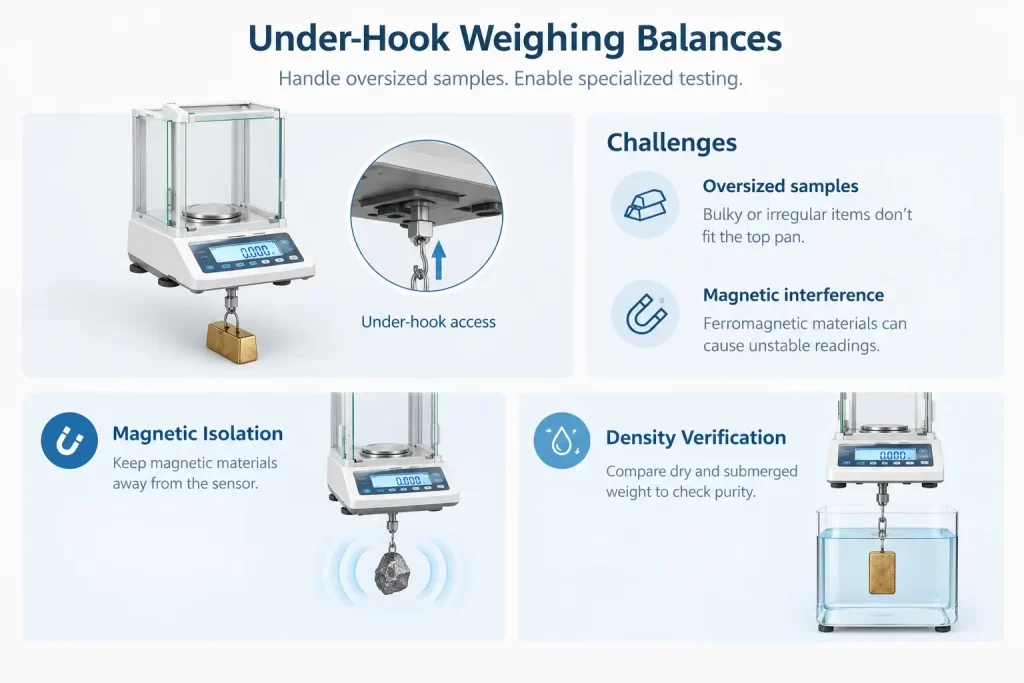
Standard top-loading pans struggle when presented with outsized scrap or suspected counterfeit materials.
Challenges Beyond the Weighing Surface
- Oversized Geometry: Bulky master molds, irregular scrap clusters, and raw bullion bars often exceed standard pan dimensions or draft chamber clearance.
- Magnetic Interference: Unrefined scrap frequently contains iron, cobalt, or nickel impurities. Placing ferromagnetic samples directly above an EMFC sensor distorts the electromagnetic field, resulting in erratic readouts.
Practical Applications of Under-Hook Weighing Balances
Factory-configured under-hook weighing balances feature an access port through the bottom casting, extending measurement capability beneath the workbench:
- Magnetic Isolation: Suspending questionable scrap batches beneath the instrument isolates ferromagnetic materials from the electromagnetic assembly above. The distance eliminates false attractive forces, ensuring the sensor registers purely gravitational mass.
- Hydrostatic Density Verification: By linking the under-hook to an immersion rig holding water or auxiliary fluids, operators can execute direct Archimedes’ principle testing. Measuring dry weight versus buoyant submerged weight allows gold buyers to verify the specific gravity of large bars and uncover tungsten cores without drilling into the metal.
IV. Eliminating Off-Center Load Errors: Leveling Systems and True Alignment

Accurate gravitational measurement requires a level instrument. Even small floor or bench misalignments introduce systematic balance errors.
The Physics of Cosine Tilt Error
A balance measures the vertical gravitational force vector acting normal to its pan:
F = mg · cosθ
If an intake counter has a tilt of just 1° (θ = 1°), the vertical force component drops by the factor of cos(1°) ≈ 0.99985. On a 2,000-gram lot of scrap gold, this angular tilt subtracts roughly 0.3g of detected mass. At scale, this angular deviation creates systemic margin loss.
Structural Leveling Architecture
Professional balances counter angular errors through dedicated stabilization hardware:
- Heavy-Duty Leveling Feet: Broad-diameter feet machined with fine-pitch metal threads resist settling under heavy daily loads. Integrated locknuts prevent foot drift caused by continuous counter vibration.
- Integrated Optical Spirit Level: A front-mounted spirit bubble gives operators a direct visual reference to confirm physical alignment at a glance.
- Automatic Internal Calibration (Auto CAL): Factory-integrated internal mechanisms deploy reference weights automatically based on timer intervals or ambient temperature fluctuations, removing the need for manual handling of external test weights.
- Configurable Digital Filtering: Selectable signal filters smooth out structural ambient tremors, foot traffic, and air turbulence, delivering stable readouts without display lag.
V. Data Integration, Transaction Integrity, and Audit Trails
Manual weight transcription introduces human error and creates opportunities for internal shrinkage. Commercial intake workstations require electronic records for every transaction.
- Bidirectional RS-232 / USB Interfaces: Connecting the balance directly to a dedicated thermal ticket printer or store POS terminal generates duplicate physical receipts with timestamps, batch designations, and tare values. One copy stays with the vendor; the other goes directly into the auditing file.
- Instant Unit Conversion: Commercial buying desks handle varied units based on global origin. The internal firmware should toggle instantly between standard grams (g), troy ounces (ozt), pennyweights (dwt), metric carats (ct), and regional standards like Tola or Mesghal without manual conversion math.
- Weighing Parameter Lock: Supervisory lockouts prevent accidental button presses from changing units, print profiles, or filter modes mid-transaction, keeping data consistent across counter shifts.
VI. Benchmark Model for Commercial Intake: Stuccler SENSE-JD Series
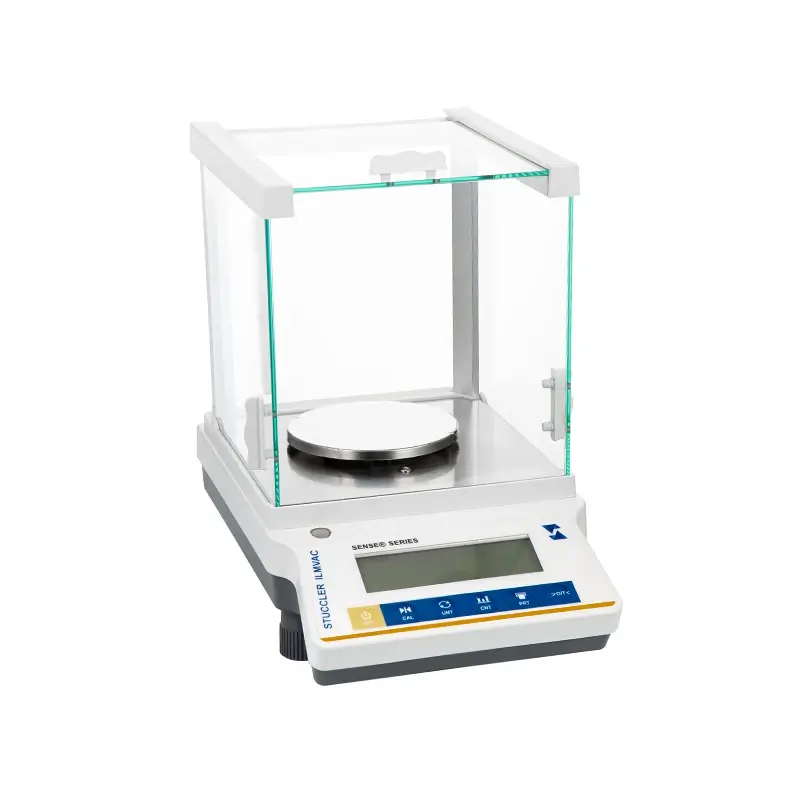
For precious metal brokers requiring laboratory precision alongside heavy-duty throughput, the Stuccler SENSE-JD Series serves as a direct hardware benchmark for high-volume trade.
Hardware Engineering Highlights
- Cast Aluminum Subframe: Engineered with a rigid aluminum lower body and heavy-duty ABS covers to withstand busy intake operations.
- φ120mm Solid Stainless Pan: An expansive platform that readily supports wide collection jars and standard melting crucibles.
- Factory-Fitted Draft Enclosure and Under-Hook: Out of the box, the unit includes an all-glass three-door enclosure and a dedicated bottom weighing hook for fast sample handling and density checks.
- Automated Internal Calibration: An internal motorized mechanism self-calibrates the instrument in response to detected temperature shifts, keeping accuracy steady all day.
- Wide Unit Matrix & Security: Provides 20 selectable weighing units, automated interface locks, and a clear VATN backlit display visible across counter dividers.
SENSE-JD Series Specifications Matrix
| Model | Capacity | Readability (ddd) | Repeatability | Linearity | Typical Application Scenarios |
| JD-R102Q | 1020g / 5100ct | 1mg / 0.01ct | ±1 mg | ±2 mg | Fast over-the-counter buybacks, estate sorting, scrap lot grading |
| JD-R152Q | 1520g / 7600ct | 1mg / 0.01ct | ±1 mg | ±2 mg | High-volume pawn intake, bulk estate jewelry lots, casting houses |
| JD-R202Q | 2020g / 10100ct | 1mg / 0.01ct | ±1 mg | ±2 mg | Kilogram-bar verification, refinery scrap intake, high-capacity trade |
VII. Model Selection & Comparison Checklist
| Evaluation Criteria | Entry-Level Retail Scales | Standard Industrial Bench Scales | Benchmark: SENSE-JD Balances |
| Capacity vs. Precision | 500g x 0.01g (Restricts batch sizes) | 3kg–20kg x 0.1g (Lacks milligram precision) | 1020g–2020g x 1mg (High load with analytical precision) |
| Sensor Architecture | Inexpensive strain gauge; susceptible to mechanical shock | Standard strain gauge; prone to temperature-induced zero drift | EMFC restoration; fatigue-resistant under sustained loading |
| Calibration Method | Manual external application using loose hand weights | Manual external calibration with hand weights | Fully automatic internal motorized calibration (Auto CAL) |
| Draft Enclosure | Plastic flip-tops or open pans | Open platform without draft protection | All-glass three-door sliding enclosure (left/right/top access) |
| Specialized Density Testing | No auxiliary bottom ports | Occasional hook access; limited milligram buoyancy tracking | Integrated under-hook for immediate hydrostatic verification |
| Chassis Durability | Thin molded plastics; prone to flexing | Folded sheet metal or basic aluminum housings | Die-cast aluminum structural base with reinforced shell |
| Data Integrity | Display only; manual logbooks | Basic continuous output; prone to interface mismatch | RS232 interface, 20 weighing units, and operational parameter lock |
Conclusion & Sourcing Next Steps
Protecting profits during high-volume precious metal purchases comes down to precision, throughput, and reliable data capture. Three-door draft enclosures accelerate everyday material handoffs. Under-hook weighing ports allow quick density checks on suspicious bullion. Rigid die-cast bases and leveling hardware protect the measurement axis against daily physical wear. Upgrading to an EMFC balance that pairs 2-kilogram capacity with 1-milligram readability gives buyers a solid defense against cumulative weight discrepancies.
To outfit your commercial evaluation stations with professional-grade balances, consult with Stuccler. As a premier jewelry scale manufacturer and supplier, Stuccler provides complete B2B manufacturing support, custom technical specifications, and private-label OEM services for enterprise gold buyers and retail networks. Contact their engineering team today to configure the right high-capacity weighing solution for your operational needs.