
If you’ve ever tried to weigh gold dust, a delicate silver chain, or a freshly cast platinum ring, you’ll know how unforgiving precious metals can be when it comes to accuracy. Even a tiny difference—say, 0.05 grams—can shift the price by tens of dollars. That’s why jewelers, refiners, and metal traders depend on precision scales every single day.
Yet, not all “digital jewelry scales” are created equal. Many inexpensive models look similar online but fail to stay consistent once used regularly. Numbers flicker, units jump from grams to ounces, and calibration drifts over time. I’ve seen workshops unknowingly lose money because their scales weren’t telling the truth.
So, how do you pick a scale you can actually trust? Let’s walk through what really matters before you buy one.
Why Precision Is More Than a Technical Term
In jewelry and metalwork, precision directly translates to value. When crafting gold rings or mixing alloys, you rely on accurate ratios. A small deviation can ruin an entire batch. The same goes for traders pricing recycled silver or evaluating gemstones—the difference between 2.00g and 2.01g might decide whether a deal makes sense.
In my own experience, once you move into fine metals, a resolution of 0.001g becomes a must. Anything less, and you’ll be guessing rather than knowing.
What to Look For in a Reliable Jewelry Scale
After testing dozens of models, here’s what consistently separates a professional tool from a disposable gadget.
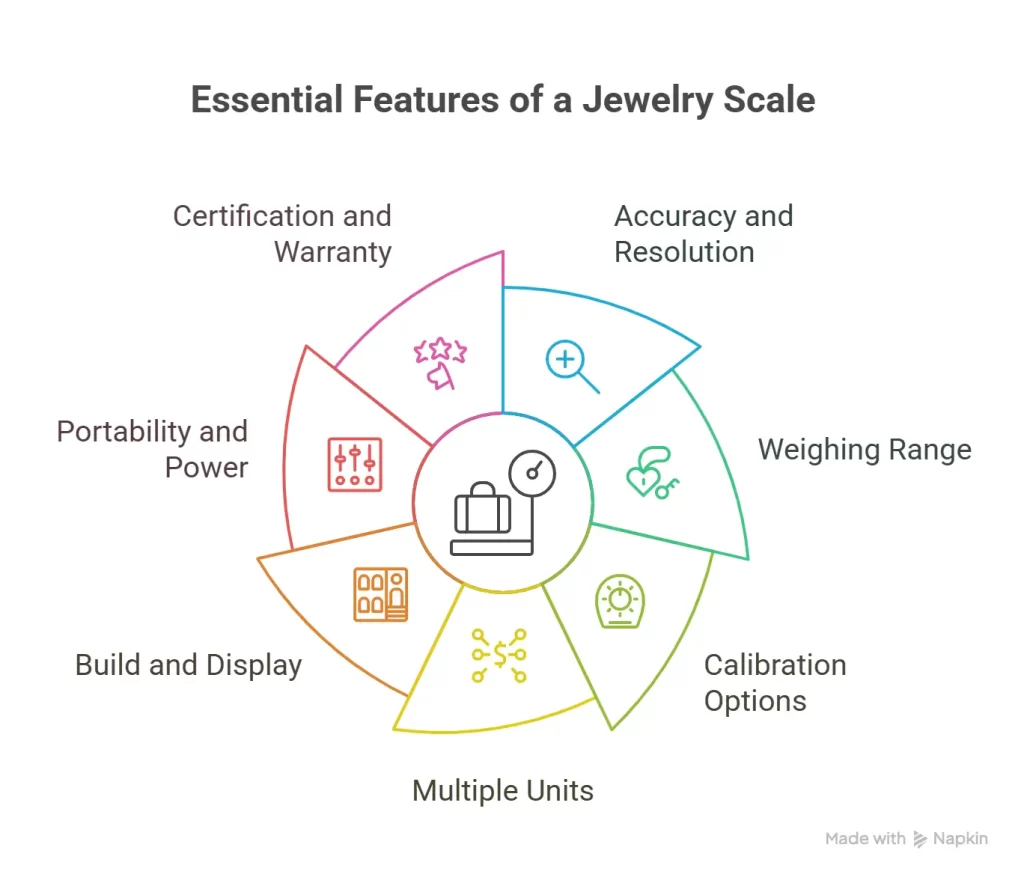
1. Accuracy and Resolution
For gold, silver, or gemstones, look for 0.01g or finer (0.001g) resolution. High resolution ensures repeatable results even for small pieces.
2. Weighing Range
A practical range is 200g–500g, enough for small parts and mid-sized metal pieces. Going too high usually sacrifices precision.
3. Calibration Options
Regular calibration keeps the scale honest. Models that allow manual or automatic calibration with certified weights are worth the investment.
4. Multiple Units
Switching between grams, carats, pennyweights (dwt), or ounces can save time, especially if you sell internationally.
5. Build and Display
A solid metal platform, stable feet, and a backlit LCD display make a real difference in daily use. Cheap plastic casings tend to warp or cause drift.
6. Portability and Power
If you attend trade shows or buy metals on-site, a compact USB-rechargeable pocket scale is a great pick. For studio work, bench-top models with continuous AC power are more stable.
7. Certification and Warranty
Look for scales that comply with OIML or CE standards and come with a decent warranty. It shows the maker takes precision seriously.
Technical Support Note: As an industrial manufacturer, Stuccler provides OIML and CE compliant weighing systems for professional workshops and material laboratories. If you require bulk equipment sourcing configurations or official product datasheets.
Best Scales for Weighing Gold and Silver: Which Type Fits Your Work?
Pocket Scales
Small and highly portable, pocket scales are designed primarily for traveling jewelers, pawn brokers, and field appraisers who need to conduct rapid, on-site material sorting. While excellent for mobility and basic cross-checking of light items, their compact strain gauge sensors are highly sensitive to ambient draft, vibration, and temperature changes. For a high-volume refining shop or an alloy manufacturing floor, the structural limitation of a pocket-sized platform can eventually lead to unnoticeable calibration drift over continuous shifts.
Bench Scales
Designed specifically for heavy-duty workshop environments. They are heavier, more structurally stable, and capable of handling larger metal casting pieces without vibration interference. Commercial bench models (such as the Stuccler Precision Series) utilize rigid housing to isolate the internal load cells, making them the standard choice for reliable daily scrap gold intake and silver refining operations.
Professional Balances
Used in stationary laboratories or high-end jewelry studios where extreme precision (0.001g to 0.0001g) is non-negotiable. These analytical systems feature an enclosed weighing chamber with built-in glass draft shields to completely isolate the weighing pan from room air currents, ensuring the highest repeatability for gemstone appraisal and precise fine gold alloy formulation.
Each has its place—it’s less about price, more about where and how you use it.
Keeping Your Scale Accurate
Even the best scale can lose accuracy if mistreated. Always place it on a flat, vibration-free surface, away from drafts or air vents. Calibrate it frequently—once a week if you use it daily. Clean the platform gently with a soft cloth, never with water. And when not in use, store it in its box or cover to prevent dust buildup.
Temperature changes can also throw readings off. If your workshop gets cold at night and hot during the day, let the scale rest for a few minutes before use. Precision thrives on consistency.
A Brand Worth Considering
For anyone serious about precision, Stuccler’s digital jewelry scales are well worth a look. They’re built with jewelers in mind—tight tolerances, easy calibration, and a rugged design that holds up to daily use. The higher-end models even feature 0.001g precision sensors and multi-unit displays, ideal for both professional studios and investment collectors.
They’re not the cheapest, but they’re the kind of tools that pay for themselves by avoiding mistakes.
Final Thoughts
Accuracy in jewelry and precious metal work isn’t optional—it’s the backbone of trust and craftsmanship. Whether you’re weighing gold flakes or full silver bracelets, the right digital scale helps you stay precise, consistent, and confident in your results.
Take your time to choose one that fits your workflow. If you want something you can rely on for years, explore Stuccler for tested and proven jewelry scales built for professionals.