

Have you ever experienced continuous reading drift or delayed stability indicators on your analytical balance? In micro-level weighing, environmental vibration is the primary invisible killer that compromises accuracy. Solving this requires a three-pronged approach: optimizing software filtering, strategic physical relocation, and employing high-damping hardware isolation.
Root Cause Analysis: How Do Invisible Vibrations Compromise Balance Results?
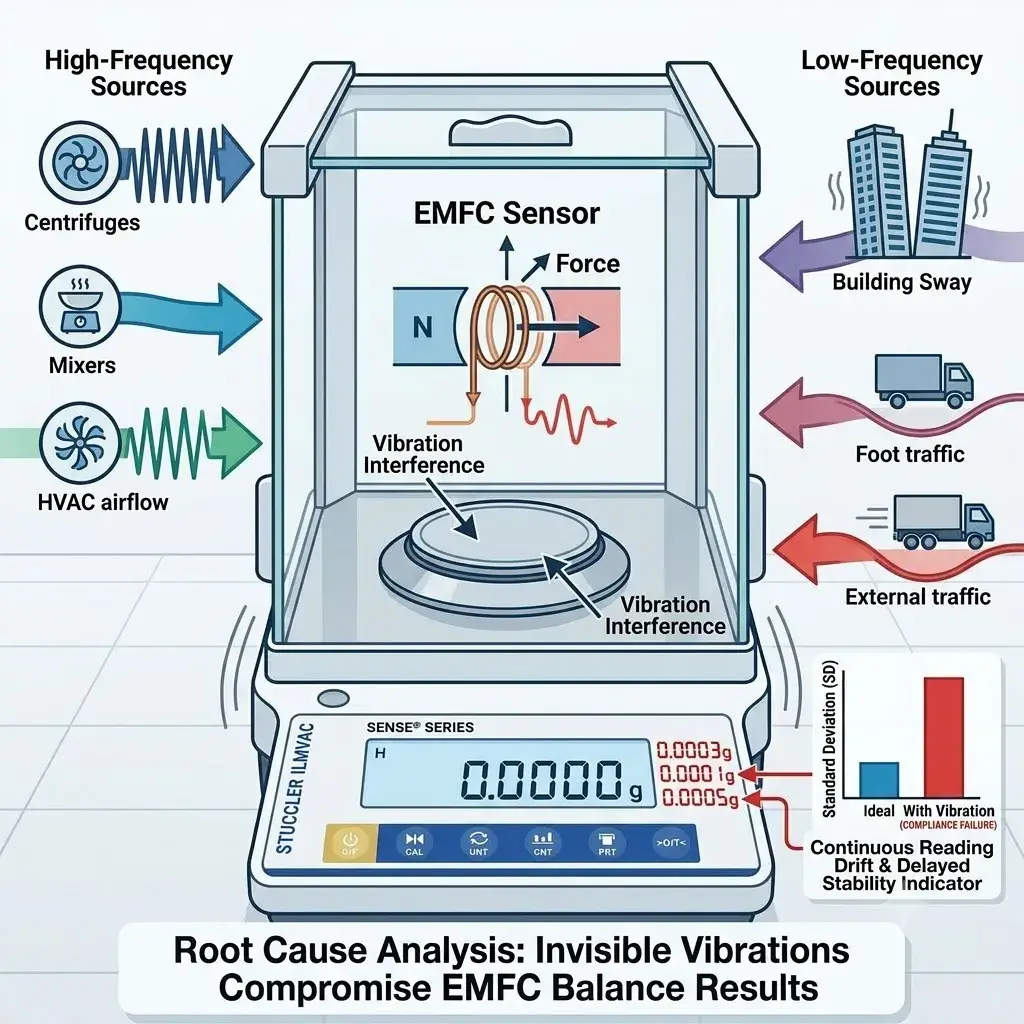
Brief Overview of Balance Operation
Modern Electromagnetic Force Compensation (EMFC) sensors are extremely sensitive. They do not measure mass directly. They measure the counter-force required to displace a coil in a magnetic field.
When a sample is placed on the pan, a position sensor detects the microscopic movement. An electric current is passed through the coil to return it to its original position. This current is directly proportional to the weight.
Even minute vibrations introduce additional mechanical acceleration. This changes the dynamic force acting on the pan. The EMFC sensor misinterprets this acceleration as a change in weight. It leads to unstable current adjustments and constant display drift.
Classification of Vibration Sources
Vibrations come from many places. Use this troubleshooting checklist to find them:
- High-Frequency Vibration: Laboratory centrifuges operating at high RPM, vortex mixers, refrigerator compressor resonance, and high-velocity airflow from HVAC diffusers striking the draft shield.
- Low-Frequency Vibration: Micro-swaying of tall building structures due to wind loads, rhythmic foot traffic in corridors, and external road traffic like heavy trucks or subways passing nearby.
Compliance Consequences
Vibration drastically increases standard deviation across replicate measurements. It directly causes the lab balance to fail compliance tests for Minimum Weight and Repeatability.
Under the strict guidelines of USP Chapter 41, the repeatability of a balance is satisfactory if two times the standard deviation divided by the nominal mass does not exceed 0.10%. When ambient vibration causes the final digit to fluctuate, your standard deviation spikes, rendering the entire data set legally non-compliant during a regulatory audit.
Step 1: Zero-Cost Software Fix — Adjusting Internal Balance Filter Settings
Before purchasing any new hardware, maximize the potential of the balance’s built-in Digital Signal Processing (DSP) capabilities.
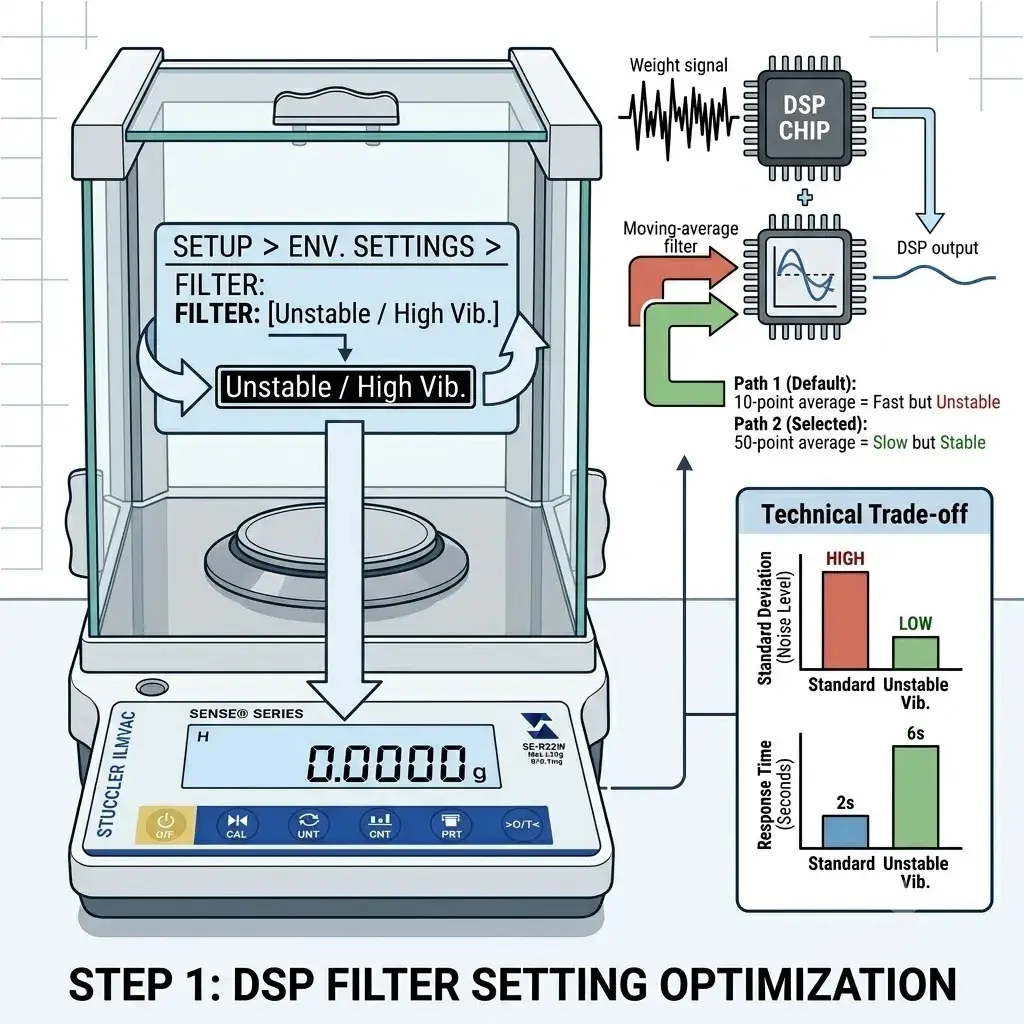
Specific Steps
- Enter the main setup menu of your instrument.
- Navigate to the Environmental Settings or Filter Settings sub-menu.
- Locate the current ambient condition parameters.
- Change the default Standard or Stable mode.
- Select the Unstable / High Vibration mode.
Technical Analysis
This action activates a smoothing moving-average algorithm with a significantly longer time constant. The DSP chip samples the weight signals at a high frequency but averages a much larger pool of data points before updating the LCD display.
The Technical Trade-off: The advantage is that the readings stabilize because high-frequency noise is mathematically flattened. The disadvantage is a sharp increase in the balance’s response time, often jumping from 2 seconds to 6 seconds. This slows down fast-paced formulation work, representing a direct trade-off between speed and raw stability.
Step 2: Low-Cost Spatial Optimization — Lab Site Selection and Bench Adjustment
Where you place your equipment matters. Use this standard operating procedure (SOP) guide for physical site selection to minimize structural disturbances.
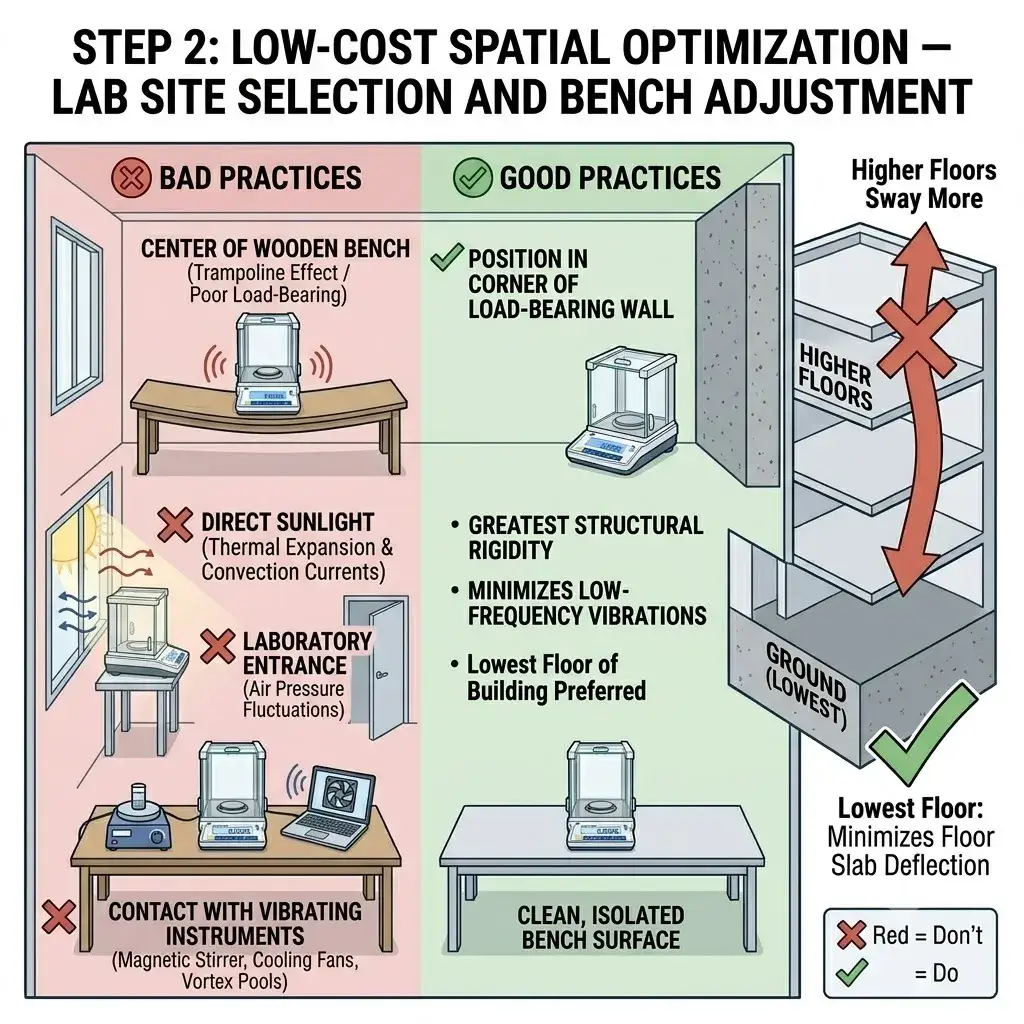
Physical Site Selection Guide
Do not place the balance in the center of a wooden lab bench. Wooden structures have poor load-bearing capacity and act like a trampoline for low-frequency steps.
Never set up directly next to a window. Direct sunlight causes thermal expansion inside the balance housing. It creates internal convection currents that mimic mechanical vibration. Avoid placement near the laboratory entrance where swinging doors alter air pressure.
Instead, position the unit in the corner of a true load-bearing wall. This specific area offers the greatest structural rigidity. It minimizes low-frequency vibrations caused by floor slab deflection. Choose the lowest floor of the building if possible. Higher floors sway much more.
Bench Environment
Keep the surface clean. Ensure the weighing bench is free of contact with any operating instruments. Magnetic stirrers, vortex pools, or computers with cooling fans must absolutely not be placed on the same surface. The structural energy transfers directly through the bench frame, causing the balance pan to vibrate.
Step 3: Ultimate Hardware Isolation — Introducing Anti-Vibration Tables and Damping Equipment
When software modifications and spatial relocation fail to achieve sub-milligram stability, you must invest in dedicated mechanical isolation.
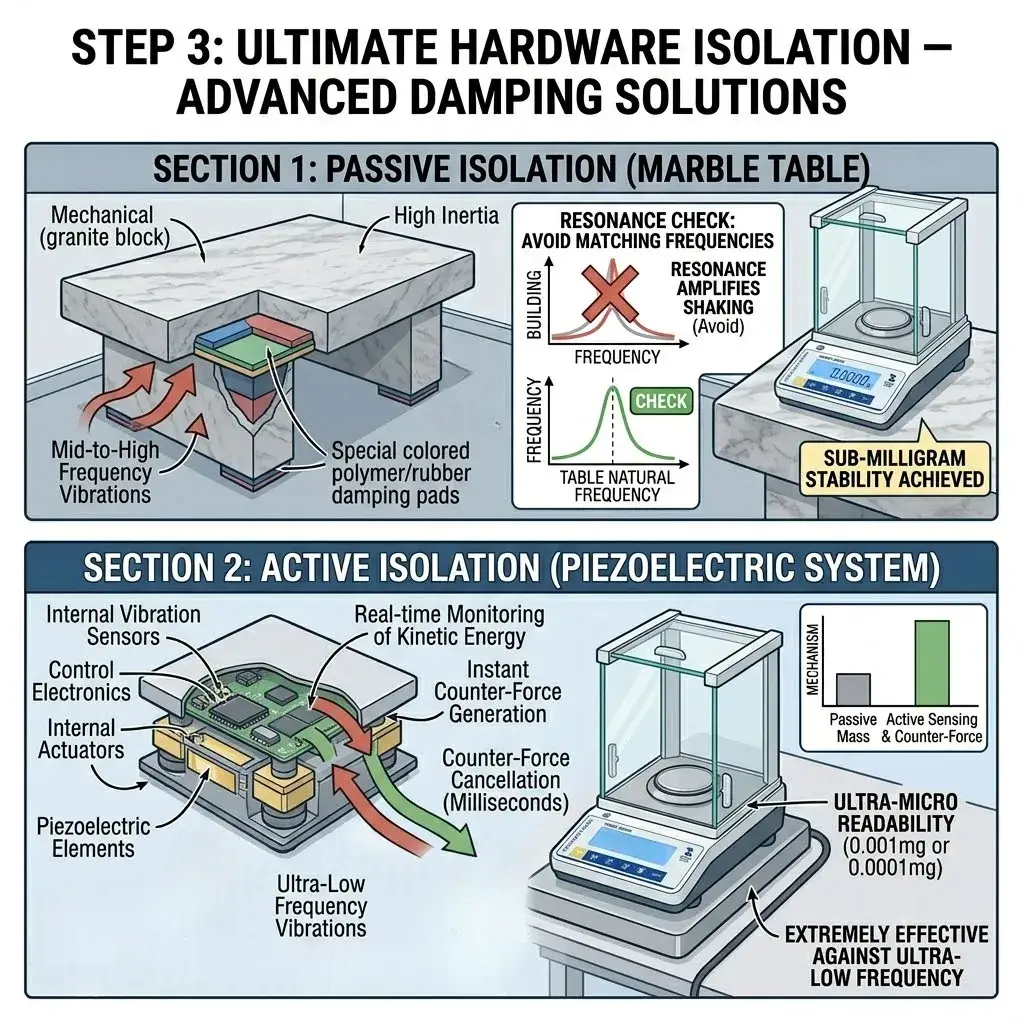
Passive Isolation: Marble Anti-Vibration Table
A heavy marble table works exceptionally well. It utilizes a high-mass, rigid granite block as a mechanical low-pass filter. The sheer mass of the stone creates high inertia, meaning it requires a massive amount of external energy to move.
Combined with specialized polymer or rubber damping pads underneath, the system effectively absorbs and isolates mid-to-high-frequency vibrations before they reach the balance feet.
- Technical Selection Tip: Always verify that the anti-vibration table’s natural frequency does not coincide with the ambient resonant frequency of your building. If they match, resonance occurs. It amplifies the shaking, making the balance readings worse than before.
Active Isolation: Piezoelectric Systems
This is the gold standard for advanced micro-balances with 0.001mg or 0.0001mg readability. Active piezoelectric isolation tables do not rely on mass alone. They feature internal vibration sensors that continuously monitor incoming kinetic energy in real-time.
The system instantly fires internal actuators to generate exact counter-forces, canceling out the ambient vibration within milliseconds. While costly, they are extremely effective against ultra-low-frequency ground vibrations where passive tables fail.
Summary
Addressing vibration issues is a systematic process. It moves from the inside out. It transitions from soft software settings to hard physical equipment solutions.
If you want to eliminate stability issues from the start, choose a high-quality lab balance built for demanding industrial and scientific environments. Stuccler designs premium precision weighing instruments engineered with advanced internal dampening and superior DSP filtering to actively fight workplace vibration.
We support bulk purchasing for outfitting entire facility upgrades and new laboratory builds. Contact our application specialists today to find the ideal high-stability setup for your lab.