

Precision is the heartbeat of every laboratory. Whether formulating pharmaceuticals or analyzing metallurgical samples, a slight drift can ruin weeks of research. Beyond the price tag and decimal places, a truly reliable balance must provide consistent, professional-grade accuracy under pressure.
1. Critical Metrological Specs: Beyond Readability and Capacity
First-time buyers often make a common mistake. They assume “readability” is the same as “accuracy.” It isn’t. Readability is simply the smallest increment the screen can display. True performance is defined by deeper metrics.
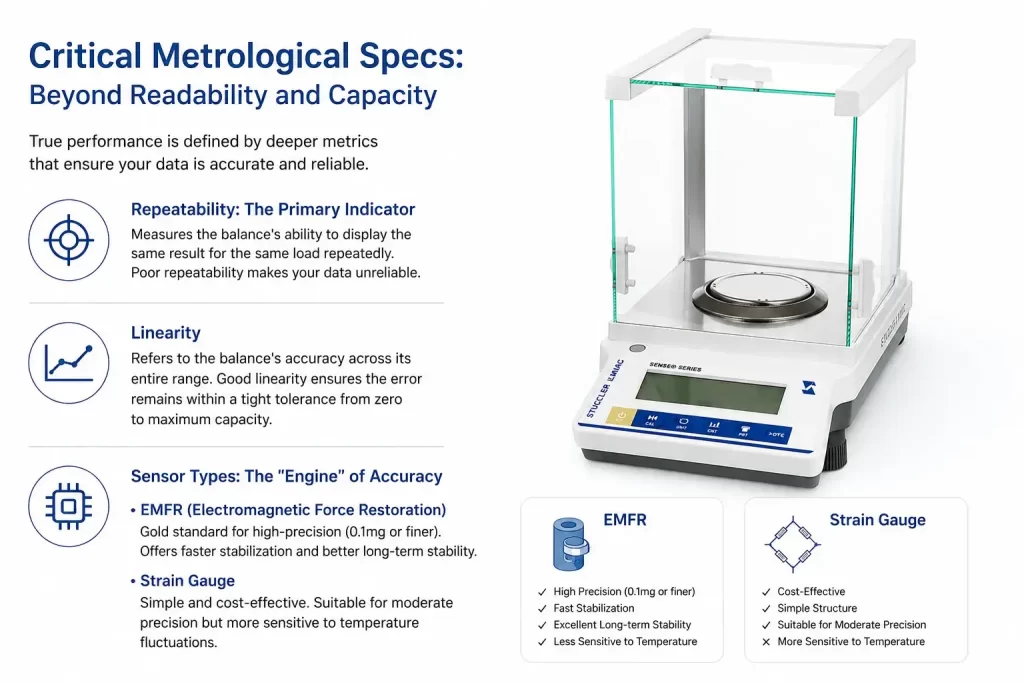
- Repeatability: The Primary Indicator. Repeatability is the most vital spec. It measures the balance’s ability to display the same result for the same load repeatedly. We define this as the standard deviation of multiple weighings. In precision-critical industries, if your repeatability is poor, your data is effectively useless. You cannot trust a single result.
- Linearity: Linearity refers to the balance’s accuracy across its entire range. A balance might be perfect at 10g but off at 100g. Good linearity ensures that the error remains within a tight tolerance from zero to maximum capacity.
- Sensor Types: The “engine” of your balance determines its lifespan and precision:
- EMFR (Electromagnetic Force Restoration): These sensors use a magnetic coil to counteract the weight. They are the gold standard for high-precision applications (0.1mg or finer). They offer faster stabilization and better long-term stability.
- Strain Gauge: These are simpler and more affordable. They work well for moderate precision where cost-effectiveness is the goal. However, they are more sensitive to temperature fluctuations.
2. Automated Calibration: Ensuring Consistent Accuracy Over Time
Gravity and temperature are constant variables. A reliable balance must account for them. Manual calibration is often neglected in busy labs. This leads to measurement drift.
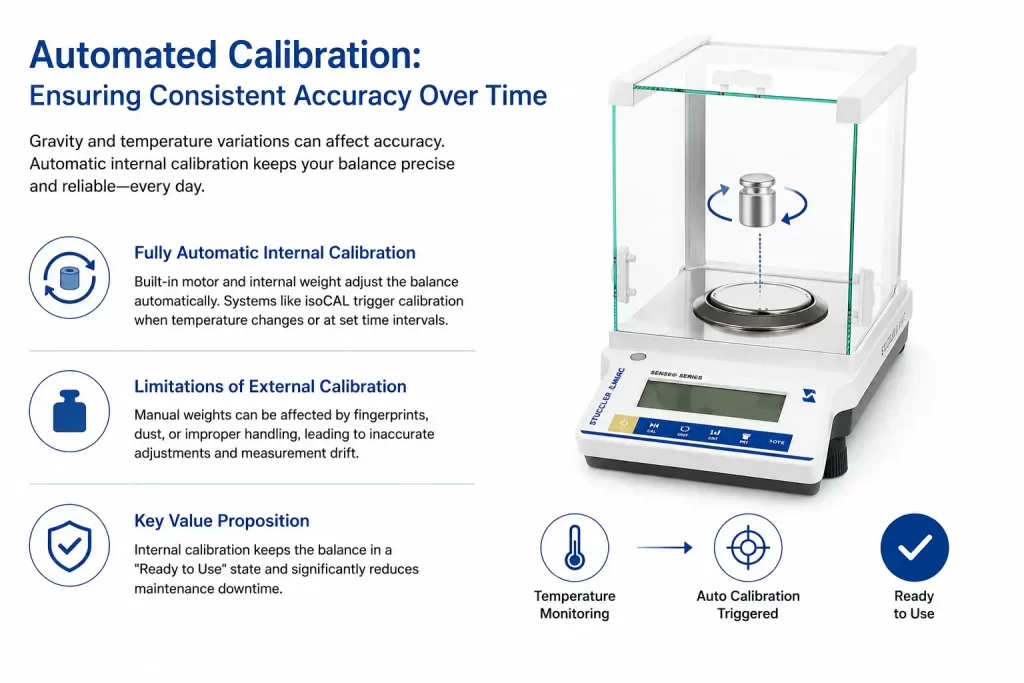
- Fully Automatic Internal Calibration: High-end balances feature internal calibration. The device uses an internal motor and a built-in weight to adjust itself. Advanced systems like isoCAL trigger automatically when they detect a change in ambient temperature. They can also be set to run at specific time intervals.
- Limitations of External Calibration: External calibration relies on manual weights. These weights are easily compromised. A tiny fingerprint or a speck of dust can change a weight’s value. Furthermore, improper handling techniques often lead to inconsistent adjustments.
- Key Value Proposition: Internal calibration keeps the balance in a “Ready to Use” state. It reduces maintenance downtime significantly.
3. Stability Features: Managing Environmental Interference
A lab is not a vacuum. Airflow, vibrations, and static electricity are constant enemies of precision.
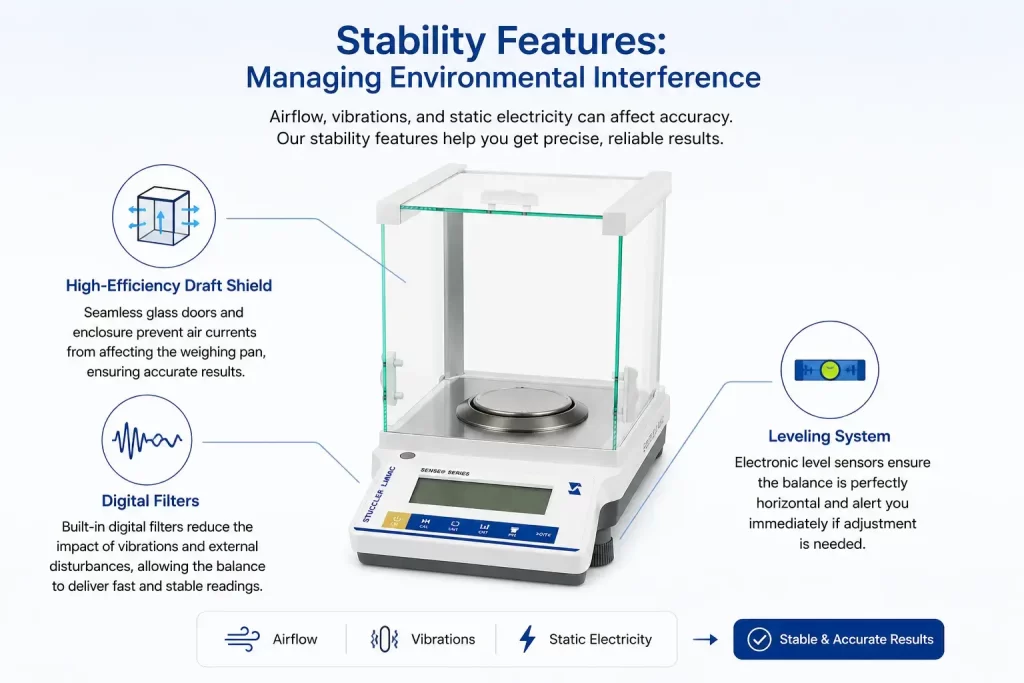
- High-Efficiency Draft Shield: For analytical balances, a draft shield is mandatory. The design matters. Seamless glass doors prevent air currents from nudging the weighing pan.
- Digital Filters: Built-in software can save your data. Digital filters smooth out signals caused by floor vibrations or nearby machinery. They allow the balance to lock onto a stable reading quickly.
- Leveling System: If a balance is tilted, the force vector is wrong. Electronic level sensors now replace the old manual bubbles. They alert the user immediately if the device is not perfectly horizontal.
4. Structural Integrity: Durability and Overload Protection
Hardware craftsmanship dictates the long-term ROI of your equipment.
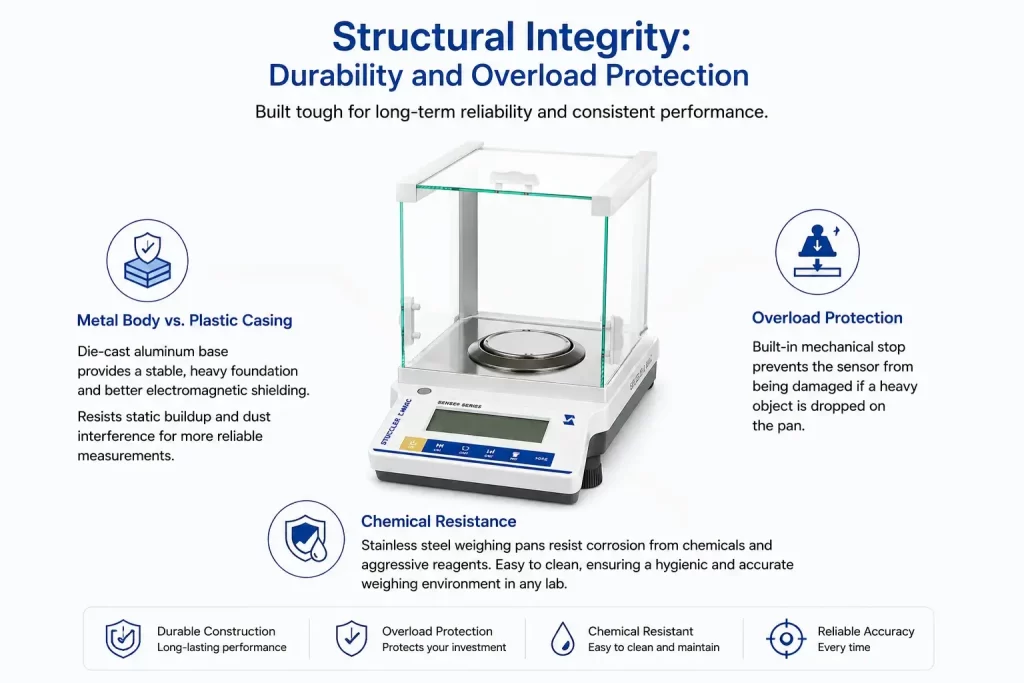
- Metal Body vs. Plastic Casing: A die-cast aluminum base is superior. It provides a heavy, stable foundation. It also offers better electromagnetic shielding. Plastic casings are prone to static buildup, which attracts dust and interferes with the sensor.
- Overload Protection: Accidents happen. A good balance includes a mechanical stop. This prevents the sensor from being crushed if a heavy object is dropped on the pan.
- Chemical Resistance: In labs handling dental materials or aggressive reagents, the materials must be tough. Look for stainless steel weighing pans. These are easy to clean and resist corrosion. Even when servicing complex tools like a dental handpiece, maintaining a clean, chemical-resistant weighing area is essential for hygiene and accuracy.
5. Digital Compliance: Connectivity and Data Integrity
In the era of digital transformation, a “reliable” balance must also be a “connected” one. Data must be traceable to stand up to audits.
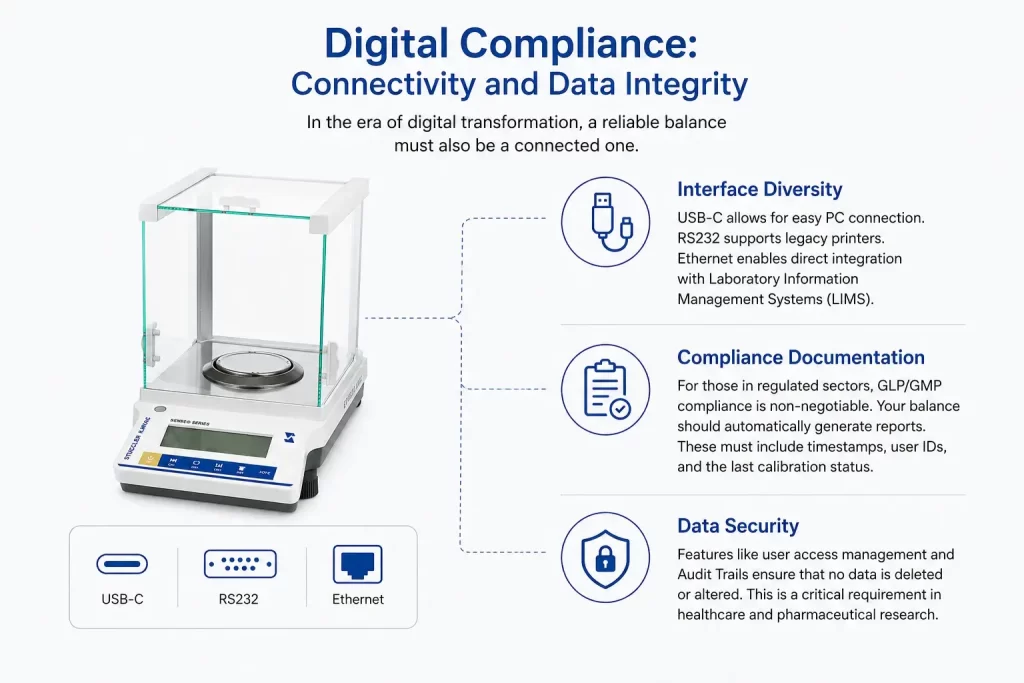
- Interface Diversity: Modern labs need options. USB-C allows for easy PC connection. RS232 supports legacy printers. Ethernet enables direct integration with Laboratory Information Management Systems (LIMS).
- Compliance Documentation: For those in regulated sectors, GLP/GMP compliance is non-negotiable. Your balance should automatically generate reports. These must include timestamps, user IDs, and the last calibration status.
- Data Security: Features like user access management and Audit Trails ensure that no data is deleted or altered. This is a critical requirement in healthcare and pharmaceutical research.
Conclusion
Choosing a laboratory weighing balance is an investment in your data’s credibility. By prioritizing repeatability, automated calibration, and structural durability, you ensure that your lab remains productive and compliant. Don’t settle for a simple scale when your research demands a precision instrument.
If you are looking to upgrade your facility, explore the professional range at Stuccler. We specialize in high-performance weighing solutions designed for rigorous environments. From individual units to bulk orders for large-scale operations, we provide the technical support and B2B flexibility your business requires. Trust Stuccler for accuracy that lasts.