

High-throughput labs and production lines running 8+ hour shifts face constant challenges with reading drift, load-cell fatigue, and the restrictive 200g–300g capacity of standard 1mg balances. High-capacity Electromagnetic Force Compensation (EMFC) precision balances solve these bottlenecks, delivering thermal stability, frictionless durability, and expanded weighing ranges up to 2020g for heavy daily workloads.
I. Technical Analysis: Why Choose EMFC Over Standard Strain Gauges for Heavy-Duty Operations?
Strain gauge balances rely on bending metal flexures, making them prone to mechanical fatigue, slow stabilization, and drift during intensive use. In contrast, Electromagnetic Force Compensation (EMFC) balances use frictionless magnetic coil feedback to eliminate physical wear, maintaining reliable ±1 mg repeatability even under non-stop daily workloads.
| Performance Metric | Traditional Strain Gauge Balance | Industrial EMFC Precision Balance |
| Operating Mechanism | Physical metal beam deflection | Electromagnetic position counter-force |
| Mechanical Fatigue | Moderate to high over prolonged cycles | Virtually non-existent (frictionless restoration) |
| Repeatability (1 mg Resolution) | Shifts to ±3 mg~±5 mg under continuous load | Consistently maintained at ±1 mg |
| Linearity Deviation | ±5 mg~±10 mg across full span | ±2 mg throughout 1 kg–2 kg range |
| Thermal Sensitivity | High temperature drift; requires manual zeroing | Active temperature compensation algorithms |
| Total Cost of Ownership (TCO) | Higher long-term cost via batch rework and early sensor failure | Lower TCO through reduced scrap, less downtime, and longer service life |
II. Four Key Criteria for Selecting Balances for Heavy-Duty Daily Operations
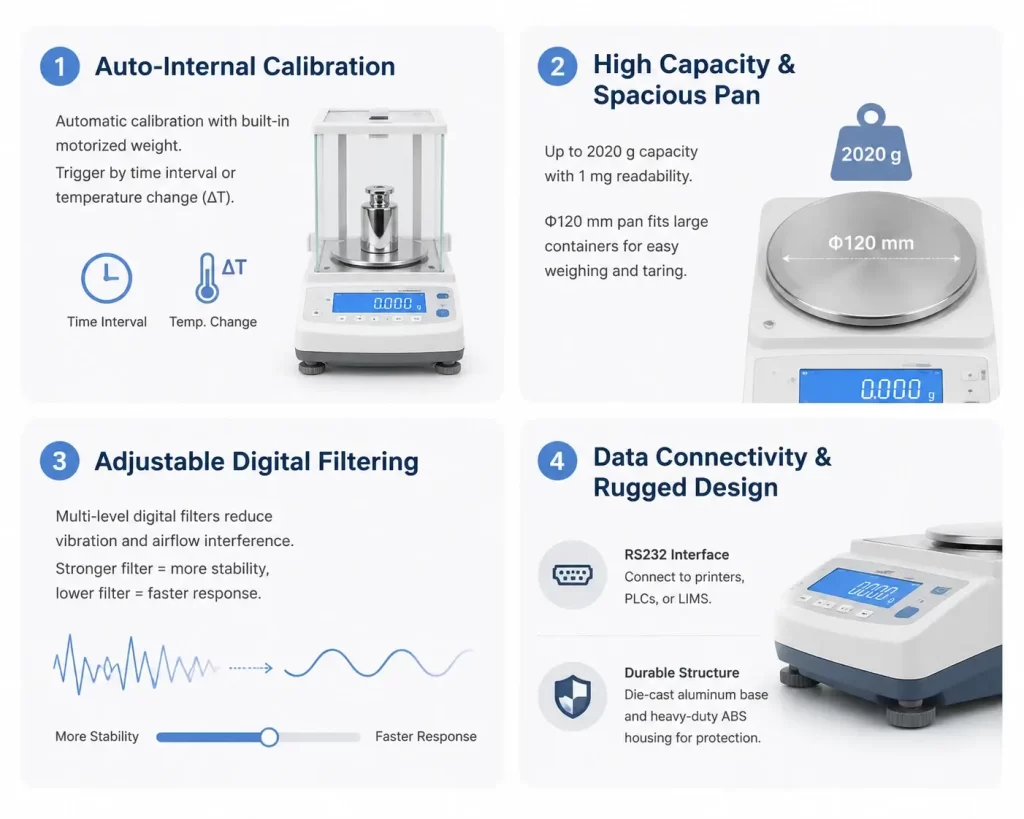
1. Fully Automatic Intelligent Internal Calibration (Auto-Internal CAL)
Continuous shop-floor operations experience ambient temperature shifts from HVAC cycling and facility machinery. Premium balances incorporate automated internal calibration driven by built-in motorized test weights. The system triggers self-calibration automatically based on user-set time intervals or ambient temperature thresholds (ΔT), eliminating manual calibration downtime while maintaining traceable compliance.
2. High Capacity and Spacious Weighing Area
Heavy-load formulation requires robust load capacity without sacrificing milligram readability. Moving from a standard 300 g model to a 1000 g–2020 g unit allows operators to tare heavy vessels directly on the platform. A wider Φ120 mm stainless steel weighing pan provides ample clearance for large containers, reducing edge-loading errors during fast-paced loading cycles.
3. Environmental Interference Rejection and Adjustable Digital Filtering
Industrial environments present constant ambient vibrations from conveyor systems, nearby equipment, and ventilation draft lines. Balances with adjustable multi-level digital wave filters permit operators to fine-tune signal dampening. Increasing filter strength stabilizes live readings in turbulent areas, while lowering it speeds up response rates in draft-protected enclosures.
4. Real-Time Data Traceability and Industrial-Grade Housing
Data integrity and physical durability protect your operational investment:
- Connectivity: A standard RS232 interface connects seamlessly with thermal label printers, programmable logic controllers (PLCs), or Laboratory Information Management Systems (LIMS).
- Structural Durability: A rugged hybrid housing combining a die-cast aluminum sub-base with heavy-duty ABS protects internal electromagnetic assemblies from accidental lateral knocks and spills.
III. In-Depth Recommendation for Heavy-Duty Models: Stuccler High-Capacity EMFC Series
The Stuccler SE-R High-Capacity Series is purpose-built to bridge the gap between high-precision analytical readability and high-capacity industrial batching.
| Model | Capacity | Readability (d) | Repeatability | Linearity | Plate Size | Calibration Type |
| SE-R102Q | 1020 g | 1 mg (0.001 g) | ±1 mg | ±2 mg | Φ120 mm | Fully Auto Internal CAL |
| SE-R152Q | 1520 g | 1 mg (0.001 g) | ±1 mg | ±2 mg | Φ120 mm | Fully Auto Internal CAL |
| SE-R202Q | 2020 g | 1 mg (0.001 g) | ±1 mg | ±2 mg | Φ120 mm | Fully Auto Internal CAL |
Flagship Highlights: Stuccler SE-R202Q
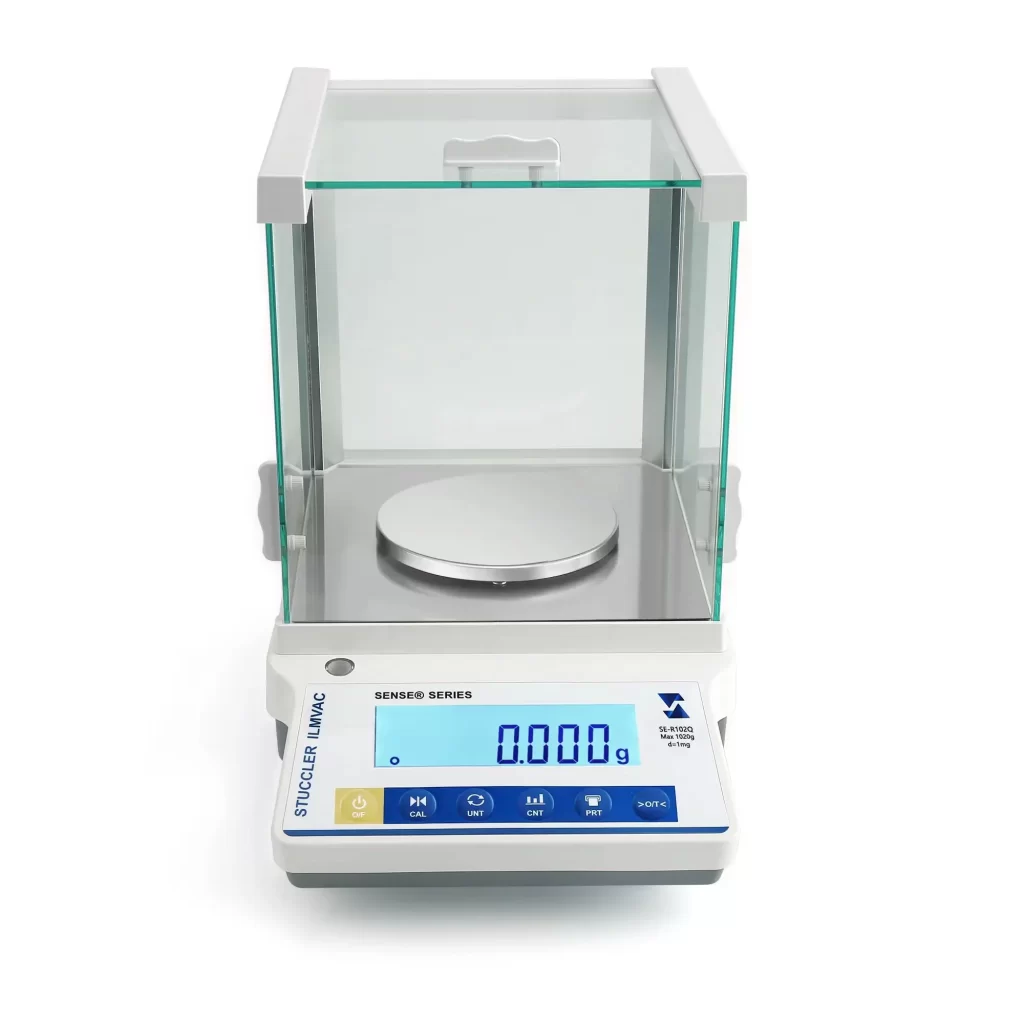
- Top-Tier 2020 g / 1 mg Specification: Engineered for continuous compounding, the SE-R202Q allows operators to place a 1.5 kg stainless steel reaction vessel on the pan, tare the weight instantly, and meter expensive active ingredients down to the milligram.
- 20 Selectable Weighing Units: Switch seamlessly between metric units (g, mg, kg), precious metal standards (ct, dwt, oz, ozt, GN), and regional units (tola, mesghal, tael).
- Integrated Underhook Mechanism: The built-in underhook port enables below-balance weighing, making hydrostatic density testing for solid metals, porous polymers, and large magnetic samples straightforward.
IV. Maintenance and Operational Recommendations for Heavy-Duty Environments
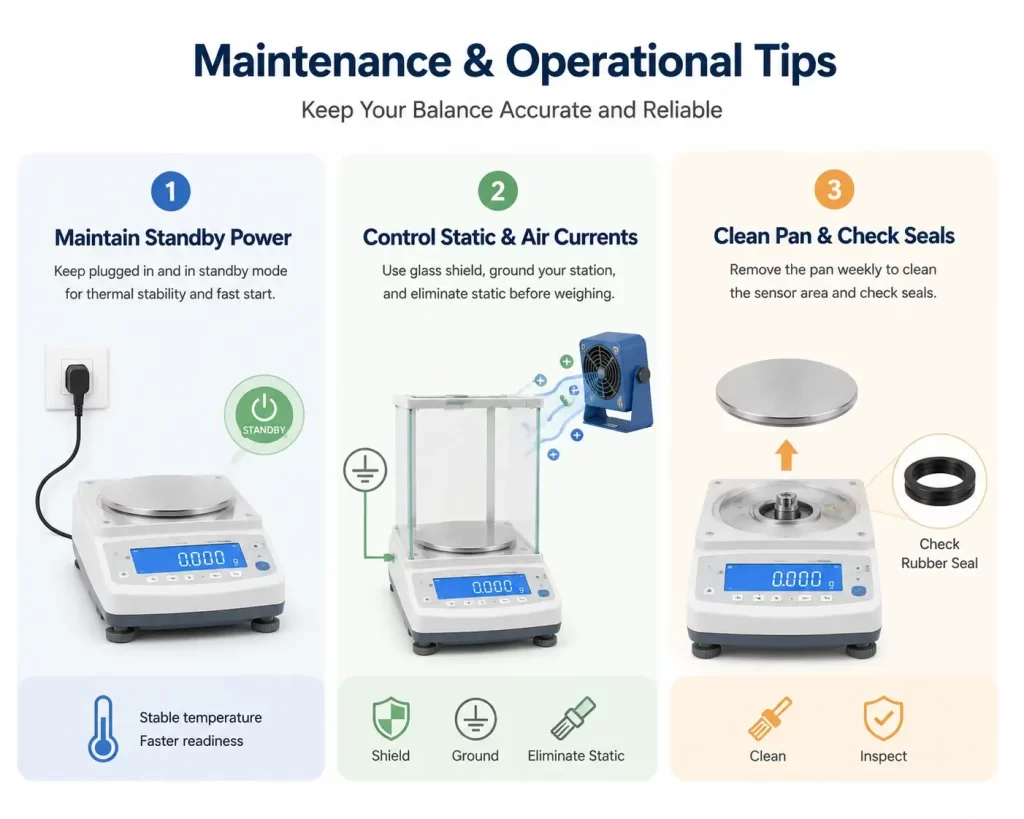
To extract peak performance and maximize equipment longevity in demanding conditions:
- Maintain Standby Power for Thermal Equilibrium: Always keep your EMFC instrument plugged in and in standby mode. Continuous low-current standby keeps the electromagnetic coil and permanent magnetic circuit at a stable internal operating temperature, eliminating cold-start stabilization delays.
- Manage Static Charges and Air Currents: Glass shields protect against cross-drafts. In dry or climate-controlled facilities, synthetic containers build up static electricity that mimics weight drift; ground your station and use an inline ionizing blower or anti-static brush before taking critical measurements.
- Routine Pan Clearing and Seal Verification: Remove the Φ120 mm pan weekly to clear away accumulated powders or particulate matter around the central sensor collar. Inspect the rubber seals around the underhook opening to prevent corrosive debris from penetrating the sensor cavity.
Selection Recommendations
Selecting the right configuration comes down to matching container tare weights and daily throughput demands:
- Choose a Standard Laboratory EMFC Balance (200 g–300 g): Best suited for analytical research stations where sample containers are limited to lightweight aluminum boats, weighing papers, and small glass vials under 300 g.
- Choose the Stuccler High-Capacity Series (1020 g–2020 g): The clear choice for manufacturing lines, metallurgical assaying, and formulation labs using heavy glass beakers, metal tare fixtures, or bulk chemical containers requiring 1 mg verification.
Equipping your workstations with high-capacity EMFC precision balances eliminates weighing bottlenecks, eliminates scrap from reading drift, and delivers measurable productivity gains across your daily operations.
As a dedicated high precision balances manufacturer and supplier, Stuccler delivers high-performance weighing equipment built for rigorous commercial use. Whether you need single analytical instruments, customized OEM/ODM builds, or volume wholesale supply for testing facilities, explore Stuccler’s catalog of precision balances or contact our technical sales team for tailored quotations and enterprise support.