
In a high-precision environment, an aging weighing balance is more than an inconvenience—it’s a threat to your data integrity and bottom line. Transitioning to new equipment isn’t just a purchase; it is a proactive move to eliminate fluctuations and ensure every milligram remains beyond reproach.
I. 5 Signs Your Balance Needs Replacement
Recognizing the symptoms of a failing instrument can save you from costly errors. If your digital scale or analytical balance shows these signs, it is time to evaluate an upgrade.
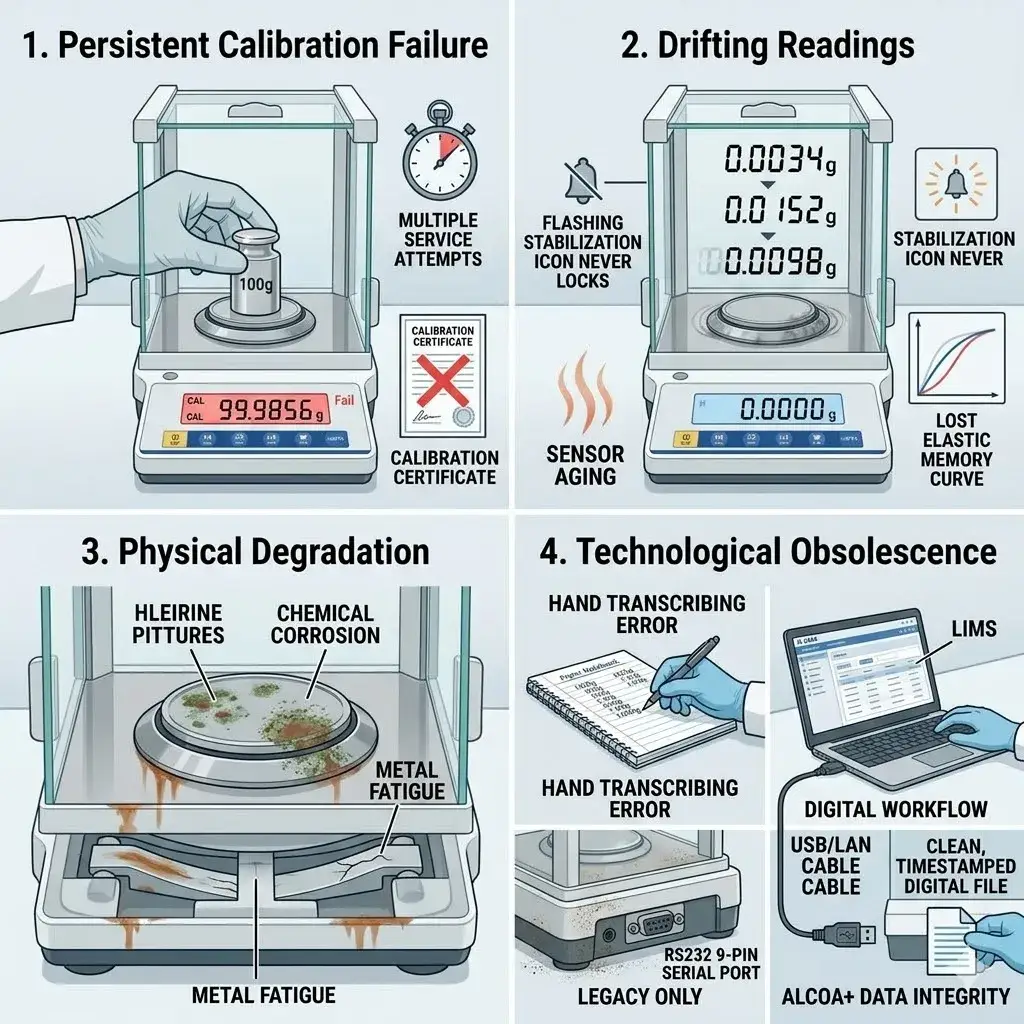
1. Persistent Calibration Failure
Reliability is the cornerstone of weighing. Even after professional servicing, errors in repeatability and linearity may remain outside the acceptable tolerance range. If you find yourself calibrating the device three times a day just to get a consistent zero, the internal mechanics are likely compromised.
2. Drifting Readings & “Hunting” for Stability
Precision requires speed. Sensor aging often causes readings to fluctuate or “creep” upward as the machine warms up. You might notice the stabilization icon takes forever to appear. This sluggishness suggests that the load cell or electromagnetic sensor has lost its elastic memory. Time is money.
3. Physical Degradation and “Metal Fatigue”
Industrial and lab environments are harsh. Over time, the weighing pan or the internal flexures may show signs of chemical corrosion or structural wear. If your model is so old that spare parts are “legacy only,” a single mechanical failure could lead to permanent downtime.
4. Diminished Environmental Adaptability
Older models often lose their electronic shielding. They become abnormally sensitive to static electricity, nearby equipment vibrations, or minor air currents from the HVAC system. If a balance that used to be a “rock” is now twitchy, its internal dampening system has failed.
5. Technological and Data Obsolescence
Modern industry is digital. Many older units lack the interfaces needed for modern workflows. If you are still manually transcribing weights because the unit only has an old RS232 port and no USB/LAN, you are inviting human error. Furthermore, many older balances cannot support the ALCOA+ principles required for modern data integrity.
II. Repair vs. Replace: The Cost-Benefit Analysis
Deciding whether to fix a broken laboratory balance involves more than checking the repair bill. You must look at the hidden “performance tax” you are paying every day.
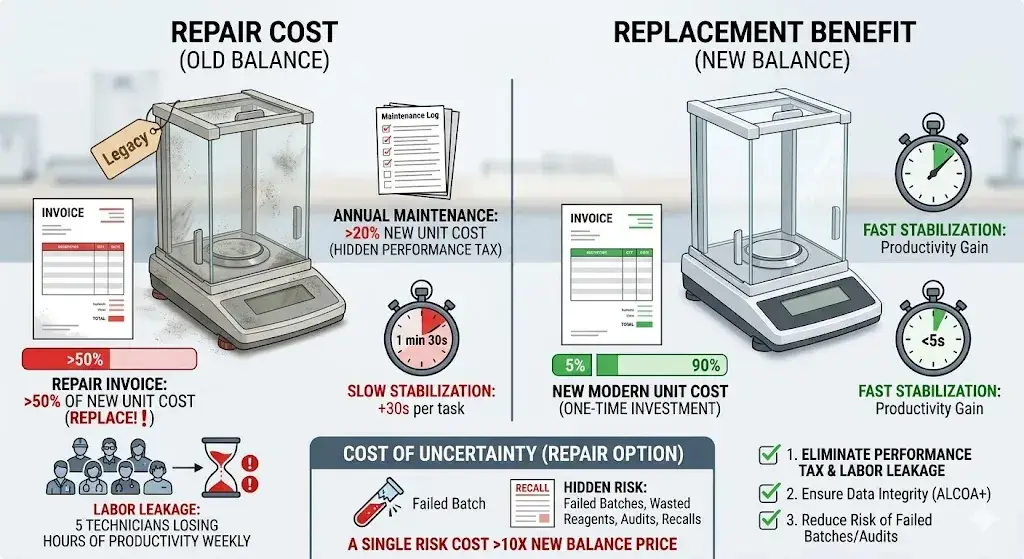
- The 50% Rule: If a single repair—such as a sensor replacement—costs more than 50% of a new, modern unit, it is a poor investment. Annual maintenance on an old machine often exceeds 20% of the cost of a new one. The math is simple.
- The Cost of Uncertainty: Inaccurate weighing leads to failed batches or wasted expensive reagents. One failed audit or a product recall due to an out-of-tolerance balance can cost ten times the price of a high-precision balance.
- Labor Leakage: If each weighing task takes 30 seconds longer due to slow stabilization, a team of five technicians loses hours of productive time every week.
III. Why Upgrading Makes Sense
Modern weighing technology offers advantages that go beyond simple measurement. Upgrading is an investment in future-proofing your workflow.
The EMFR Advantage
Modern Electromagnetic Force Restoration (EMFR) sensors are now more robust and faster than ever. They offer higher resolution in shorter windows. You get stable results in under a second, even in less-than-ideal conditions.
Intelligent Compliance Features
Modern units think for you. Built-in IsoCAL technology performs fully automatic internal calibration triggered by time or temperature changes. This removes the “human factor” from your SOPs. Meanwhile, an integrated Audit Trail logs every change, making GMP/GLP inspections effortless.
Connectivity and UX
Modern interfaces mimic smartphones with intuitive touchscreens. Seamless data transfer allows for one-click export to Excel or direct integration with LIMS systems. No more paper logs. It is clean and secure.
IV. How to Choose the Right New Equipment?
When you decide to upgrade, avoid buying a “like-for-like” replacement without re-evaluating your current needs.
- Re-evaluate Your Readability: Does your current work require higher precision? Perhaps a semi-microbalance is now more appropriate than a standard precision model.
- Environment-Specific Ratings: If you work in a dusty or wet area, look for an IP65-rated balance. For jewelry or dental labs, focus on compact footprints and easy-to-clean surfaces.
- Service Life-Cycle: Assess the supplier’s calibration support. A balance is only as good as the service behind it.
Conclusion
Balances are precision instruments with a finite lifecycle. Replacing them at the appropriate time is a wise investment that ensures business continuity and peace of mind.
If your current equipment is showing these warning signs, don’t wait for a total failure to disrupt your workflow. Contact us today to find the ideal high-performance weighing balance for your specific application. Our experts are ready to help you upgrade your precision.